


Strainer Basket Parts
In industrial fluid processing, the reliability of a filtration system is often determined by the integrity of its smallest components. While the outer housing of a strainer provides the pressure vessel, the internal strainer basket is the functional heart of the operation. Understanding the specific strainer basket parts and their engineering requirements is essential for engineers and maintenance teams tasked with protecting pumps, valves, and heat exchangers from particulate damage.
Industrial strainers are designed to remove large-scale debris from liquid or gas streams. However, as applications become more specialized—ranging from high-temperature chemical processing to hygienic food production—the demand for precision-engineered strainer basket parts increases. This guide examines the technical specifications, material considerations, and structural elements that define high-performance filtration baskets.
The Anatomy of an Industrial Strainer Basket
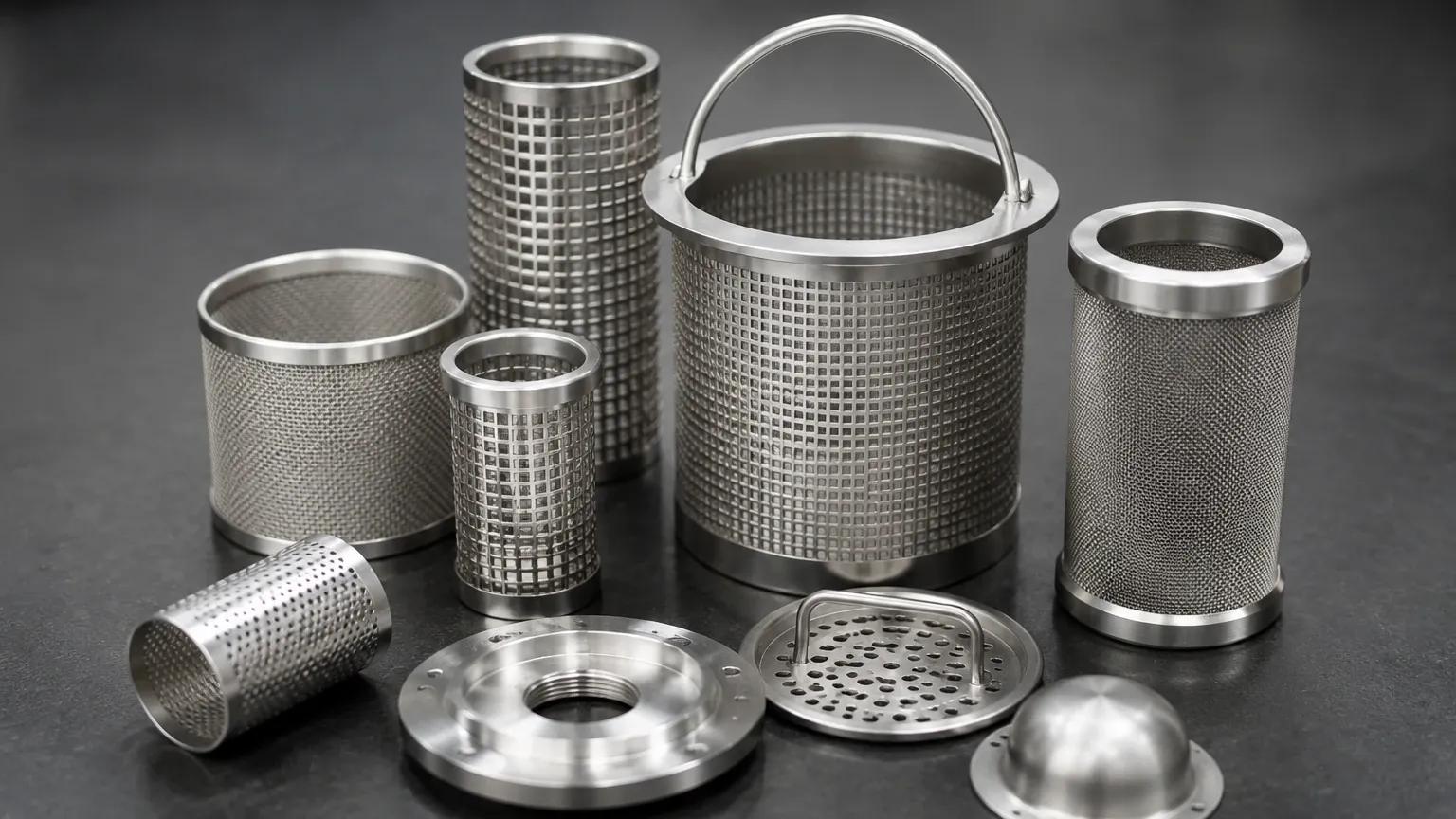
A strainer basket is rarely a single piece of metal; it is an assembly of several distinct parts, each serving a specific mechanical or hydraulic purpose. When sourcing or designing these components, it is helpful to break them down into their primary functional categories.
1. The Perforated Support Body
The foundation of most industrial baskets is a perforated metal cylinder or cone. This component provides the structural rigidity required to withstand high differential pressures. Without a robust support body, the finer filter media would collapse under the force of the fluid flow. Engineers must specify the hole size, pattern (staggered or straight), and the thickness of the plate to ensure the basket does not deform during operation.
2. The Filter Media (Lining)
While the support body provides strength, the filter media determines the filtration accuracy. This is typically a fine stainless steel wire mesh or a precision-etched metal sheet. The mesh is often spot-welded or seam-welded to the interior or exterior of the support body. In high-viscosity applications, wedge wire may be used instead of mesh to provide better release characteristics and higher mechanical strength. The choice of media directly impacts the micron rating and the total open area of the basket.
3. The Top Flange and Sealing Ring
The top flange is one of the most critical strainer basket parts because it ensures a tight seal between the basket and the strainer housing. If the flange is improperly machined or if the gasket seat is uneven, fluid will "bypass" the filter media, allowing contaminants to flow downstream. Flanges can be designed as flat rings, angled seats, or O-ring grooves, depending on the pressure requirements and the type of fluid being processed.
4. Handles and Lifting Mechanisms
For ease of maintenance, baskets are equipped with handles. In large-scale industrial systems, these handles must be robust enough to support the weight of the basket when it is fully loaded with heavy debris. Common designs include heavy-duty bail handles, dual side-lifting lugs, or threaded rods for mechanical extraction tools. The handle design must not interfere with the flow of fluid or the closure of the strainer lid.
5. Reinforcement Bands and Bottom Caps
To prevent the basket from bursting or buckling, reinforcement bands are often welded around the circumference at strategic intervals. Additionally, the bottom of the basket may be flat, conical, or pleated. A solid bottom cap is common for collecting heavy sediment, while a perforated bottom increases the total surface area and reduces pressure drop.
Material Selection for Strainer Basket Parts
Material compatibility is the most frequent cause of premature failure in industrial filtration. Most Strainers & Baskets are manufactured from stainless steel due to its balance of strength and corrosion resistance, but the specific grade must be matched to the environment.
* 304 Stainless Steel: The standard for general-purpose industrial applications, offering good corrosion resistance and excellent formability. It is suitable for water treatment, cooling systems, and non-corrosive chemical lines.
* 316L Stainless Steel: Contains molybdenum, which provides superior resistance to chlorides and acids. This is the preferred material for pharmaceutical, food and beverage, and marine applications where pitting corrosion is a risk.
* 904L and Duplex Steels: For highly aggressive environments, such as those found in offshore oil and gas or specialized chemical synthesis, these alloys provide extreme resistance to stress corrosion cracking and high-temperature oxidation.
Beyond the metal itself, engineers must consider the compatibility of seals and gaskets. EPDM, Viton, and PTFE are common choices, each offering different levels of chemical resistance and temperature tolerance.
Engineering Considerations: Open Area and Pressure Drop
One of the most important technical metrics for any strainer basket is the "Open Area Ratio." This is the ratio of the total area of the holes in the basket to the cross-sectional area of the inlet pipe. A common industry standard is a 6:1 or 8:1 ratio.
A higher open area ratio means that the fluid can pass through the basket with less resistance, resulting in a lower initial pressure drop (clean delta-P). This is vital because it extends the time between cleaning cycles. If the strainer basket parts are designed with too little open area, the velocity of the fluid through the mesh increases, which can lead to "impingement erosion," where particles wear away the wire mesh over time.
When calculating the required open area, engineers must account for:
1. Fluid Viscosity: Thicker fluids require larger open areas to maintain flow rates.
2. Contaminant Loading: If the fluid contains a high concentration of solids, a larger basket (or a pleated design) is necessary to prevent rapid clogging.
3. Maximum Allowable Pressure Drop: Every system has a limit beyond which the pump efficiency drops or the process is compromised.
Customization and OEM Capabilities
Standard off-the-shelf baskets often fail to meet the specific needs of complex industrial processes. This is where custom manufacturing becomes essential. Customization of strainer basket parts allows for optimizations that standard parts cannot provide, such as:
* Pleated Designs: By pleating the wire mesh, the surface area can be increased by 200% to 400% without changing the external dimensions of the basket. This is an ideal solution for systems with high flow rates and limited space.
* Magnetic Inserts: For applications involving metal wear particles (such as hydraulic systems), magnetic rods can be integrated into the basket assembly to capture fine ferrous debris that might otherwise pass through the mesh.
* Reinforced Liners: For high-pressure backwashing systems, the mesh liner can be sandwiched between two perforated plates to prevent the media from flexing and fatiguing.
As a professional manufacturer, Kaifil specializes in these types of tailored solutions, ensuring that every component—from the handle to the bottom weld—is engineered for the specific stresses of the application.
Common Failure Modes and Maintenance
To maximize the lifespan of Strainers & Baskets, it is important to recognize the signs of wear in various strainer basket parts. Regular inspection can prevent catastrophic system failures.
Structural Collapse
This usually occurs when the differential pressure across the basket exceeds its design limit. If a basket is not cleaned regularly, the buildup of debris creates a "cake" that blocks flow. The resulting pressure can crush the perforated support. Monitoring differential pressure with gauges is the best way to prevent this.
Mesh Abrasion and Tearing
In high-velocity systems, abrasive particles can wear down the wires of the filter mesh. Once a single wire breaks, the integrity of the mesh is compromised, and the hole will quickly expand, allowing bypass. During maintenance, technicians should check for "thinning" of the mesh or any signs of fraying at the weld points.
Gasket Degradation
If the strainer is opened frequently for cleaning, the seals and gaskets can become compressed or brittle. A leaking seal at the basket flange allows unfiltered fluid to bypass the basket entirely. It is a best practice to replace gaskets whenever the basket is removed for deep cleaning.
Corrosion and Pitting
Even stainless steel can corrode if the fluid chemistry changes or if the basket is exposed to stagnant, high-chloride fluids for long periods. Pitting often starts at weld joints. Using passivated stainless steel and ensuring high-quality TIG welding can significantly reduce this risk.
Selection Guide: Questions for Purchasing Teams
Before ordering replacement strainer basket parts or commissioning a new design, purchasing and engineering teams should confirm the following data points:
1. What is the exact micron rating required? Over-filtering (selecting a mesh that is too fine) leads to excessive maintenance and pressure drop. Under-filtering risks downstream equipment damage.
2. What are the maximum and operating pressures? This determines the required thickness of the perforated support and the need for reinforcement bands.
3. Is the fluid corrosive or food-grade? This dictates the material grade (e.g., 316L) and the required surface finish (e.g., electropolishing for hygienic applications).
4. Are there space constraints? If the housing is small but the flow rate is high, a pleated basket may be necessary.
5. What is the cleaning method? If the basket will be cleaned via ultrasonic bath or high-pressure spray, the construction must be rugged enough to withstand these processes without deforming the mesh.
The Role of Precision Manufacturing
The performance of an industrial strainer is only as good as the precision of its components. Poorly welded seams, inconsistent perforation patterns, or improperly seated flanges can lead to bypass, structural failure, and increased operational costs. By focusing on the engineering details of strainer basket parts, facilities can ensure higher uptime, lower maintenance costs, and better protection for their critical infrastructure.
Whether you are dealing with standard water filtration or complex chemical processing, selecting high-quality Strainers & Baskets is a strategic investment in process stability. Custom manufacturers like Kaifil provide the technical expertise necessary to bridge the gap between standard designs and the rigorous demands of modern industrial environments, delivering filtration components that are built to last and designed to perform.
