


Basket Strainer Quick Opening
In industrial fluid handling, the efficiency of a filtration system is measured not only by its ability to remove contaminants but also by the ease with which it can be maintained. For processes that involve high solids loading or require frequent cleaning to prevent excessive pressure drop, the standard bolted-cover design often proves to be a bottleneck. This is where the basket strainer quick opening design becomes a critical engineering choice. By replacing traditional nut-and-bolt closures with specialized mechanical interfaces, these strainers allow for tool-less access to the internal filter basket, significantly reducing downtime and labor costs.
As a core component of Strainers & Baskets solutions, the quick-opening mechanism is engineered to balance two competing requirements: the need for a high-pressure, leak-proof seal and the need for rapid operator access. Understanding the nuances of these closure types, their material requirements, and their safety implications is essential for engineers and procurement teams looking to optimize their industrial piping systems.
The Mechanics of Quick-Opening Closures
A basket strainer quick opening mechanism is designed to eliminate the time-consuming process of loosening and tightening multiple bolts. In a standard simplex strainer, a bolted cover might require a dozen or more bolts to be removed with a wrench, a process that can take 15 to 30 minutes depending on the size of the unit. In contrast, a quick-opening closure can often be operated in under a minute.
There are several common mechanical designs used to achieve this:
Swing Bolt Closures
This is perhaps the most common quick-opening design for industrial strainers. The cover is held in place by heavy-duty T-bolts that are hinged to the strainer body. Instead of removing the nuts entirely, the operator simply loosens them enough to allow the bolts to swing out of slots in the cover. The cover, often equipped with a davit arm or hinge, can then be lifted away. This design is robust and suitable for moderate to high-pressure applications.
Yoke and Slide-Bar Closures
A yoke closure utilizes a single central screw or a lever-actuated bar that applies downward pressure on the center of the cover. This pressure is distributed across the sealing surface. By turning a handwheel or releasing a clamp, the yoke can be swung aside, allowing the cover to be removed. This is ideal for smaller to medium-sized strainers where rapid access is prioritized over extreme pressure ratings.
Clamp-Type Closures
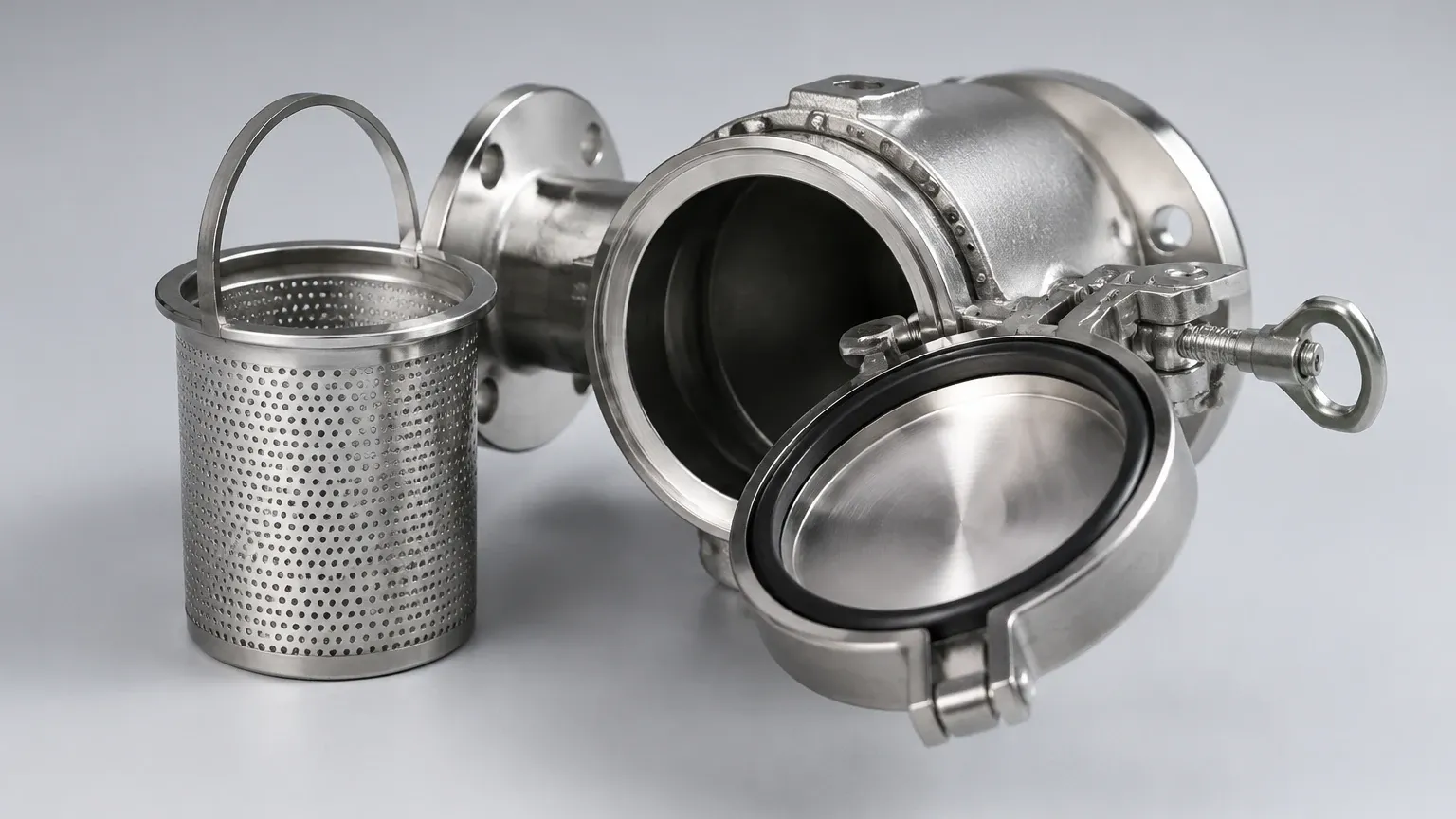
Commonly found in sanitary and low-pressure applications, clamp closures (such as Tri-Clamp or V-band styles) use a circumferential clamp to hold the cover and body flanges together. While highly effective for frequent cleaning in food and beverage or pharmaceutical sectors, they are generally limited by the maximum pressure the clamp can safely contain.
Engineering Considerations for High-Performance Filtration
When selecting a basket strainer with a quick-opening cover, engineering teams must look beyond the closure speed. The integrity of the filtration process depends on several technical factors that ensure the unit performs reliably under varying operational stresses.
Sealing Integrity and Gasket Selection
Because quick-opening covers are designed for frequent operation, the sealing mechanism must be exceptionally durable. O-ring seals are typically preferred over flat gaskets in these designs. O-rings provide a more reliable seal under lower clamping forces and are less prone to misalignment during rapid closure. Material compatibility is paramount; while EPDM or Buna-N may suffice for water treatment, chemical processing applications often require Viton (FKM) or PTFE-encapsulated O-rings to withstand corrosive fluids and high temperatures.
Pressure and Temperature Ratings
Quick-opening mechanisms must be rated for the specific Maximum Allowable Working Pressure (MAWP) of the system. It is a common misconception that quick-opening covers are inherently weaker than bolted covers. However, they must be engineered with higher safety factors. Engineers should verify that the closure design complies with relevant standards, such as ASME Section VIII, which governs the design of pressure vessels and their closures.
Davit Arms and Cover Hinges
For larger Strainers & Baskets, the weight of the cover itself becomes a safety and operational concern. A 10-inch or 12-inch stainless steel cover can be too heavy for a single operator to lift manually. In these cases, a davit arm—a mechanical pivot assembly—is integrated into the design. This allows the operator to lift the cover slightly and swing it horizontally out of the way, preventing back injuries and protecting the sealing surfaces from accidental impact.
Operational Benefits and Total Cost of Ownership
The primary driver for adopting a basket strainer quick opening configuration is the reduction of "Total Cost of Ownership" (TCO). While the initial capital expenditure for a quick-opening unit may be higher than a standard bolted model, the long-term savings are substantial.
1. Reduced Labor Costs: In facilities where strainers must be cleaned daily or even once per shift, the labor hours saved by quick-opening designs can pay for the equipment upgrade within the first year of operation.
2. Minimized Process Downtime: In continuous flow processes, every minute the flow is bypassed or stopped for maintenance represents lost production. Quick-opening strainers ensure that the system returns to full capacity as quickly as possible.
3. Improved Operator Safety: By eliminating the need for heavy power tools or the repetitive strain of manual wrenching, these designs contribute to a safer working environment. Furthermore, many quick-opening systems include safety interlocks that prevent the cover from being opened while the vessel is still under pressure.
Material Selection for Industrial Environments
Kaifil specializes in custom stainless steel filtration solutions, and the choice of material for both the strainer body and the quick-opening hardware is a critical decision point. Stainless steel is the industry standard for high-performance strainers due to its corrosion resistance and structural integrity.
* 304 Stainless Steel: Suitable for most general industrial applications, including water filtration and non-corrosive chemical handling. It offers excellent durability and cost-effectiveness.
* 316L Stainless Steel: The preferred choice for pharmaceutical, food and beverage, and marine environments. The addition of molybdenum provides superior resistance to chlorides and pitting corrosion. The "L" (low carbon) designation ensures better weldability and resistance to intergranular corrosion in the heat-affected zones of the strainer body.
* Specialty Alloys: For highly aggressive chemical environments, materials like Hastelloy or Monel may be required for the internal basket and the quick-opening components to ensure longevity.
Selecting the Right Basket Strainer for Your Application
To ensure optimal performance of a basket strainer quick opening system, several application-specific variables must be confirmed during the design phase:
Flow Rate and Pressure Drop (Delta P)
The size of the strainer should be determined by the maximum allowable pressure drop across a clean basket. Generally, a clean pressure drop should not exceed 2 PSI at the design flow rate. If the fluid has high viscosity, the strainer size may need to be increased to maintain efficient flow through the basket mesh.
Filtration Accuracy (Mesh vs. Perforation)
The internal basket can be fabricated with various media, ranging from coarse perforated plates for large debris to fine wire mesh for microscopic particles. For quick-opening applications, the basket must be designed for easy removal and cleaning. Reinforced baskets with heavy-duty lifting handles are recommended to withstand the rigors of frequent handling.
Safety and Venting Requirements
Before a quick-opening cover is released, the internal pressure of the strainer must be neutralized. Engineers should ensure the unit is equipped with a vent valve on the cover and a drain valve at the bottom of the housing. This allows the operator to safely depressurize and drain the unit before accessing the basket, preventing exposure to hazardous fluids or high-pressure sprays.
Customization and OEM Solutions
Industrial filtration is rarely a one-size-fits-all endeavor. Customization is often required to fit existing piping layouts or to meet specific process requirements. Whether it is adjusting the nozzle orientation, adding specialized coatings, or engineering a unique Strainers & Baskets configuration for a proprietary chemical process, working with a manufacturer that understands the engineering behind the metal is vital.
For OEM applications, the integration of quick-opening strainers into larger equipment skids requires precise tolerances and reliable performance. High-quality manufacturing ensures that every component, from the swing bolt hinge to the precision-machined O-ring groove, functions flawlessly over thousands of cycles.
Conclusion
The transition to a basket strainer quick opening design is a strategic move for any industrial facility looking to enhance operational efficiency. By selecting the appropriate closure mechanism, material grade, and safety features, engineers can ensure that their filtration systems provide maximum protection to downstream equipment with minimal impact on production schedules. As industrial processes become more automated and uptime-sensitive, the role of rapid-access filtration components will only continue to grow in importance.
