


Basket Strainer Que Es
In the realm of industrial fluid handling, the term "basket strainer que es" refers to a critical mechanical component designed to remove unwanted solids from liquid or gas streams. Technically defined, a basket strainer is a closed vessel with a removable screen element (the basket) that intercepts particulate matter to protect downstream equipment such as pumps, valves, and heat exchangers. Unlike simpler filtration devices, these components are engineered for high-flow applications where the accumulation of debris is expected and must be managed without frequent system shutdowns.
For engineers and procurement professionals, understanding the nuances of Strainers & Baskets is essential for maintaining system integrity. These devices are not merely passive filters; they are precision-engineered tools that balance filtration accuracy with hydrodynamic efficiency. Whether in chemical processing, water treatment, or the food and beverage industry, the selection of a basket strainer directly impacts the reliability and longevity of the entire piping system.
Understanding the Core Functionality of Basket Strainers
The primary question of "basket strainer que es" is best answered by looking at its internal geometry. A basket strainer typically features a top-loading design, allowing for easy access to the internal straining element. As fluid enters the strainer housing, it is directed into the basket. The mesh or perforated metal of the basket allows the liquid to pass through while trapping solids.
One of the defining characteristics of a basket strainer is its large surface area relative to the pipe diameter. This design provides a significant debris-holding capacity, which results in a lower pressure drop across the unit compared to Y-strainers. In industrial environments where fluid viscosity may vary or where high concentrations of solids are present, the basket strainer is the preferred choice for coarse to medium filtration.
Furthermore, the top-entry design facilitates maintenance. Because the basket can be lifted vertically out of the housing, cleaning can be performed with minimal spillage and without disconnecting the strainer from the main pipeline. This operational convenience is a major factor in its widespread adoption across heavy industries.
Engineering Components: The Anatomy of High-Performance Strainers & Baskets
To appreciate the technical value of industrial filtration, one must examine the individual components that constitute a high-quality strainer. A standard unit consists of the housing (body), the cover, the basket element, and the sealing mechanism.
The Housing and Cover
In industrial applications, the housing must withstand significant internal pressures and potential corrosive environments. Kaifil specializes in manufacturing these components from high-grade stainless steel, ensuring structural integrity under thermal stress and mechanical vibration. The cover is often secured with swing bolts or quick-opening clamps to reduce the time required for basket inspection and cleaning.
The Straining Element (The Basket)
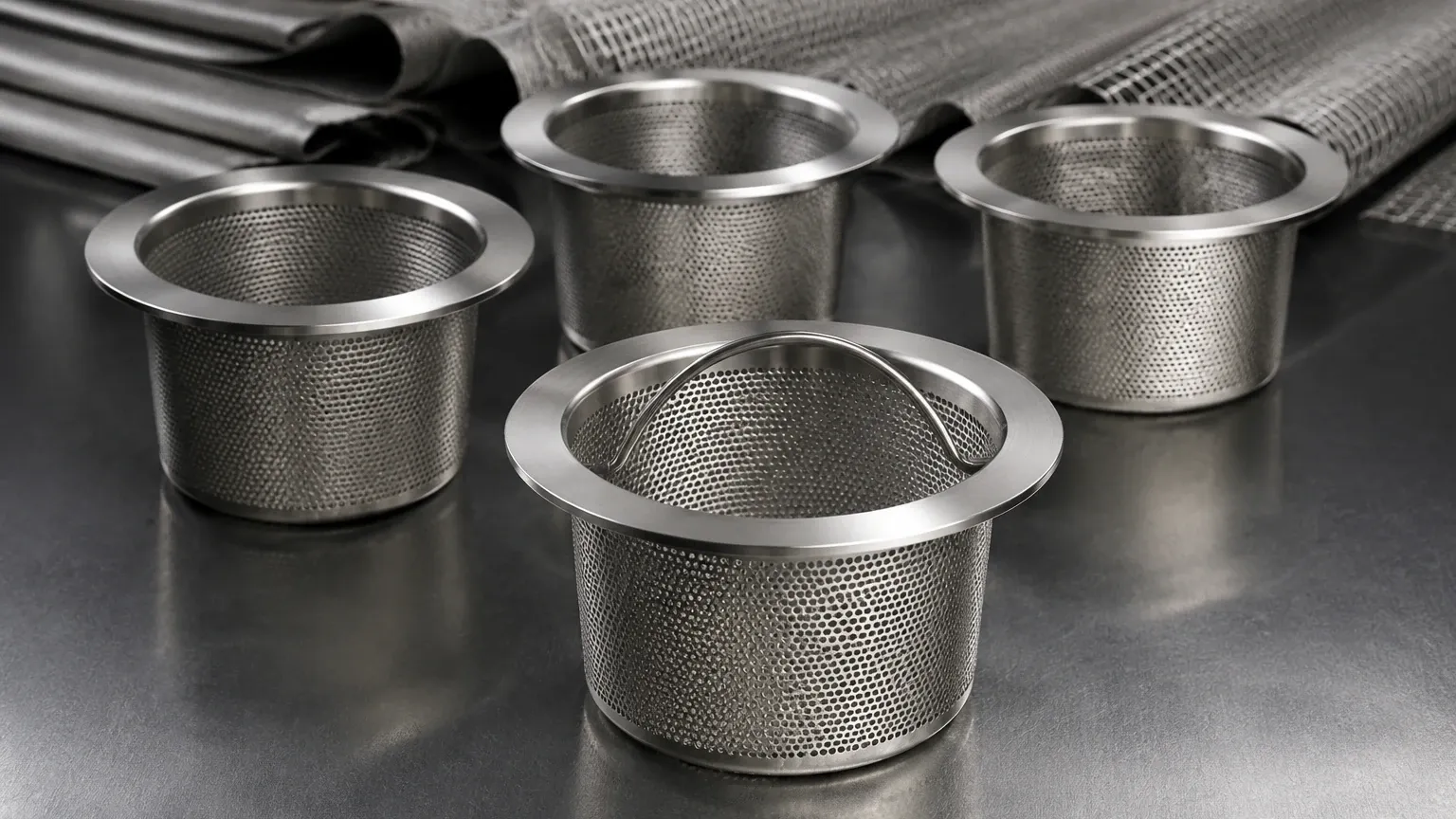
The basket is the heart of the device. It is usually constructed from a perforated metal sheet which provides structural support, often lined with a finer wire mesh to achieve the desired micron rating. The relationship between the hole size in the perforated plate and the mesh count of the lining determines the filtration efficiency. Engineers must consider the "Open Area Ratio" (OAR), which is the ratio of the total area of the holes in the basket to the cross-sectional area of the inlet pipe. A higher OAR (typically 6:1 or higher) ensures that the strainer does not become a bottleneck in the system.
Sealing and Gaskets
Effective sealing is paramount to prevent bypass—where fluid skips the filtration element—and external leaks. Depending on the chemical nature of the fluid, seals may be made from EPDM, Viton, or PTFE. Choosing the correct seal material is vital for preventing degradation in aggressive chemical or high-temperature applications.
Material Selection and Chemical Compatibility
When addressing the technical requirements of "basket strainer que es," material selection stands out as a primary engineering consideration. Most industrial basket strainers are fabricated from stainless steel (Grade 304 or 316L) due to its superior corrosion resistance and durability.
* Grade 304 Stainless Steel: Suitable for general-purpose applications, including water treatment and mild chemical processing. It offers good resistance to atmospheric corrosion and many organic and inorganic chemicals.
* Grade 316L Stainless Steel: Contains molybdenum, which provides enhanced resistance to chlorides and pitting. This is the standard for marine environments, pharmaceutical production, and aggressive chemical plants where hygiene and corrosion resistance are non-negotiable.
In addition to the housing, the mesh material must be compatible with the fluid. For example, in food and beverage applications, the surfaces must be smooth and electropolished to prevent bacterial growth. In hydraulic systems, the mesh must be strong enough to withstand high-pressure surges without collapsing or deforming.
Performance Evaluation: Pressure Drop and Filtration Efficiency
A critical aspect of selecting Strainers & Baskets is calculating the clean pressure drop ($ΔP$). Every filter introduces some resistance to flow; however, an optimized basket design minimizes this loss.
The pressure drop is influenced by several factors:
1. Fluid Viscosity: Thicker fluids require more force to pass through the mesh, increasing $ΔP$.
2. Flow Velocity: Higher velocities result in higher turbulence and resistance.
3. Mesh Size: Finer mesh provides better filtration but increases resistance.
4. Debris Loading: As the basket fills with solids, the available open area decreases, and the pressure drop rises exponentially.
Engineers typically install differential pressure gauges across the inlet and outlet of the strainer. When the pressure difference reaches a predetermined limit (usually 5-10 psi above the clean drop), it signals that the basket requires cleaning. Ignoring this can lead to basket failure or pump cavitation due to restricted suction.
Simplex vs. Duplex Configurations: Choosing the Right Operational Model
In the context of industrial filtration, the choice between simplex and duplex designs depends on the continuity of the process.
Simplex Basket Strainers
A simplex strainer is used in systems where the flow can be intermittently stopped. When the basket is full, the system is shut down, the pressure is relieved, and the basket is cleaned. These are cost-effective and ideal for batch processes or systems with redundant piping loops.
Duplex Basket Strainers
For critical operations that cannot afford downtime—such as continuous chemical reactors or power plant cooling systems—a duplex strainer is required. A duplex unit consists of two separate strainer housings connected by a diverting valve. When one basket becomes clogged, the operator can switch the flow to the clean chamber without interrupting the process. This allows for "on-the-fly" maintenance, ensuring 100% uptime.
Maintenance Protocols and Service Life Optimization
To ensure the long-term performance of a basket strainer, a rigorous maintenance schedule must be implemented. The "basket strainer que es" concept extends beyond the physical product to the lifecycle management of the component.
1. Regular Inspection: Even if the pressure drop is within limits, periodic visual inspections can identify signs of corrosion, erosion, or mechanical fatigue in the basket mesh.
2. Proper Cleaning: Baskets should be cleaned using methods that do not damage the mesh. High-pressure water or ultrasonic cleaning is often preferred over mechanical brushing, which can fray wire mesh.
3. Spare Parts Inventory: Maintaining a stock of replacement baskets and seals is essential. A damaged basket allows debris to pass through, potentially causing catastrophic failure in downstream high-precision equipment.
4. Seal Replacement: Gaskets and O-rings should be replaced every time the cover is opened to ensure a leak-proof seal upon reassembly.
Selection Checklist for Industrial Procurement
When sourcing Strainers & Baskets, engineers should verify the following parameters with the manufacturer to ensure the product meets the specific application requirements:
* Pipe Size and Connection Type: Flanged (ANSI, DIN, JIS), threaded (NPT/BSP), or socket weld.
* Design Pressure and Temperature: Must exceed the maximum possible system peaks.
* Filtration Rating: Specified in microns or mesh size based on the smallest particle that needs to be removed.
* Material of Construction: Verification of alloy grades for both the housing and the internal element.
* Fluid Properties: Viscosity, density, and chemical composition.
* Flow Rate: Maximum and minimum operating flow rates to calculate velocity and pressure drop.
* Customization Options: Need for magnetic inserts (to catch fine iron particles), specialized coatings, or custom dimensions for tight installation spaces.
Conclusion
Answering the question of "basket strainer que es" involves understanding the intersection of fluid mechanics, material science, and mechanical design. As a fundamental component in industrial piping, the basket strainer serves as the first line of defense against particulate contamination. By selecting high-quality stainless steel solutions and adhering to proper engineering calculations regarding flow and pressure, facilities can significantly reduce maintenance costs and prevent unplanned downtime.
Kaifil continues to support global industries by providing precision-engineered filtration components tailored to the most demanding environments. From material selection to custom basket designs, ensuring the right filtration solution is in place is the key to operational excellence and equipment longevity.
