


Basket Strainer Uae
Industrial filtration systems in the United Arab Emirates (UAE) operate under some of the most demanding environmental conditions globally. From the high-salinity coastal areas supporting desalination plants to the intensive heat of oil and gas processing facilities, the requirement for robust debris management is critical. A basket strainer serves as a primary defense mechanism for pumps, valves, and heat exchangers by removing large particles from liquid pipelines.
For engineers and procurement specialists sourcing a basket strainer uae based projects require, understanding the technical nuances of material selection, pressure drop calculations, and customization is essential for ensuring long-term system integrity. As a specialized manufacturer, Kaifil provides high-performance Strainers & Baskets designed to meet these rigorous industrial standards.
Technical Fundamentals of Basket Strainers
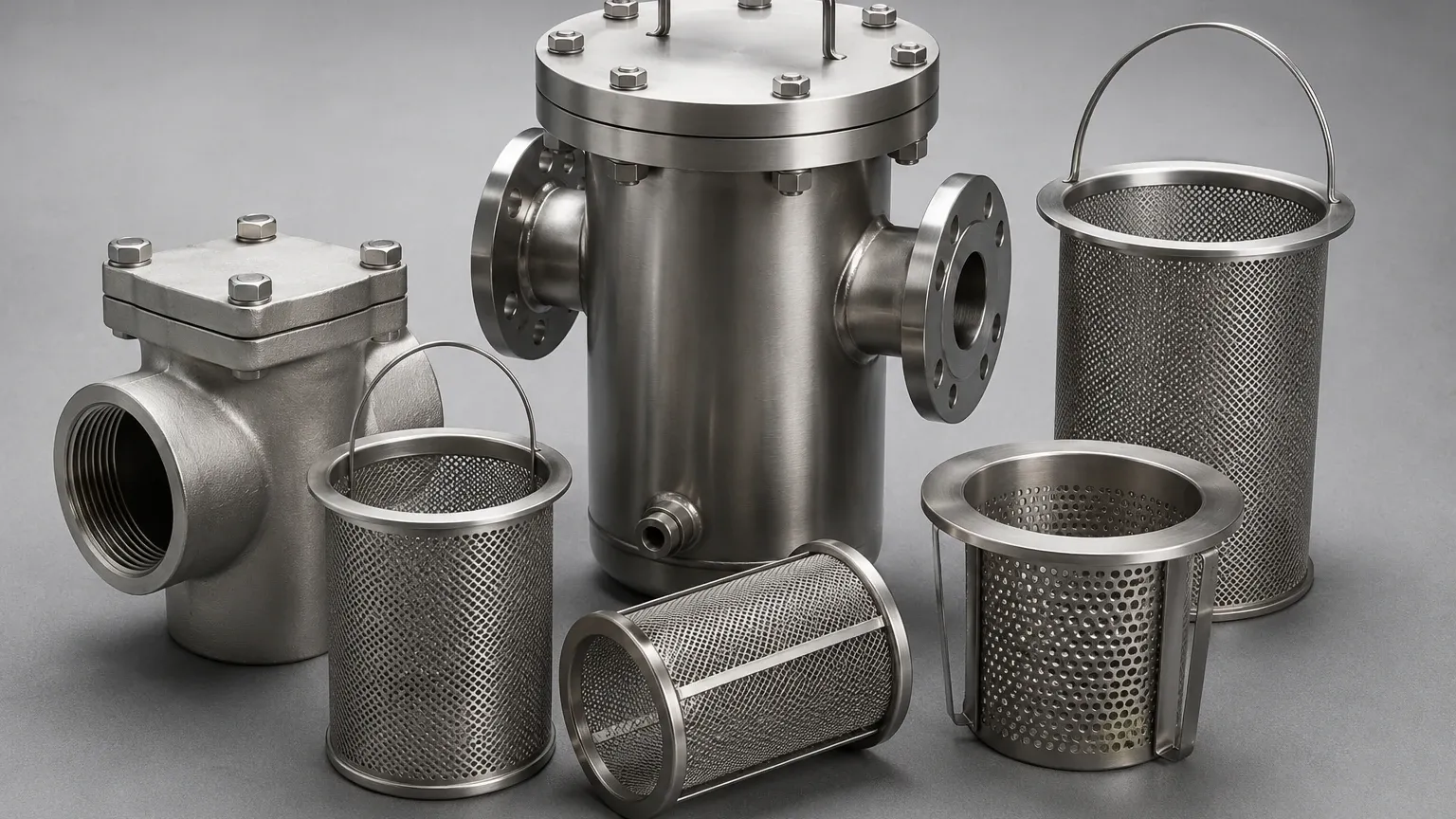
A basket strainer is a closed vessel with a removable screen element (the basket) that collects particles as fluid passes through it. Unlike Y-strainers, which are typically used for smaller amounts of debris in high-pressure steam or gas lines, basket strainers are designed for liquid applications where a higher dirt-holding capacity is required.
In the context of the UAE’s heavy industries, these components are vital for protecting downstream equipment from scale, rust, and foreign solids. The design allows for the collection of a significant volume of debris before the pressure drop necessitates cleaning. This is particularly important in cooling water systems and chemical processing lines where downtime must be minimized.
Flow Dynamics and Pressure Drop
The efficiency of a basket strainer is measured by its ability to remove contaminants while maintaining a low pressure drop (ΔP). In engineering terms, the pressure drop is the difference in total pressure between two points of a fluid carrying network. For a basket strainer, this is influenced by:
1. Fluid Velocity: Higher velocities increase the pressure drop exponentially.
2. Viscosity: Thicker fluids require larger mesh openings or larger strainer bodies to maintain flow.
3. Open Area Ratio (OAR): This is the ratio of the total area of the holes in the basket to the internal cross-sectional area of the inlet pipe. A high-quality industrial strainer should ideally have an OAR of at least 6:1 to ensure long intervals between cleanings.
Material Selection for the UAE Environment
When specifying a basket strainer for use in the UAE, material science is the most critical factor in preventing premature failure. The combination of high ambient temperatures and proximity to the Arabian Gulf introduces significant corrosion risks.
Stainless Steel 316 and 316L
For most desalination and chemical applications in the region, Stainless Steel 316 (SS316) is the industry standard. The addition of molybdenum provides superior resistance to chloride-induced pitting and crevice corrosion compared to SS304. For welded components, SS316L (low carbon) is preferred to prevent intergranular corrosion in the heat-affected zones of the welds.
Specialized Alloys
In high-sulfur oil and gas environments or extreme seawater applications, standard stainless steels may not suffice. In these cases, duplex stainless steels or high-nickel alloys like Monel are utilized. These materials offer the mechanical strength and chemical resistance needed to handle the aggressive fluids common in the Middle East’s energy sector.
Engineering Considerations for Customization
Off-the-shelf filtration solutions often fail to meet the specific spatial or performance requirements of complex industrial plants. Customization is frequently necessary to integrate the strainer into existing piping layouts or to handle unique particulate loads.
Basket Design and Mesh Sizing
The internal basket is the heart of the strainer. It can be constructed from perforated metal, wire mesh, or a combination of both.
* Perforated Metal: Provides structural strength and is used for removing larger debris (usually 1/32" to 1/4" holes).
* Wire Mesh: Used for finer filtration (down to 5 microns). In many industrial designs, a fine wire mesh liner is supported by a heavy-duty perforated metal basket to prevent the mesh from collapsing under high differential pressure.
Simplex vs. Duplex Configurations
For many projects involving a basket strainer uae operators must decide between simplex and duplex designs based on the necessity of continuous flow.
* Simplex Strainers: These are used in systems where the flow can be interrupted for a short period to clean the basket. They are cost-effective and have a smaller footprint.
* Duplex Strainers: These consist of two separate strainer chambers connected by a valve assembly. When one basket becomes clogged, the flow is diverted to the second chamber, allowing the first to be cleaned without shutting down the system. This is the preferred choice for 24/7 operations like power plants and refinery cooling systems.
Application-Specific Requirements in the UAE
The diverse industrial landscape of the UAE requires tailored filtration approaches across different sectors.
Desalination and Water Treatment
The UAE relies heavily on Multi-Stage Flash (MSF) and Reverse Osmosis (RO) desalination. Basket strainers are used in the pre-treatment phase to protect high-pressure pumps from sea shells, sand, and organic matter. Given the high salinity of the intake water, the internal components must be meticulously finished to avoid any sites for localized corrosion.
Oil, Gas, and Petrochemicals
In the upstream and downstream sectors, strainers are used to protect sensitive instrumentation and flow meters. They must be designed to withstand high pressure ratings (ANSI Class 150, 300, or higher) and comply with international standards such as ASME B16.34. Custom-engineered baskets are often required to handle the high temperatures of process fluids.
HVAC and District Cooling
District cooling is a major infrastructure component in cities like Dubai and Abu Dhabi. Large-scale basket strainers are integrated into chilled water loops to prevent the accumulation of scale and sediment in heat exchangers, which would otherwise significantly reduce the energy efficiency of the cooling plant.
Evaluating Performance and Reliability
When engineers evaluate a basket strainer, they must look beyond the initial purchase price and consider the Total Cost of Ownership (TCO). A poorly designed strainer will lead to frequent maintenance, higher energy costs due to excessive pressure drops, and potential damage to expensive downstream equipment.
Key Evaluation Criteria:
1. Seal Integrity: High-quality O-rings or gaskets are required to ensure a leak-proof seal, especially when handling hazardous chemicals or high-pressure water.
2. Ease of Access: For simplex strainers, quick-opening covers (such as swing-bolt or clamp covers) reduce maintenance time compared to standard bolted covers.
3. Structural Integrity: The basket must be designed to withstand the maximum possible differential pressure. If a basket becomes completely clogged, it should not burst or collapse, which would send debris and metal fragments into the downstream system.
4. Finish Quality: Smooth internal surfaces reduce the risk of bacterial growth in food and beverage applications and minimize turbulence.
Maintenance and Operational Best Practices
To ensure the longevity of a basket strainer uae industrial sites must implement a rigorous maintenance schedule. The frequency of cleaning is entirely dependent on the level of contamination in the fluid.
Monitoring Differential Pressure
The most effective way to manage maintenance is through the use of differential pressure gauges. By monitoring the ΔP across the strainer, operators can determine exactly when the basket needs cleaning. Typically, a basket should be cleaned when the pressure drop reaches 5-10 psi above the clean pressure drop. Waiting too long can result in "permanent" pressure loss or damage to the basket.
Cleaning Procedures
When cleaning the basket, it is essential to inspect the mesh for signs of wear, tearing, or corrosion. In high-velocity systems, wire mesh can suffer from erosion over time. If the mesh is compromised, the entire basket should be replaced rather than repaired to ensure the filtration rating remains consistent.
Why Choose Kaifil for Industrial Filtration?
Kaifil specializes in the manufacturing of custom stainless steel filtration solutions that address the specific challenges of the industrial sector. Our expertise in wire mesh and precision metal components allows us to develop Strainers & Baskets that provide reliable performance in the most demanding environments.
We understand that every application has unique parameters. Whether you are dealing with high-viscosity fluids in a chemical plant or high-volume seawater intake, our engineering team works closely with global customers to provide OEM and customized filtration components. Our focus on quality manufacturing ensures that every strainer provides the durability and precise filtration accuracy required to protect your critical infrastructure.
In conclusion, selecting the right basket strainer for UAE-based applications involves a deep understanding of environmental stressors, material capabilities, and fluid dynamics. By prioritizing high-grade materials like SS316L and ensuring proper OAR and pressure drop ratings, engineers can secure the efficiency and safety of their liquid processing systems.
