


Metal-mesh Grease Filter Replacement
In industrial ventilation and food processing environments, the management of airborne grease and oil mist is a critical factor for both operational efficiency and fire safety. The primary line of defense in these systems is the metal-mesh grease filter. Over time, these components degrade due to thermal stress, corrosive cleaning agents, and mechanical wear. Understanding the technical nuances of metal-mesh grease filter replacement is essential for maintenance engineers and procurement teams who must balance initial capital expenditure with long-term filtration performance and safety compliance.
The Role of Metal-Mesh in Industrial Grease Extraction
Industrial grease filters are not merely barriers; they are heat sinks and impingement devices. In high-volume extraction systems, such as those found in commercial food production or industrial coating lines, the air contains a high concentration of vaporized fats and oils. As this air passes through the filter media, the grease particles must be separated from the airflow before they enter the ductwork.
Metal-mesh filters utilize the principle of mechanical impingement. The multi-layered, staggered structure of the wire mesh creates a tortuous path for the air. As the air changes direction rapidly through the layers, the heavier grease droplets—possessing greater momentum than the air molecules—cannot follow the streamlines. They collide with the wire surfaces, coalesce into larger droplets, and eventually drain into a collection trough. This process prevents the accumulation of highly flammable grease deposits in the ventilation ducts and protects downstream components like exhaust fans and heat recovery units.
Technical Criteria for Metal-Mesh Grease Filter Replacement
When a metal-mesh grease filter replacement becomes necessary, the selection process must be guided by specific engineering parameters rather than simple dimensional matching. A failure to account for these factors can lead to increased static pressure, reduced extraction efficiency, and a significant increase in fire risk.
1. Filtration Efficiency and Micron Rating
Grease particles vary in size depending on the temperature and the nature of the process (e.g., frying vs. charbroiling). Industrial filters are often rated by their ability to capture particles within the 5 to 10-micron range. When selecting a replacement, engineers must verify the mesh density. A higher density improves capture efficiency but increases the resistance to airflow.
2. Static Pressure and Airflow Resistance
The pressure drop (ΔP) across the filter is a critical metric. If a replacement filter has a significantly higher resistance than the original design, the exhaust fan may fail to move the required volume of air (CFM), leading to poor air quality and heat buildup in the workspace. Conversely, a filter with too little resistance may allow too much grease to bypass the impingement stage.
3. Structural Integrity and Frame Design
Industrial environments subject filters to high face velocities and frequent handling during cleaning cycles. A robust frame—typically constructed from 0.5mm to 1.2mm thick stainless steel—is required to prevent warping. The internal mesh should be securely fastened to the frame to avoid "fluttering" or bypass gaps that can occur under high-pressure conditions.
Structural Design: Wire Mesh Filter Cylinders & Tubes in Grease Management
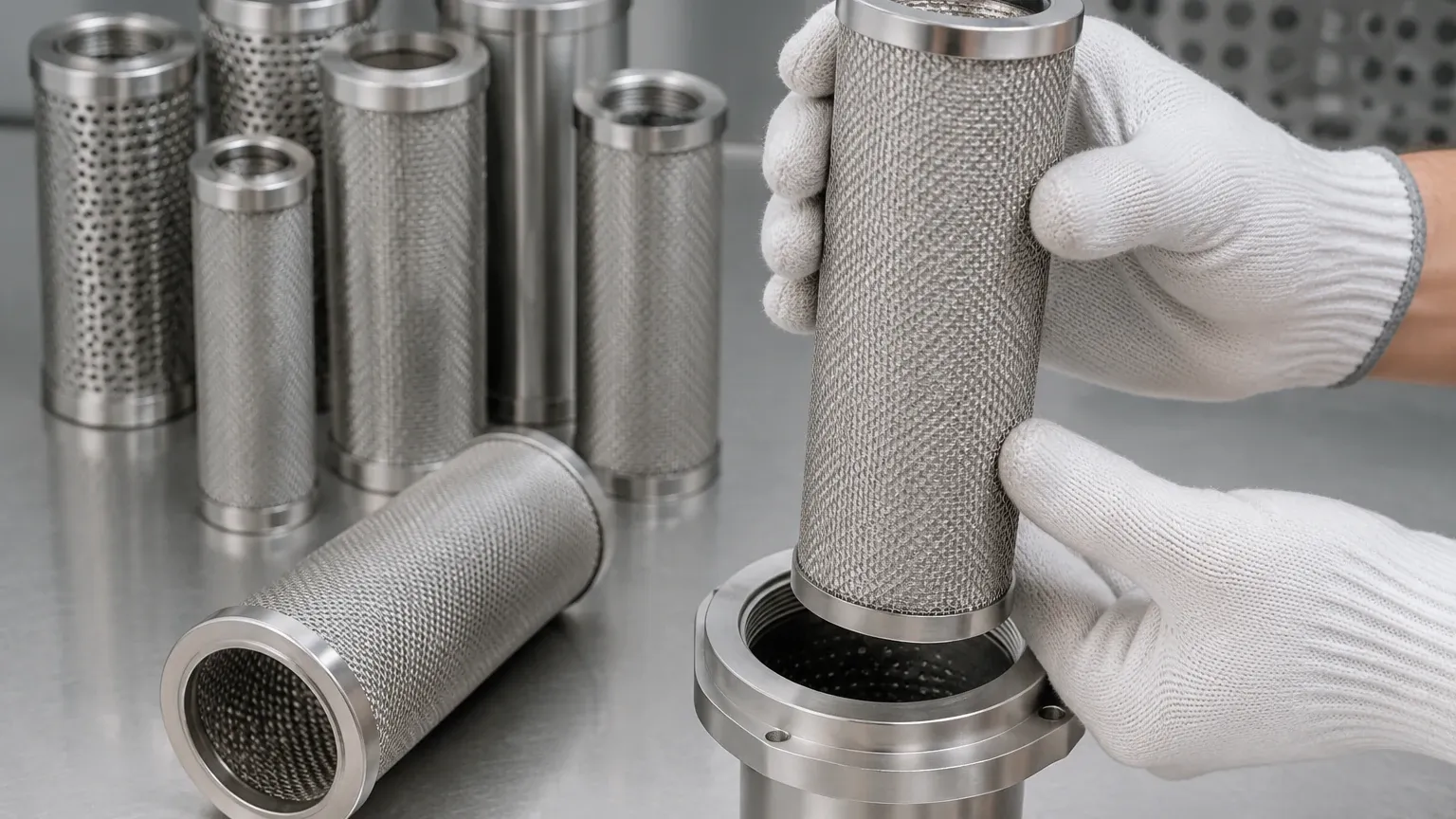
While flat panel filters are common in standard kitchen hoods, many industrial applications require specialized geometries to handle higher volumes or integrated centrifugal separation. This is where Wire Mesh Filter Cylinders & Tubes become the preferred choice for engineers.
Cylindrical filters offer a significantly higher surface area-to-volume ratio compared to flat panels. This increased surface area allows for a lower face velocity at the same CFM, which enhances the coalescence of grease droplets and reduces the frequency of cleaning cycles. In many heavy-duty industrial scrubbers and oil mist eliminators, these tubes are arranged in banks to provide multi-stage filtration. When replacing these components, it is vital to specify the exact weave type—whether knitted or woven—as this dictates the internal surface area available for grease impingement.
Material Science: Why Stainless Steel is the Industrial Standard
In the context of metal-mesh grease filter replacement, material selection is perhaps the most significant factor affecting total cost of ownership (TCO). While aluminum and galvanized steel filters are available at lower price points, they rarely meet the demands of rigorous industrial use.
Stainless Steel 304 vs. 316
* Grade 304: This is the standard for most industrial grease filtration. It offers excellent resistance to the high temperatures found in extraction hoods and is resilient against the caustic chemicals used in heavy-duty degreasing cycles.
* Grade 316: For environments involving high salinity (such as marine galleys or coastal food processing plants) or highly acidic vapors, Grade 316 stainless steel is required. The addition of molybdenum provides superior pitting resistance, ensuring the mesh does not disintegrate prematurely.
Aluminum filters, by contrast, are prone to oxidation and can become brittle after repeated exposure to high-heat and chemical cleaning. In a fire event, aluminum has a lower melting point than stainless steel, which can allow flames to penetrate the ductwork more easily. Therefore, for industrial-grade replacements, stainless steel is the engineering recommendation for durability and safety.
Installation Constraints and Maintenance Protocols
A successful metal-mesh grease filter replacement involves more than just sliding a new unit into a slot. Engineers must consider the installation environment to ensure the filter operates as intended.
Sealing and Bypass Prevention
Even the highest efficiency filter is rendered ineffective if air can bypass it. Replacement filters must be sized with precision, typically within a 1.5mm tolerance of the housing. In some high-pressure systems, specialized gaskets or spring-loaded clips are used to maintain a tight seal against the filter frame.
Orientation and Drainage
Many grease filters are designed with a specific orientation to facilitate the drainage of captured oils. If a cylindrical tube or flat panel is installed incorrectly, grease can pool within the mesh, increasing airflow resistance and creating a "slugging" effect where large amounts of grease are suddenly pulled into the ductwork. Maintenance teams should ensure that drainage holes or tapered frames are positioned at the lowest point of the assembly.
Cleaning and Replacement Cycles
How often should a filter be replaced versus cleaned? In industrial settings, filters are typically cleaned daily or weekly. However, even with rigorous maintenance, the mesh will eventually suffer from "fatigue"—the small wires may break or become permanently clogged with carbonized grease that caustic cleaners cannot remove. A metal-mesh grease filter replacement is generally triggered when the clean pressure drop exceeds the original design specifications by 15-20%, or when visual inspection reveals gaps in the mesh layers.
International Procurement: Technical Checklist for Buyers
For procurement teams sourcing filters globally, clear technical communication is necessary to ensure the replacement components meet the operational requirements of the site. When requesting quotes for custom or standard filters, the following technical data should be provided:
1. Dimensional Specifications: For Wire Mesh Filter Cylinders & Tubes, specify the Outside Diameter (OD), Inside Diameter (ID), and total length. For panels, specify height, width, and thickness.
2. Mesh Configuration: Define the number of layers and the mesh count (wires per inch). Specify if the layers should be pleated (to increase surface area) or flat.
3. Material Grade: Explicitly state SS304 or SS316. Request material mill certificates if compliance is required for food-grade or pharmaceutical applications.
4. Airflow Requirements: Provide the design CFM and the maximum allowable initial pressure drop.
5. Compliance Standards: Ensure the filters meet relevant local fire safety standards, such as UL 1046 or equivalent international norms for grease-laden air.
Application Risks and Safety Considerations
The primary risk associated with improper grease filter management is fire. Grease accumulated in ducts is one of the leading causes of devastating industrial fires. A high-quality metal-mesh grease filter replacement acts as a flame arrestor. In the event of a flash fire on the processing line, the dense, multi-layered stainless steel mesh dissipates the heat of the flame, preventing it from igniting the grease deposits in the exhaust system.
Furthermore, engineers must be aware of the "grease breakthrough" point. This occurs when the air velocity is so high that it strips captured grease off the mesh and carries it downstream. Choosing a replacement with the correct mesh density and surface area is the only technical way to mitigate this risk without redesigning the entire ventilation system.
Conclusion
Selecting the right components for metal-mesh grease filter replacement is a balance of fluid dynamics, material science, and fire safety engineering. By prioritizing high-grade stainless steel and precise structural specifications—such as those found in specialized Wire Mesh Filter Cylinders & Tubes—industrial facilities can ensure long-term reliability and lower maintenance costs. Whether for a standard exhaust hood or a complex industrial air scrubbing system, the technical integrity of the filter is the foundation of a safe and efficient production environment.
