


Pack Filter Goiania
In the industrial landscape of Goiânia, Brazil, the demand for precision filtration has grown significantly alongside the expansion of the region's chemical, plastic, and food processing sectors. For engineers and procurement specialists managing high-pressure extrusion or fine chemical separation, selecting the right filtration component is not merely a matter of finding a spare part; it is an engineering decision that impacts production uptime, product purity, and equipment longevity. High-performance Filter Discs & Packs serve as the critical barrier against contaminants, ensuring that industrial processes maintain consistent flow rates and meet stringent quality standards.
When sourcing a pack filter Goiania industrial operators must evaluate several technical variables, ranging from alloy composition to the structural integrity of the mesh layers. This guide provides a technical overview of industrial filter packs, focusing on the engineering considerations that define their performance in demanding environments.
Engineering Standards for Filter Discs & Packs
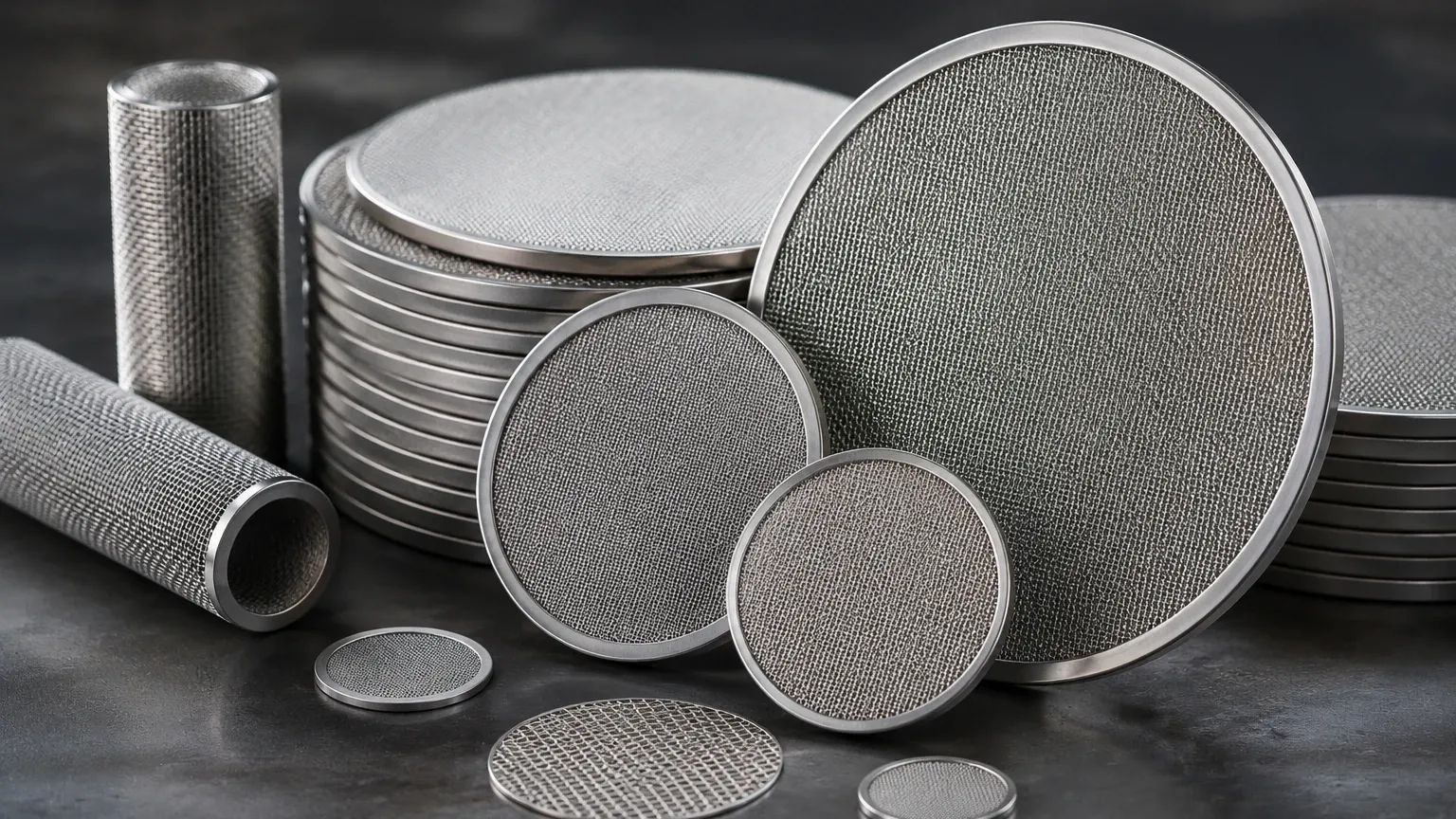
Industrial filter packs are engineered assemblies consisting of one or more layers of wire mesh. These layers are often combined to provide a balance between filtration fineness and mechanical strength. In many applications, a single layer of fine mesh is too fragile to withstand the high differential pressures found in polymer extrusion or hydraulic systems. Therefore, a multi-layer design is employed.
The Layered Architecture
In a typical multi-layer pack, the layers are arranged strategically:
1. Filtration Layer: The central or primary layer, usually a fine Dutch weave or square weave mesh, determines the micron rating.
2. Support Layer: Heavier mesh layers placed on either side of the filtration layer to prevent deformation under pressure.
3. Drainage Layer: Coarse mesh that facilitates the even distribution of fluid or melt across the entire surface area of the filter.
For industries in Goiânia looking for a pack filter Goiania, understanding this architecture is vital. A poorly designed pack can lead to "mesh migration" or premature blinding, where the fine wires of the filtration layer are pushed into the openings of the support layer, effectively reducing the available filtration area.
Types of Filter Packs for Industrial Extrusion
Extrusion processes, particularly in the plastics and recycling industries, require filter packs that can handle high temperatures and viscous materials. There are two primary construction methods for these packs: spot-welded and rimmed.
Spot-Welded Packs
Spot-welded packs consist of multiple mesh layers joined at specific points around the perimeter. This design is cost-effective and suitable for applications where the filter is held securely within a recessed breaker plate. The welding process must be precise to ensure that all layers remain aligned during installation and operation.
Rimmed (Bound) Packs
Rimmed packs feature an aluminum, stainless steel, or copper border compressed around the edges of the mesh layers. This rim serves two purposes: it provides a superior seal against the filter housing, preventing "bypass" (where unfiltered material leaks around the edges), and it adds significant structural rigidity. For high-pressure polymer melt filtration, rimmed packs are often the preferred choice to ensure that no contaminants bypass the filter media.
Material Selection: Why Stainless Steel Dominates
The choice of material is perhaps the most critical factor in the performance of a pack filter Goiania. While various metals can be used, stainless steel remains the industry standard due to its thermal stability and chemical resistance.
AISI 304 Stainless Steel
Grade 304 is the most common material for general industrial applications. It offers excellent resistance to atmospheric corrosion and is suitable for most food-grade applications and standard chemical processing. It provides a good balance between cost and performance for non-acidic environments.
AISI 316L Stainless Steel
For more aggressive environments, such as those involving high salinity or acidic chemicals, 316L is required. The addition of molybdenum enhances its resistance to pitting and crevice corrosion. The "L" denotes low carbon content, which is essential if the filter pack requires extensive welding, as it prevents carbide precipitation that can lead to intergranular corrosion.
Specialty Alloys
In extreme cases involving high-temperature corrosive gases or highly reactive chemicals, alloys like Hastelloy or Inconel may be specified. These materials maintain their mechanical properties at temperatures where stainless steel would begin to soften or oxidize rapidly.
Key Performance Indicators in High-Pressure Filtration
When evaluating a pack filter Goiania, engineers must look beyond the physical dimensions and consider the performance metrics that affect the total cost of ownership.
Micron Rating and Efficiency
The micron rating defines the size of particles the filter is intended to capture. However, it is important to distinguish between nominal and absolute ratings. A nominal rating indicates the ability to retain a percentage of particles of a certain size, while an absolute rating refers to the diameter of the largest spherical particle that can pass through the mesh. For precision applications, absolute ratings are necessary to ensure consistent product quality.
Dirt Holding Capacity
A filter's life cycle is determined by its dirt-holding capacity. As contaminants build up on the surface and within the depth of the mesh, the differential pressure across the filter increases. A pack with high porosity and optimized layering will allow for a higher volume of contaminants to be trapped before reaching the terminal pressure drop, thereby extending the time between filter changes.
Pressure Drop (ΔP)
The initial pressure drop is the resistance to flow caused by the clean filter media. In energy-intensive processes like extrusion, a high initial ΔP requires more pump power and generates more heat. Engineering the mesh weave (e.g., using Reverse Dutch Weave) can provide a high surface area with lower resistance, optimizing energy efficiency.
Customization and OEM Solutions for Local Industries
Every industrial setup in Goiânia has unique requirements based on the machinery and the specific materials being processed. Standard off-the-shelf filters often fail to meet the exact tolerances required for specialized equipment. This is where custom manufacturing becomes essential.
Tailoring Dimensions and Shapes
While circular discs are the most common, filter packs can be manufactured in oval, rectangular, or even complex kidney shapes to fit specific breaker plates. Precision laser cutting or die-stamping ensures that the dimensions are accurate to within microns, preventing installation issues and leaks.
Custom Mesh Combinations
Depending on the viscosity of the fluid and the nature of the contaminants, a custom combination of mesh counts may be required. For example, a five-layer pack might use a 20-mesh support, a 60-mesh drainage layer, a 325-mesh filtration layer, and then repeat the drainage and support layers on the downstream side. This symmetrical construction prevents the pack from being installed backward, a common human error in fast-paced industrial environments.
Selecting a Global Partner for Local Operations
For companies seeking a pack filter Goiania, the choice of supplier involves balancing local availability with global manufacturing quality. While local distributors may offer quick delivery, the technical integrity of the filter depends on the manufacturer's capabilities.
Quality Control and Certification
A reliable manufacturer should adhere to international standards such as ISO 9001. Quality control processes should include wire diameter verification, mesh count validation, and bubble point testing to ensure the integrity of the weave. For the food and pharmaceutical industries, material traceability (MTRs) is often a mandatory requirement to prove the alloy composition.
Technical Support and Troubleshooting
Beyond supplying the product, a professional manufacturer provides technical guidance. If a filter pack is failing prematurely, the supplier should be able to analyze the failure mode—whether it is chemical corrosion, mechanical fatigue, or over-pressurization—and recommend a revised specification. This engineering-led approach helps Goiânia-based industries optimize their processes rather than simply replacing failed components.
Conclusion: Optimizing Filtration Performance
The selection of a pack filter Goiania is a critical component of industrial maintenance and process optimization. By focusing on material science, structural design, and specific application requirements, engineers can significantly improve the efficiency of their filtration systems. Whether it is a simple single-layer disc or a complex multi-layer rimmed pack, the quality of the wire mesh and the precision of the assembly are the primary determinants of success.
For professionals looking to upgrade their current filtration systems or develop new OEM components, focusing on technical specifications—such as absolute micron ratings, alloy grades, and burst pressure resistance—will ensure that the chosen Filter Discs & Packs deliver long-term value and reliable performance in the most demanding industrial environments.
