


Wire Mesh Filter Media: An Engineering Guide to Selection and Application
In industrial process engineering, the selection of filtration media is a critical decision that impacts system efficiency, product purity, and long-term operational costs. Among the various options available, stainless steel wire mesh filter media stands out for its durability, precision, and ability to withstand extreme environments. This guide examines the technical characteristics of wire mesh, its fabrication into functional components, and the engineering considerations necessary for optimizing filtration performance.
Understanding Wire Mesh Filter Media Fundamentals
Wire mesh filter media is a porous material manufactured by weaving metallic wires—typically stainless steel—into specific patterns. Unlike depth filtration media, such as felt or ceramic, wire mesh primarily functions as surface filtration. This means that particles larger than the mesh openings are captured on the upstream surface of the media, allowing for easier cleaning and more predictable flow characteristics.
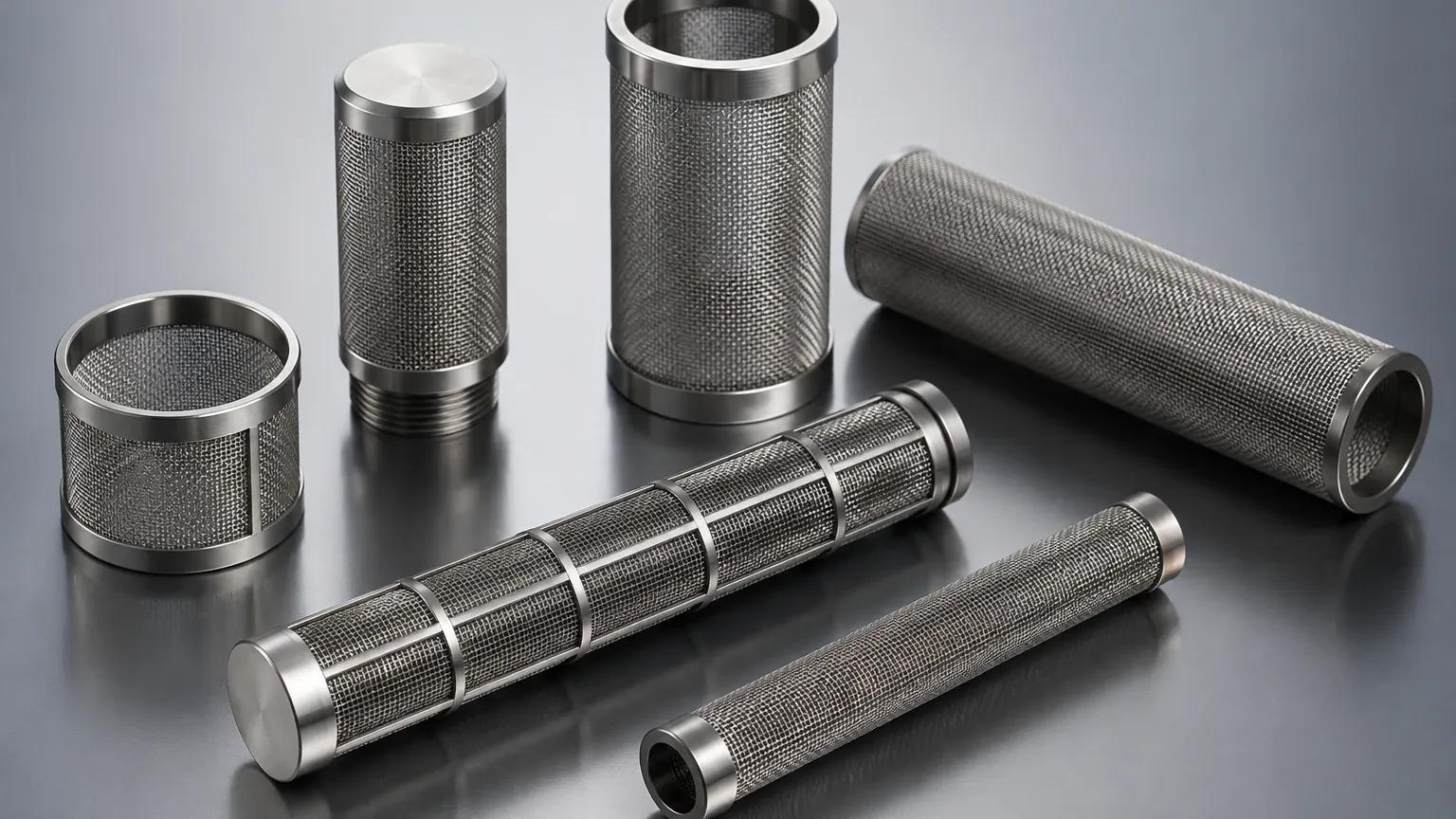
From an engineering perspective, the performance of wire mesh is defined by its aperture size, wire diameter, and weave type. These factors collectively determine the "micron rating," which indicates the size of particles the mesh can effectively remove. In industrial applications, wire mesh is rarely used as a loose cloth; instead, it is engineered into rigid structures such as Wire Mesh Filter Cylinders & Tubes to handle high-pressure differentials and mechanical stresses.
Surface vs. Depth Filtration
While depth filters trap particles within a complex matrix of fibers, wire mesh provides a precise, two-dimensional barrier. This precision is vital in applications where "absolute" filtration is required, meaning no particle larger than the rated size can pass through the media. Furthermore, the metallic nature of the media prevents fiber migration, a common failure mode in polymer or paper filters where fragments of the filter itself contaminate the filtrate.
Technical Analysis of Weave Types
The geometry of the weave dictates the mechanical strength and filtration accuracy of the media. Engineers must select the weave type based on the specific requirements of the fluid dynamics and the nature of the contaminants.
Plain Weave
The most common and straightforward weave, where each warp wire crosses over and under each shute wire. Plain weave provides a high percentage of open area, resulting in low pressure drop and high flow rates. It is ideal for coarse to medium filtration tasks where high throughput is prioritized over extreme precision.
Twill Weave
In a twill weave, each shute wire passes over and under two warp wires. This allows for the use of heavier wires for a given mesh count, increasing the mechanical strength of the media. Twill weaves are often employed when the filter must withstand higher pressures without deforming the pore structure.
Dutch Weave (Plain and Twilled)
Dutch weaves utilize different diameters for warp and shute wires. The wires are driven closely together, creating a dense, firm filter cloth with very small, triangular openings. This weave type offers superior strength and is capable of achieving much finer filtration ratings (down to 5-10 microns) than standard plain weaves. Twilled Dutch weaves are particularly effective for high-pressure applications in hydraulic systems and chemical processing.
Engineering Wire Mesh Filter Cylinders & Tubes
To integrate wire mesh into an industrial system, the media must be fabricated into a stable geometric form. The most common configurations are cylinders and tubes, which provide a high surface-area-to-volume ratio and can be easily installed into standard filter housings.
Structural Integrity and Reinforcement
Because wire mesh is inherently flexible, thin-gauge mesh often requires a support structure. In the construction of Wire Mesh Filter Cylinders & Tubes, the filter media is frequently layered with a perforated metal core or an external cage. This reinforcement prevents the mesh from collapsing or bursting under the force of the fluid flow. For multi-layer designs, a coarse drainage mesh may be placed between the fine filtration layer and the support core to ensure even flow distribution across the entire surface.
Joining and Welding Techniques
The integrity of a filter cylinder depends heavily on the quality of its seams. In B2B industrial manufacturing, Plasma or TIG (Tungsten Inert Gas) welding is preferred over adhesives or mechanical crimping. Welding ensures a leak-proof seal that is as chemically and thermally resistant as the base metal. For precision components, spot welding or continuous seam welding is used to join the mesh to end caps or flanges, ensuring that bypass—the unintended passage of unfiltered fluid—is eliminated.
Material Selection: Stainless Steel Grades
The choice of alloy is dictated by the chemical composition of the process fluid and the operating temperature. Kaifil specializes in stainless steel solutions due to their versatility and corrosion resistance.
* AISI 304: The standard grade for general industrial use. It offers good corrosion resistance and is suitable for most water treatment and food-grade applications.
* AISI 316L: Contains molybdenum, which significantly enhances resistance to pitting and crevice corrosion in chloride-rich environments. This is the preferred material for marine applications, pharmaceutical production, and aggressive chemical processing.
* Specialty Alloys: For extreme conditions involving high concentrations of acids or temperatures exceeding 500°C, alloys such as Inconel, Monel, or Hastelloy may be utilized in the wire mesh construction.
Performance Metrics: Flow Rate and Pressure Drop
One of the most critical calculations for an engineer is the initial clean pressure drop ($ΔP$). This value is influenced by the fluid viscosity, flow velocity, and the "open area" of the wire mesh filter media.
The Importance of Open Area
The open area is the percentage of the total mesh surface that is not occupied by wire. A higher open area reduces the resistance to flow, which in turn lowers energy consumption for pumps. However, there is a trade-off: increasing the open area usually requires using thinner wires, which can reduce the structural lifespan of the filter. Engineers must find the balance between hydraulic efficiency and mechanical durability.
Dirt Holding Capacity
While wire mesh is a surface medium, its dirt-holding capacity can be enhanced through pleating. By folding the mesh into a star-shaped cross-section before forming it into a cylinder, the effective filtration area can be increased by 3 to 5 times compared to a plain cylindrical design. This significantly extends the time between cleaning cycles, reducing maintenance downtime.
Cleaning and Maintenance Protocols
A primary advantage of wire mesh over disposable media is its cleanability. In many industrial sectors, the ability to regenerate the filter media is a key factor in reducing the Total Cost of Ownership (TCO).
1. Backwashing: Reversing the flow of the fluid to dislodge particles trapped on the surface. This is often automated in continuous flow systems.
2. Ultrasonic Cleaning: Utilizing high-frequency sound waves in a cleaning solvent to remove fine particles embedded deep within the weave of Dutch weave media.
3. Chemical Cleaning: Using acids, alkalis, or surfactants to dissolve organic or inorganic scaling. Because the media is stainless steel, it can withstand aggressive cleaning agents that would destroy polymer filters.
4. Thermal Burn-off: For polymer melt filtration or heavy hydrocarbon applications, the filter can be heated in a controlled furnace to oxidize and remove contaminants.
Selection Criteria for International Buyers
When sourcing Wire Mesh Filter Cylinders & Tubes for industrial projects, procurement teams and engineers should confirm several technical specifications to ensure compatibility and performance:
* Micron Rating (Absolute vs. Nominal): Ensure the manufacturer specifies whether the rating is absolute (100% efficiency at that size) or nominal (a lower percentage efficiency).
* Operating Temperature and Pressure: Define the maximum surge pressures and the steady-state operating temperature to determine if reinforcement is necessary.
* Chemical Compatibility: Provide a full breakdown of the process fluid, including trace chemicals that might cause stress corrosion cracking.
* End Fitting Configuration: Specify the type of connection required (e.g., DOE – Double Open End, SOE – Single Open End with O-rings, NPT threads, or custom flanges) to ensure a proper fit in existing housings.
* Quality Certification: For pharmaceutical or food and beverage applications, verify that the materials comply with FDA or EU food contact regulations.
Conclusion
Wire mesh filter media represents a highly engineered solution for demanding industrial filtration tasks. By understanding the nuances of weave patterns, material science, and fabrication techniques, engineers can specify components that provide precise filtration while minimizing operational costs. Whether used in high-pressure hydraulic systems or sensitive pharmaceutical processes, the durability and cleanability of stainless steel wire mesh make it an indispensable asset in modern industrial engineering.
For custom requirements and technical support in developing optimized filtration components, reviewing specific product options and application support is the recommended next step for achieving reliable system performance.
