


Engineering Guide to Wire Mesh Hydraulic Filters: Performance, Selection, and Optimization
In industrial hydraulic systems, the presence of particulate contamination is the leading cause of component wear and system failure. As hydraulic pressures increase and tolerances within valves and pumps become tighter, the demand for precision filtration has never been higher. While disposable media like cellulose or synthetic fibers are common, the wire mesh hydraulic filter has emerged as a critical component for applications requiring durability, high-temperature resistance, and reusability.
This article provides an in-depth technical analysis of wire mesh filtration technology, focusing on the engineering considerations that dictate performance in demanding hydraulic environments. From material properties to structural design, understanding these variables is essential for engineers and procurement teams tasked with maintaining system integrity and reducing total cost of ownership.
1. The Role of Wire Mesh in Hydraulic Systems
Hydraulic systems rely on fluid to transmit power. Any particulate matter—whether ingested from the environment or generated internally through component wear—can cause catastrophic damage to high-precision components like piston pumps and servo valves. A wire mesh hydraulic filter serves as a robust barrier, typically used in suction lines, return lines, or as a last-chance filter to protect specific sensitive components.
Unlike depth media, which traps particles within a thick layer of fibers, stainless steel wire mesh provides surface filtration. This means the particles are captured on the upstream side of the mesh. The primary advantages of using wire mesh in hydraulic applications include:
* High Mechanical Strength: Capable of withstanding high differential pressures without media migration.
* Thermal Stability: Operates effectively in extreme temperature ranges where polymer-based media would fail.
* Chemical Compatibility: Stainless steel is resistant to a wide variety of hydraulic fluids, including mineral oils, water glycols, and phosphate esters.
* Cleanability: Unlike disposable filters, wire mesh elements can often be cleaned and returned to service, offering long-term cost benefits.
2. Material Engineering and Mesh Weave Types
The performance of a hydraulic filter is fundamentally tied to the material and the weave pattern of the wire mesh. Most industrial applications utilize stainless steel, specifically AISI 304 or 316L, due to their excellent corrosion resistance and structural integrity.
Stainless Steel Grades
* AISI 304: The standard grade for most hydraulic applications, providing good resistance to corrosion and high physical strength.
* AISI 316L: Contains molybdenum, which offers superior resistance to pitting and crevice corrosion, making it the preferred choice for hydraulic systems in marine environments or chemical processing plants.
Weave Patterns and Filtration Characteristics
The geometry of the weave determines the micron rating and the flow characteristics of the filter. Common weaves include:
* Plain Weave: The simplest pattern where wires cross over and under each other. It provides high flow rates but is generally limited to coarser filtration (above 50 microns).
* Twill Weave: Each shute wire passes over and under two warp wires. This allows for the use of heavier wires for a given mesh count, increasing the strength and allowing for finer filtration.
* Dutch Weave (Plain and Twill): This weave uses a larger diameter warp wire and a smaller diameter shute wire. It creates a dense, strong mesh with very fine openings, ideal for high-pressure hydraulic applications where precision is paramount.
3. Structural Design: Wire Mesh Filter Cylinders & Tubes
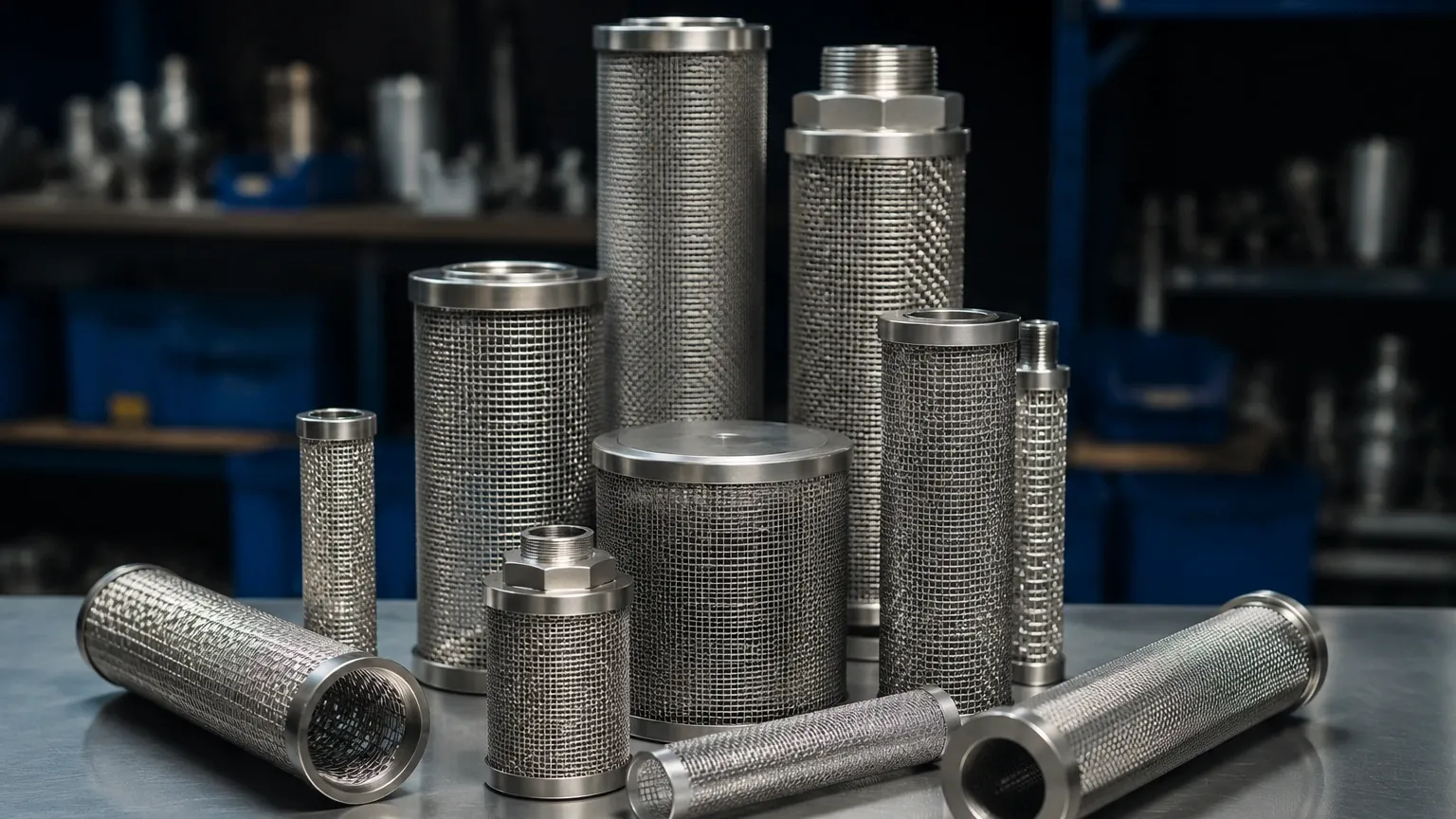
For a filter to function effectively within a hydraulic circuit, the mesh must be supported by a robust structure. In most industrial settings, the mesh is fabricated into Wire Mesh Filter Cylinders & Tubes to provide the necessary surface area while fitting within standard housing dimensions.
Reinforcement and Support
Because hydraulic systems often experience pressure spikes and high flow velocities, a single layer of wire mesh is rarely sufficient. Engineering a durable filter tube involves several layers:
1. The Filtration Layer: The specific mesh weave that dictates the micron rating.
2. Support Layers: Coarser mesh layers placed on the upstream or downstream sides to prevent the filtration mesh from deforming under pressure.
3. Perforated Core: A central stainless steel tube with punched holes that provides the primary structural framework, ensuring the cylinder does not collapse under high differential pressure.
Fabrication Techniques
High-quality Wire Mesh Filter Cylinders & Tubes are typically assembled using advanced welding techniques such as plasma or TIG welding. This ensures that the seams are as strong as the parent material and prevents the bypass of unfiltered fluid through gaps in the assembly.
4. Key Selection Criteria for Engineers
When specifying a wire mesh hydraulic filter, engineers must look beyond the basic dimensions. Several performance metrics must be evaluated to ensure the filter meets the application requirements.
Micron Rating: Absolute vs. Nominal
* Nominal Rating: An approximate value indicating the ability of the filter to retain the majority of particles of a specific size. It is not a guarantee of 100% efficiency.
* Absolute Rating: The diameter of the largest hard spherical particle that will pass through the filter under specified test conditions. For critical hydraulic components, absolute-rated mesh is usually required.
Clean Pressure Drop ($ΔP$)
The pressure drop across a clean filter element is a function of the fluid viscosity, flow rate, and the open area of the mesh. A high initial pressure drop reduces the available system pressure and can lead to early bypass or cavitation in suction lines. Engineers should calculate the $ΔP$ based on the maximum expected flow rate at the lowest operating temperature (highest viscosity).
Dirt Holding Capacity
While wire mesh is surface-type filtration, the weave density affects how much contaminant the filter can hold before the pressure drop reaches the bypass threshold. Pleating the wire mesh is a common engineering solution to increase the surface area within a fixed cylinder volume, thereby extending the service life between cleanings.
5. Maintenance, Cleaning, and Reusability
One of the primary value propositions of a stainless steel wire mesh hydraulic filter is its reusability. However, the cleaning process must be handled correctly to avoid damaging the delicate mesh structure.
Cleaning Methods
* Ultrasonic Cleaning: The most effective method for fine mesh. High-frequency sound waves create cavitation bubbles that dislodge particles trapped deep within the weave.
* Backflushing: Using clean fluid or compressed air to blow contaminants off the surface of the mesh in the opposite direction of normal flow.
* Chemical Cleaning: Utilizing solvents to dissolve varnishes or organic deposits that may have accumulated on the mesh. Compatibility between the solvent and the filter materials (including seals) must be verified.
1
When to Replace vs. Clean
While reusable, wire mesh filters have a finite lifespan. Repeated cleaning cycles and exposure to pressure surges can lead to "wire fatigue." Engineers should inspect filters for:
* Media Migration: Broken wires that could enter the downstream flow.
* Permanent Deformation: Distorted mesh that alters the pore size.
* Uncleanable Contamination: If the pressure drop remains high after professional cleaning, the element has reached the end of its functional life.
6. Application Risks and Mitigation
Implementing a wire mesh hydraulic filter requires an understanding of potential failure modes. If not properly specified, even the highest quality filter can fail.
Cavitation in Suction Lines
Suction filters are often made of wire mesh to protect the pump from large debris. However, if the mesh is too fine or becomes clogged, it can restrict flow to the pump, causing cavitation. This leads to rapid pump erosion and noise. Suction filters are typically coarser (100-150 microns) to mitigate this risk.
Bypass Leakage
If the filter element does not seal perfectly within the housing, fluid will take the path of least resistance, bypassing the mesh entirely. This is often caused by damaged O-rings or poor machining tolerances on the filter end caps. Ensuring precision fitment of Wire Mesh Filter Cylinders & Tubes is critical for system protection.
Structural Collapse
In high-pressure return lines, a sudden surge in flow can create a differential pressure that exceeds the collapse rating of the filter core. Engineers must specify the maximum allowable $ΔP$ and ensure the perforated core and support mesh are designed to handle these transients.
7. Buyer’s Checklist: Confirming Specifications
For international buyers and procurement teams, providing clear technical specifications to the manufacturer is essential for obtaining a filter that performs as expected. Before placing an order, confirm the following:
1. Micron Rating Requirement: Is it nominal or absolute? What is the specific particle size that must be captured?
2. Fluid Compatibility: Specify the type of hydraulic fluid and any additives used.
3. Operating Conditions: Provide the normal operating temperature, maximum temperature, and normal/peak flow rates.
4. Pressure Ratings: Define the maximum operating pressure and the required collapse pressure rating.
5. Dimensions and End Fittings: Provide exact measurements for the outer diameter (OD), inner diameter (ID), and length, as well as the type of end caps (e.g., open both ends, threaded, or closed with a handle).
6. Certification Needs: Does the application require material mill certificates (e.g., 3.1 certs) or specific ISO filtration standards?
Conclusion
The wire mesh hydraulic filter is a sophisticated engineering solution that offers durability and precision beyond the capabilities of disposable media. By selecting the appropriate stainless steel grade, weave pattern, and structural reinforcement, industrial operators can ensure long-term protection for their hydraulic assets. Whether utilized in high-pressure circuits or as a protective screen in suction lines, the correct implementation of Wire Mesh Filter Cylinders & Tubes is a cornerstone of effective hydraulic fluid power management. Through careful selection and proper maintenance, these components provide a cost-effective and reliable path to achieving high system cleanliness standards.
