


Engineering Guide to Metal Mesh Intake Filters: Selection, Performance, and Industrial Application
In industrial engineering, the integrity of downstream equipment—such as compressors, pumps, turbines, and hydraulic power units—depends heavily on the quality of the initial intake. A metal mesh intake filter serves as the primary barrier against particulate contamination, preventing mechanical wear, erosion, and catastrophic system failure. Unlike disposable synthetic or paper media, stainless steel mesh offers a unique combination of mechanical strength, thermal stability, and reusability, making it the standard for demanding B2B industrial environments.
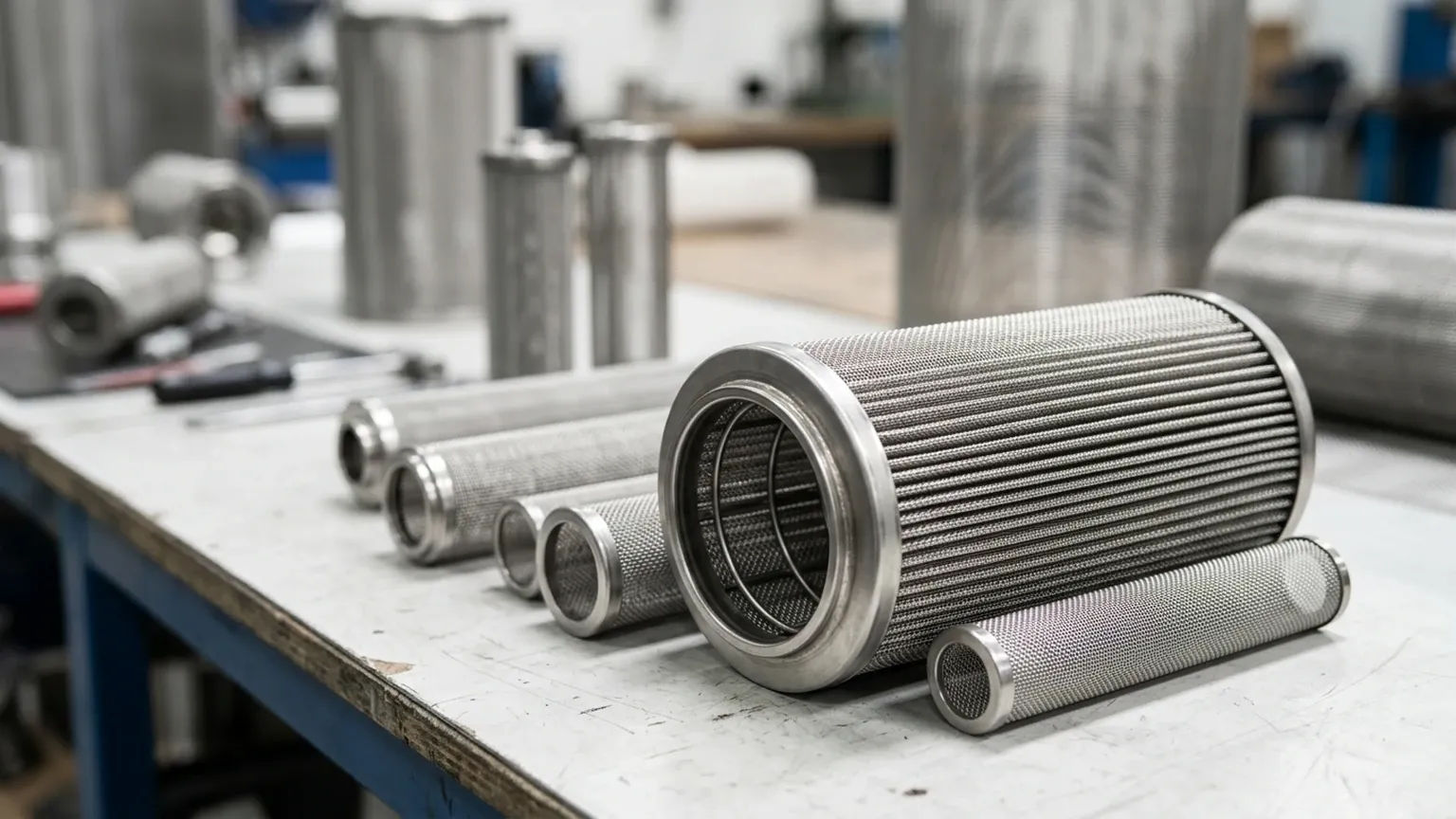
Selecting the correct filtration component requires a deep understanding of fluid dynamics, material science, and the specific mechanical constraints of the system. This guide examines the technical considerations for Wire Mesh Filter Cylinders & Tubes and how they are engineered to meet the rigorous demands of modern industrial processing.
1. Operating Principles of Metal Mesh Intake Filtration
The primary function of an intake filter is to remove contaminants from an incoming stream of air, gas, or liquid before it enters a sensitive component. Metal mesh filters operate primarily through surface filtration, where particles larger than the mesh openings are mechanically trapped on the upstream side of the media.
Surface vs. Depth Filtration
While depth filters (like felt or pleated paper) trap particles within a thick matrix, a metal mesh intake filter utilizes a precise, two-dimensional geometry. This provides several engineering advantages:
* Predictable Micron Rating: The aperture size is determined by the wire diameter and weave density, ensuring a consistent cutoff point.
* Low Initial Pressure Drop: The high open-area percentage of stainless steel mesh allows for high flow rates with minimal resistance, which is critical for intake systems where vacuum or suction head is limited.
* Ease of Cleaning: Because contaminants are captured on the surface, they can be removed via backwashing, ultrasonic cleaning, or chemical baths, restoring the filter to its original differential pressure state.
Fluid Dynamics and Face Velocity
Engineers must calculate the face velocity—the speed at which the fluid passes through the filter surface. If the velocity is too high, it can lead to "particle migration," where contaminants are forced through the mesh, or it can cause excessive turbulence and pressure drop. Properly sized Wire Mesh Filter Cylinders & Tubes ensure that the effective filtration area (EFA) is sufficient to keep velocities within the laminar flow regime, protecting the pump or compressor from cavitation or starvation.
2. Structural Design: Wire Mesh Filter Cylinders & Tubes
Intake filters are rarely just a single layer of mesh. To withstand the pressure differentials and mechanical stresses of industrial use, they are typically constructed as reinforced cylinders or tubes. These components are engineered with multiple layers to balance filtration fineness with structural rigidity.
Multi-Layer Construction
For high-performance applications, Kaifil utilizes a multi-layer approach:
1. Filtration Layer: The inner or outer layer (depending on flow direction) that determines the micron rating.
2. Support Layer: A coarser mesh or perforated metal core that provides the mechanical strength to prevent the filtration layer from collapsing under high suction or pressure.
3. Protective Layer: An external mesh that guards against large debris and mechanical damage during handling or installation.
Sintered vs. Non-Sintered Mesh
In environments with high vibration or pulsating flows, sintered mesh is often preferred. Sintering is a process where multiple layers of mesh are bonded together using heat and pressure without the use of binders. This creates a monolithic structure where individual wires cannot shift, ensuring that the pore size remains constant even under extreme mechanical stress. For standard intake applications, however, pleated or wrapped Wire Mesh Filter Cylinders & Tubes offer a cost-effective solution with high surface area.
3. Material Selection for Industrial Environments
The choice of material for a metal mesh intake filter is dictated by the chemical composition of the fluid and the operating temperature. Stainless steel is the industry standard due to its corrosion resistance and durability.
Grade 304 vs. Grade 316L
* SS304: Suitable for general industrial applications, including air intake for compressors and filtration of non-corrosive liquids. It offers excellent strength and cost-efficiency.
* SS316L: Contains molybdenum, which provides superior resistance to chlorides and pitting. This is essential for marine environments, chemical processing, and pharmaceutical applications where the intake fluid may be aggressive or where stringent sanitation is required.
Temperature and Chemical Compatibility
Unlike polymer-based filters, stainless steel intake filters can operate at temperatures exceeding 400°C (752°F) and are compatible with a wide range of solvents, oils, and acids. This makes them indispensable in hot gas filtration and high-temperature hydraulic systems where synthetic media would degrade or melt.
4. Key Selection Criteria for Engineers
When specifying a metal mesh intake filter, purchasing teams and engineers should evaluate the following parameters to ensure optimal performance and total cost of ownership (TCO).
Micron Rating: Absolute vs. Nominal
It is vital to distinguish between nominal and absolute ratings. A nominal rating refers to the ability of the filter to retain a percentage of particles of a certain size, whereas an absolute rating (often achieved with high-precision Dutch weave mesh) indicates the size of the largest spherical particle that can pass through the mesh. For protecting high-precision bearings or nozzles, an absolute-rated filter is often required.
Flow Rate and Pressure Drop (ΔP)
Every filter introduces a pressure drop. In intake systems, an excessive ΔP can lead to:
* Pump Cavitation: In liquid systems, if the intake pressure drops below the vapor pressure of the liquid, bubbles form and collapse, causing severe damage to pump impellers.
* Reduced Efficiency: In air compressors, a clogged intake filter forces the motor to work harder, increasing energy consumption and heat generation.
Connection and End-Cap Design
To ensure a leak-proof installation, the end-caps of the Wire Mesh Filter Cylinders & Tubes must be matched to the housing. Common configurations include:
* DOE (Double Open End): Requires gaskets at both ends to seal against the housing.
* SOE (Single Open End): Often features a threaded connection (NPT/BSP) or a specialized fitting like a 222 or 226 O-ring plug for high-purity applications.
* Flanged Ends: Used for large-scale industrial intakes where heavy-duty bolting is required.
5. Applications of Metal Mesh Intake Filters
Metal mesh filters are versatile components used across various sectors where reliability is non-negotiable.
1. Air Compressor and Blower Intakes
In dusty industrial environments, compressors require robust intake filtration to prevent particulates from scoring cylinders or damaging rotary screws. Metal mesh filters are often used as pre-filters or primary filters in these systems because they can be cleaned and reused, reducing the waste associated with disposable cartridges.
2. Hydraulic and Lube Oil Systems
Suction strainers located at the pump intake in hydraulic reservoirs are almost exclusively made of metal mesh. They protect the pump from large contaminants (nuts, bolts, scale) that may have entered the reservoir during maintenance or through breathers.
3. Water Treatment and Desalination
In water intake systems, especially in coastal or river-based facilities, Wire Mesh Filter Cylinders & Tubes act as the first stage of filtration, removing sand, organic matter, and debris before the water reaches fine filtration or RO membranes.
4. Chemical and Petrochemical Processing
Intake filters in chemical plants must withstand aggressive solvents and high pressures. Stainless steel mesh provides the necessary chemical inertness and structural integrity to handle hazardous fluids safely.
6. Maintenance, Cleaning, and Longevity
One of the primary B2B advantages of a metal mesh intake filter is its long service life. However, achieving maximum longevity requires a disciplined maintenance schedule.
Cleaning Protocols
When the differential pressure reaches a pre-defined limit (usually indicated by a gauge), the filter should be cleaned. Methods include:
* Backwashing: Reversing the flow of fluid to dislodge particles from the mesh surface.
* Ultrasonic Cleaning: Using high-frequency sound waves in a cleaning solution to remove fine particles trapped deep within the mesh pores. This is the most effective method for restoring high-precision filters.
* Chemical Cleaning: Using specific solvents or acids to dissolve scale or organic buildup, provided the chemicals are compatible with the stainless steel grade.
When to Replace
While reusable, metal mesh filters are not infinite. They should be replaced if there is evidence of "media migration" (broken wires), permanent deformation of the support core, or if the pressure drop no longer returns to acceptable levels after thorough cleaning.
7. Customization and OEM Solutions with Kaifil
Industrial systems often have unique spatial constraints or performance requirements that off-the-shelf filters cannot meet. As a specialist manufacturer, Kaifil provides customized Wire Mesh Filter Cylinders & Tubes tailored to specific OEM needs.
Engineers looking to source custom filters should provide the following data for an accurate technical assessment:
* Medium Type: (Air, water, oil, or specific chemical).
* Operating Temperature and Pressure: Both steady-state and peak values.
* Target Micron Rating: Based on the sensitivity of downstream equipment.
* Physical Dimensions: Length, outer diameter (OD), and inner diameter (ID).
* Mounting Requirements: Threaded, flanged, or friction-fit end-caps.
By focusing on precision engineering and high-quality stainless steel materials, Kaifil ensures that every metal mesh intake filter delivers consistent performance, protecting critical industrial infrastructure and optimizing process efficiency. For technical consultation or to discuss specific filtration challenges, contact our engineering team to review product options and application support.
