


Metal Mesh Screen Filter Intake Covers: An Engineering Guide to Industrial Intake Protection
In industrial fluid handling systems, the intake point represents the first line of defense against particulate contamination and mechanical damage. Whether drawing water from a natural source, circulating hydraulic fluids, or managing chemical feedstocks, the integrity of downstream pumps, valves, and instrumentation depends on the performance of metal mesh screen filter intake covers. These components are frequently designed using Wire Mesh Filter Cylinders & Tubes to provide a balance between high flow rates and precise mechanical exclusion.
For engineers and procurement specialists, selecting the correct intake cover involves more than choosing a mesh size. It requires a comprehensive understanding of fluid dynamics, material compatibility, and the structural stresses inherent in high-volume suction environments. This guide examines the technical considerations necessary to optimize intake filtration performance and ensure long-term system reliability.
Engineering Principles of Intake Filtration
The primary function of an intake cover is to prevent the ingress of debris that could cause catastrophic failure or accelerated wear in downstream equipment. In pump-driven systems, the intake screen must also minimize pressure drop to prevent cavitation—a phenomenon where low pressure causes vapor bubbles to form and collapse, leading to pitting and mechanical damage of pump impellers.
The Role of Geometry
Most industrial intake covers utilize a cylindrical or tubular geometry. This design is preferred because it maximizes the surface area relative to the footprint of the intake pipe. By increasing the "Effective Filtration Area" (EFA), engineers can reduce the face velocity of the fluid as it passes through the mesh. Lower face velocity decreases the likelihood of "impingement," where particles are forced into the mesh openings, making them harder to remove during cleaning cycles.
Flow Dynamics and Open Area
A critical metric in the design of Wire Mesh Filter Cylinders & Tubes for intake applications is the percentage of open area. This is the ratio of the total area of the mesh openings to the total surface area of the screen. A higher open area typically results in a lower initial pressure drop (Delta P). However, engineers must balance this against the required mechanical strength of the wire. Finer wires increase open area but may lack the structural rigidity to withstand the suction forces of large industrial pumps.
Material Science: Selecting Alloys for Durability
Industrial environments subject intake covers to a variety of stressors, including chemical corrosion, abrasive particles, and biological fouling. Selecting the appropriate metal alloy is fundamental to the component's lifespan.
Stainless Steel Grades
* Grade 304: The standard for general industrial applications. It offers excellent mechanical properties and good corrosion resistance in non-saline water and mild chemical environments.
* Grade 316L: Containing molybdenum, 316L provides superior resistance to chlorides and pitting. It is the preferred choice for marine environments, food and beverage processing, and pharmaceutical applications where sanitation and corrosion resistance are paramount.
* Duplex and Super Duplex: For highly aggressive chemical processing or deep-sea water intakes, duplex stainless steels offer higher yield strength and exceptional resistance to stress corrosion cracking.
Surface Treatments and Coatings
In some applications, the base metal may be treated to enhance performance. Electropolishing is frequently used in the pharmaceutical and food industries to create a microscopically smooth surface that resists bacterial adhesion and simplifies the cleaning process. For intake covers used in natural water sources, specialized anti-fouling coatings may be applied to prevent the growth of algae or zebra mussels, which can quickly occlude the screen.
Critical Selection Criteria for Wire Mesh Filter Cylinders & Tubes
When specifying Wire Mesh Filter Cylinders & Tubes for use as metal mesh screen filter intake covers, engineers must evaluate several performance parameters to ensure the component meets the specific needs of the application.
Micron Rating and Particle Retention
The "micron rating" defines the size of particles the mesh is designed to trap. This is categorized into two types:
1. Nominal Rating: An approximate value indicating that the mesh will retain a majority of particles of a specific size.
2. Absolute Rating: A rigorous standard indicating that 100% of particles above a certain size will be retained. For protecting high-precision hydraulic pumps or sensitive chemical reactors, absolute ratings are often required.
Pressure Drop (Delta P) Calculations
Engineers must calculate the clean pressure drop across the intake cover at the maximum expected flow rate. This calculation accounts for fluid viscosity, density, and the mesh's flow coefficient. If the calculated Delta P is too high, it may be necessary to increase the size of the cylinder or select a mesh with a larger wire diameter and wider spacing, provided it still meets the particle retention requirements.
Structural Load and Collapse Pressure
Unlike inline filters, intake covers are often subjected to external pressure as the pump draws fluid through the screen. If the screen becomes significantly blinded by debris, the differential pressure can rise rapidly. The intake cover must be engineered with a collapse pressure rating that exceeds the maximum suction head of the pump to prevent the screen from imploding.
Customization and Structural Reinforcement
Standard wire mesh is rarely sufficient on its own for heavy-duty industrial intakes. Customization is often required to provide the necessary mechanical integrity.
Internal Support Cores
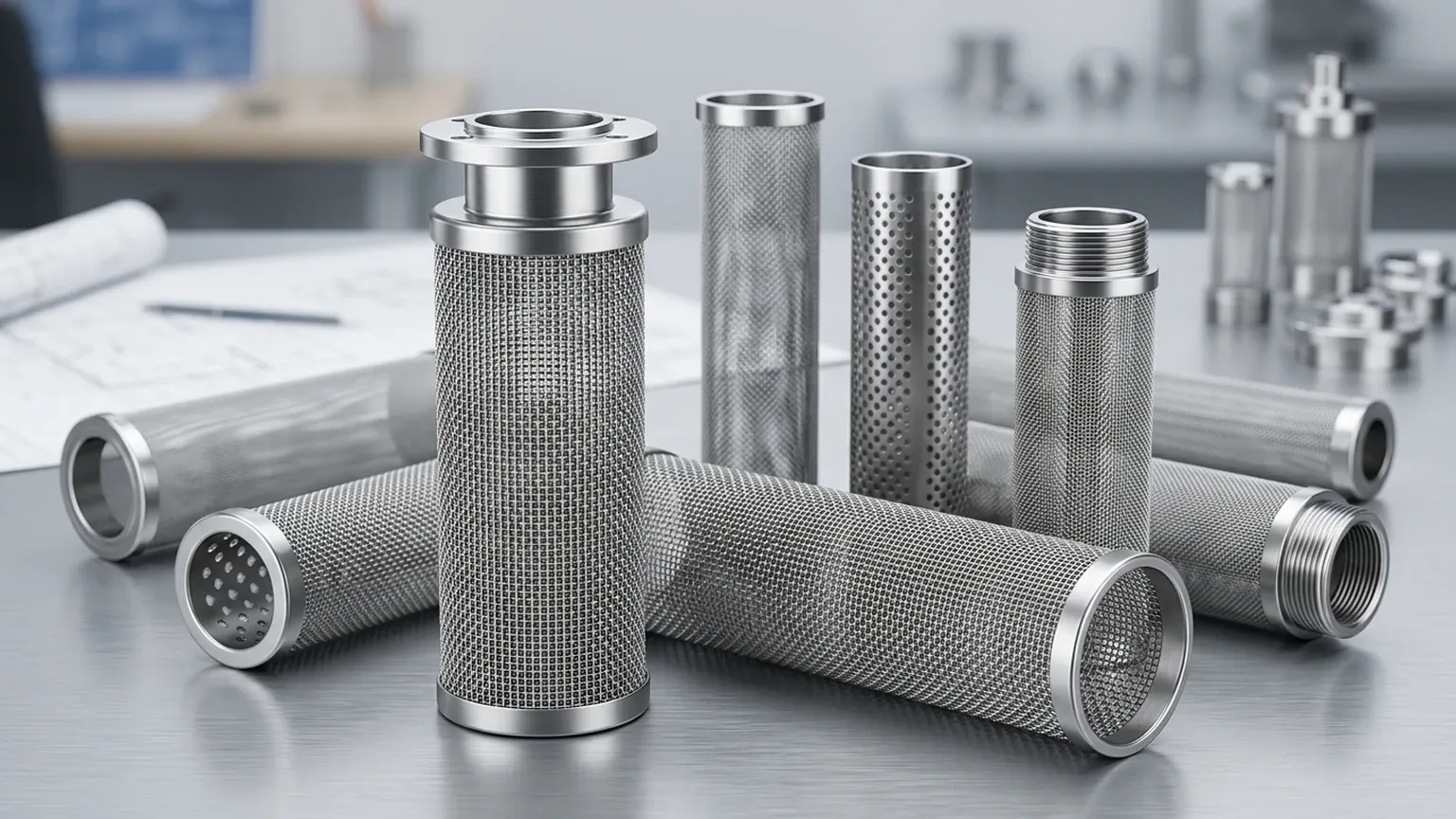
To prevent collapse under high suction, many intake cylinders are built around a perforated metal core. This core provides the structural skeleton, while the fine wire mesh is wrapped or sintered onto the exterior. The hole pattern of the perforated core must be carefully aligned to ensure it does not significantly impede the flow through the mesh.
Sintered Mesh Laminates
For applications requiring both fine filtration and high strength, sintered wire mesh is an ideal solution. This process uses heat and pressure to fuse multiple layers of mesh together. A typical laminate might include a fine filtration layer, a distribution layer, and several heavy support layers. The result is a single, robust sheet that can be formed into tubes without losing its structural properties.
End Fittings and Connection Types
The method of attachment is a key design consideration. Common options include:
* NPT/BSP Threaded Fittings: Ideal for smaller intake lines where easy removal is required.
* Flanged Connections: Used for large-diameter pipes in heavy industrial or municipal water applications.
* Quick-Disconnect Couplings: Preferred in systems that require frequent cleaning or where downtime must be minimized.
Installation Constraints and Maintenance Protocols
The effectiveness of metal mesh screen filter intake covers is heavily influenced by how they are installed and maintained. Poor placement can lead to uneven flow distribution and localized clogging.
Installation Best Practices
1. Submergence Depth: In open-water intakes, the cover must be submerged deeply enough to avoid drawing in floating debris or air (vortexing), but far enough from the bottom to avoid sucking up sediment.
2. Clearance: There should be adequate clearance around the entire circumference of the cylinder to ensure uniform flow. Placing an intake cover too close to a tank wall or floor can create high-velocity zones that accelerate wear and fouling.
3. Orientation: While vertical installation is common, horizontal orientation may be necessary in shallow tanks or flumes. In these cases, internal baffles may be required to ensure even flow across the length of the tube.
Maintenance and Cleaning
No intake cover is "maintenance-free." A proactive maintenance schedule is essential to prevent flow restrictions. Monitoring the differential pressure across the intake is the most reliable method for determining when cleaning is required.
* Backwashing: Many systems are designed with a backwash cycle where fluid is pumped in the reverse direction through the screen to dislodge accumulated debris.
* Ultrasonic Cleaning: For stainless steel mesh that has become blinded by fine particles or scale, ultrasonic cleaning in a specialized bath can restore the mesh to near-original performance.
* Chemical Cleaning: In cases of mineral scaling or organic fouling, mild acid or alkaline washes may be used, provided the chemicals are compatible with the screen's alloy.
Mitigating Operational Risks in Industrial Intake Systems
Failure to properly specify or maintain an intake cover can lead to several operational risks that impact the total cost of ownership (TCO).
Cavitation and Pump Damage
As previously mentioned, an occluded intake screen increases the vacuum at the pump inlet. If the pressure drops below the fluid's vapor pressure, cavitation occurs. The resulting micro-explosions can destroy a pump impeller in a matter of hours. Utilizing Wire Mesh Filter Cylinders & Tubes with a high EFA and implementing real-time pressure monitoring are the best defenses against this risk.
Material Fatigue
In systems with pulsating flows, such as those driven by reciprocating pumps, the mesh can be subject to vibration and fatigue. Over time, this can lead to wire breakage. Engineers should specify reinforced mesh or sintered structures in these environments to ensure the screen can withstand constant pressure fluctuations.
Bypass and Seal Failure
If the intake cover is not properly sealed to the intake pipe, fluid will take the path of least resistance, bypassing the filter entirely. This allows large contaminants to enter the system. Ensuring high-quality gaskets and precision-machined fittings is as important as the quality of the mesh itself.
Conclusion: Selecting a Technical Partner
The procurement of metal mesh screen filter intake covers should be treated as a technical engineering decision rather than a simple commodity purchase. The complexity of balancing flow rates, filtration accuracy, and structural durability requires a manufacturer with deep expertise in metal fabrication and filtration science.
When evaluating a supplier for Wire Mesh Filter Cylinders & Tubes, engineers should confirm the manufacturer's ability to provide detailed material certifications, pressure drop data, and customization capabilities. By focusing on these factual engineering boundaries, industrial facilities can ensure their intake systems provide reliable, long-term protection for their most critical assets.
