


Pre Filter vs Bag Filter
In industrial fluid processing, the selection of a filtration strategy is rarely about finding a single "perfect" filter. Instead, it is about designing a system where each stage optimizes the performance and lifespan of the next. For engineers and maintenance managers, the debate often centers on the specific roles of a pre filter vs bag filter. While both serve to remove contaminants from a process stream, their mechanical designs, material compositions, and operational roles differ significantly.
Understanding these differences is critical for optimizing throughput, reducing downtime, and protecting expensive downstream equipment. Whether you are managing a chemical processing plant, a food and beverage production line, or a high-pressure hydraulic system, the choice between these two filtration methods—or the decision to use them in tandem—impacts the total cost of ownership (TCO) and the quality of the final product.
Defining the Roles: Pre-Filtration and Bag Filtration
To compare a pre filter vs bag filter effectively, one must first define their primary functions within a multi-stage system.
The Function of a Pre-Filter
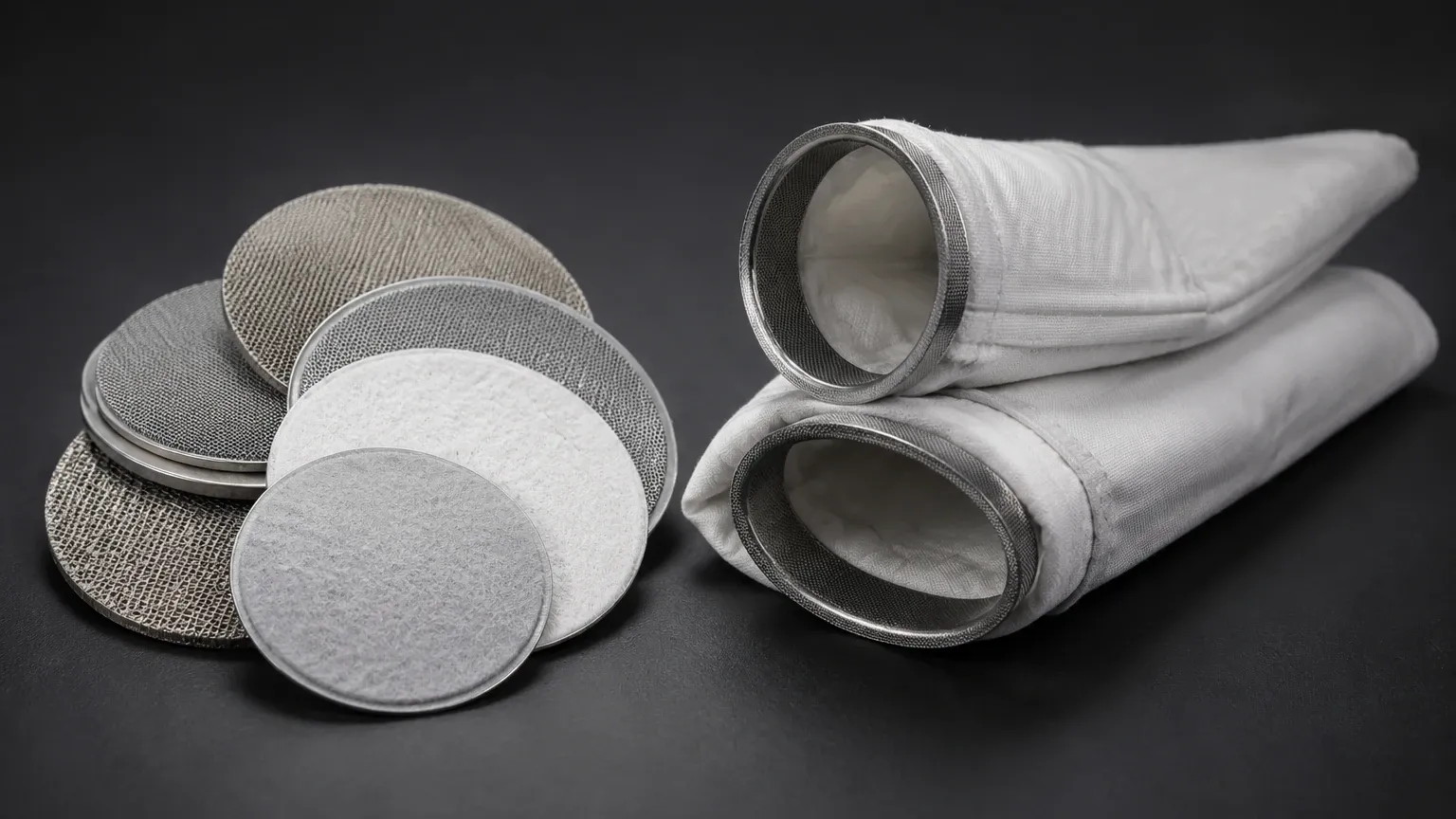
As the name suggests, a pre-filter is positioned at the beginning of the filtration sequence. Its primary objective is the removal of large particulate matter that would otherwise clog or damage more sensitive, high-precision filters downstream. In many demanding industrial environments, pre-filtration is achieved using robust components such as Filter Discs & Packs. These are often constructed from multiple layers of stainless steel wire mesh, providing the structural integrity needed to withstand high flow rates and heavy contaminant loads.
By capturing the "bulk" of the debris, pre-filters ensure that the secondary filtration stages—which are often more expensive or have lower dirt-holding capacities—can operate at peak efficiency for longer periods. This prevents premature "blinding" of fine membranes or high-efficiency cartridges.
The Function of a Bag Filter
A bag filter is a specific type of filtration vessel and media configuration. It consists of a filter housing and a replaceable bag made from felt, monofilament mesh, or multi-layer fabric. Fluid flows from the inside of the bag to the outside, trapping contaminants within the bag itself. Bag filters are favored for their high flow capacity and their ability to handle large volumes of solids. They are frequently used as a primary filtration step in applications like wastewater treatment or as a secondary step following a coarse strainer.
Technical Comparison: Pre Filter vs Bag Filter
When evaluating these two options, engineers must look beyond the initial purchase price and analyze technical performance metrics.
1. Micron Rating and Precision
Bag filters are generally available in ratings from 1 micron up to 200 microns or more. However, because bags are flexible and subject to stretching under pressure, their absolute filtration accuracy can vary. They are often considered "nominal" filters.
In contrast, pre-filters—specifically those utilizing precision-engineered metal mesh—can offer much tighter control over particle size. Multi-layer sintered Filter Discs & Packs provide a rigid pore structure that does not deform under pressure, ensuring consistent filtration accuracy even in fluctuating flow conditions. This makes them superior for protecting high-pressure pumps or precision spray nozzles.
2. Pressure Drop and Flow Rates
Bag filters excel in high-volume, low-pressure applications. Because of the large surface area of a standard #1 or #2 size bag, they offer a relatively low initial pressure drop (Delta P). However, as the bag fills with solids, the pressure drop increases rapidly, eventually requiring a shutdown for replacement.
Pre-filters, particularly those designed as discs or cartridges, are engineered for specific flow velocities. While a single disc may have less surface area than a large bag, they are often used in manifold systems or as part of a stacked assembly to match the required flow rate without sacrificing the benefits of a rigid metal structure.
3. Material Compatibility and Temperature Limits
Most bag filters are made from synthetic polymers like polypropylene, polyester, or nylon. These materials are cost-effective but have strict temperature limits (usually below 200°F/93°C) and can be degraded by certain solvents or aggressive chemicals.
For applications involving high temperatures, cryogenic fluids, or corrosive chemicals, stainless steel pre-filters are the standard. Stainless steel 304 or 316L components can operate in environments exceeding 500°F and are resistant to a wide range of industrial acids and bases. This durability is a key factor when comparing a pre filter vs bag filter for heavy industrial use.
Engineering Considerations for Selection
Choosing between a pre filter vs bag filter requires a detailed analysis of the process fluid and the desired outcome. Engineers should confirm the following data points before finalizing a system design:
Contaminant Characteristics
Is the contaminant deformable (like oils or gels) or hard (like sand or metal shavings)? Bag filters are excellent at trapping gelatinous particles because the depth of the felt media can absorb the material. Hard, abrasive particles, however, can quickly wear through synthetic bags. For abrasive solids, a stainless steel wire mesh pre-filter is more resilient and prevents bypass caused by media tearing.
Operating Pressure and Surges
In systems prone to pressure spikes or high differential pressures, bag filters face the risk of "bypass," where particles are forced through the media or around the sealing ring. Metal Filter Discs & Packs are designed to maintain their integrity under high mechanical stress, making them the safer choice for high-pressure hydraulic or polymer extrusion lines.
Batch vs. Continuous Processing
Bag filters are often used in batch processes where the system can be easily stopped to swap out a full bag. In continuous processing environments, where downtime is prohibitively expensive, engineers may opt for backwashable pre-filters or redundant metal filter assemblies that can be cleaned and reused without replacing the media.
The Role of Metal Filter Discs & Packs in Pre-Filtration
In many high-end B2B applications, the term "pre-filter" specifically refers to precision metal components. These are not merely "strainers"; they are engineered solutions designed for specific industrial challenges.
For example, in the production of synthetic fibers or plastic resins, the melt must be filtered to remove impurities before it passes through the spinneret or die. In this context, Filter Discs & Packs serve as the ultimate pre-filter. These packs may consist of a coarse mesh for support, a fine mesh for filtration, and a medium mesh for drainage, all spot-welded or sintered together.
This configuration offers several advantages over traditional bag filters:
* Cleanability: Unlike disposable bags, stainless steel discs can be cleaned via ultrasonic baths, chemical cleaning, or burnout ovens, significantly reducing the waste stream.
* Space Efficiency: Metal discs provide high filtration efficiency in a compact footprint, allowing for smaller housing designs.
* No Media Migration: Synthetic bags can occasionally shed fibers into the process stream. Precision-woven metal mesh eliminates the risk of downstream contamination from the filter media itself.
Maintenance and Total Cost of Ownership (TCO)
A common mistake in procurement is focusing solely on the unit cost of the filter media. While a single filter bag is significantly cheaper than a custom-engineered stainless steel filter pack, the TCO calculation must include:
1. Replacement Frequency: How often does the bag need to be changed compared to the cleaning cycle of a metal disc?
2. Labor Costs: The time required for technicians to open housings, replace bags, and dispose of contaminated waste.
3. Product Loss: The amount of process fluid lost during each filter change-out.
4. Disposal Costs: Environmental fees for disposing of used synthetic bags, especially if they have captured hazardous materials.
In many high-volume or high-value applications, the long-term savings provided by reusable, durable metal pre-filters far outweigh the low initial cost of disposable bag filters.
Summary of Selection Criteria: Pre Filter vs Bag Filter
To assist in the decision-making process, the following table summarizes the typical application profiles for each:
| Feature | Bag Filter | Metal Pre-Filter (Discs/Packs) |
| :— | :— | :— |
| Primary Media | Synthetic Felt/Mesh | Stainless Steel Wire Mesh |
| Best For | High solids loading, batch processing | High pressure, high temp, precision |
| Durability | Low (Disposable) | High (Cleanable/Reusable) |
| Chemical Resistance | Limited by polymer type | Excellent (304/316L/Inconel) |
| Risk of Bypass | Moderate (under high Delta P) | Very Low (Rigid structure) |
| Typical Industry | Water treatment, paints, coatings | Chemical, Pharmaceutical, Aerospace |
Conclusion
The choice of a pre filter vs bag filter is not an "either/or" scenario but a matter of matching the filter's mechanical properties to the process requirements. Bag filters remain a versatile and cost-effective solution for general-purpose filtration and high-solids applications. However, when the process demands extreme durability, precise micron control, and the ability to operate in harsh environments, stainless steel Filter Discs & Packs provide the engineering reliability that synthetic bags cannot match.
By implementing a staged filtration approach—using a robust metal pre-filter to protect finer downstream elements—industrial operators can achieve a balance of high performance, reduced maintenance, and optimized process uptime. When selecting your filtration components, always consult with a manufacturer who understands the nuances of material selection and structural design to ensure your system meets its specific performance targets.
