


V Filters
In the landscape of industrial filtration, the geometry of a filter element is often as critical as the material from which it is constructed. Among the various configurations available to engineers, "V filters"—a term encompassing V-shaped pleated media, V-bank assemblies, and V-profile wedge wires—represent a specialized approach to maximizing surface area and flow efficiency. For technical professionals managing high-viscosity fluids, aggressive chemical processes, or high-volume hydraulic systems, understanding the mechanical and operational advantages of V-configured filtration is essential for optimizing system uptime and filtration precision.
At its core, the "V" designation refers to a design philosophy intended to overcome the physical limitations of flat-surface filtration. By folding, angling, or profiling the media into a V-shape, manufacturers can significantly increase the effective filtration area (EFA) within a fixed footprint. This article explores the engineering principles, material considerations, and application-specific benefits of V filters, particularly in the context of stainless steel wire mesh and precision metal components.
Engineering Principles of V-Shaped Filtration Media
The primary driver behind the adoption of V filters is the relationship between surface area and pressure drop. In any filtration system, as the fluid passes through the media, it encounters resistance. A flat filter disc has a finite surface area; once that surface is blinded by contaminants, the pressure drop (ΔP) rises sharply, necessitating a cleaning cycle or element replacement.
Surface Area Maximization
By pleating wire mesh into a V-pattern, the surface area can be increased by a factor of three to ten times compared to a flat disc of the same diameter. This increased area allows for a lower face velocity—the speed at which the fluid passes through the mesh pores. Lower face velocity reduces the mechanical stress on the particles and the media, leading to improved capture efficiency and a slower rate of pressure buildup.
Structural Integrity and Pleat Geometry
The "V" fold itself provides inherent structural rigidity. In high-pressure applications, such as polymer melt filtration or hydraulic return lines, the pleated structure resists deformation better than unsupported flat media. However, the angle of the V-fold is critical. If the pleats are too tight (a narrow V), the "bridge effect" can occur, where contaminants clog the base of the pleat prematurely, effectively reducing the usable area. Engineering the optimal pleat density and depth is a balance between maximizing area and maintaining open flow channels.
Material Selection for V Filters in Demanding Environments
Because V filters are often deployed in extreme environments involving high temperatures or corrosive chemicals, the choice of material is paramount. Stainless steel is the industry standard due to its mechanical strength and resistance to oxidation.
1. 304/304L Stainless Steel: Suitable for general industrial applications where basic corrosion resistance is required. It is commonly used in food and beverage or water treatment sectors where the environment is relatively neutral.
2. 316/316L Stainless Steel: The preferred choice for chemical processing and pharmaceutical applications. The addition of molybdenum provides superior resistance to chlorides and pitting, which is essential when the V-shaped crevices of the filter might trap corrosive agents.
3. Specialty Alloys: In environments involving high-temperature sulfuric acid or extreme marine conditions, alloys like Hastelloy® or Monel® may be utilized. These materials ensure that the V-folds do not suffer from stress corrosion cracking at the points of mechanical deformation (the pleat tips).
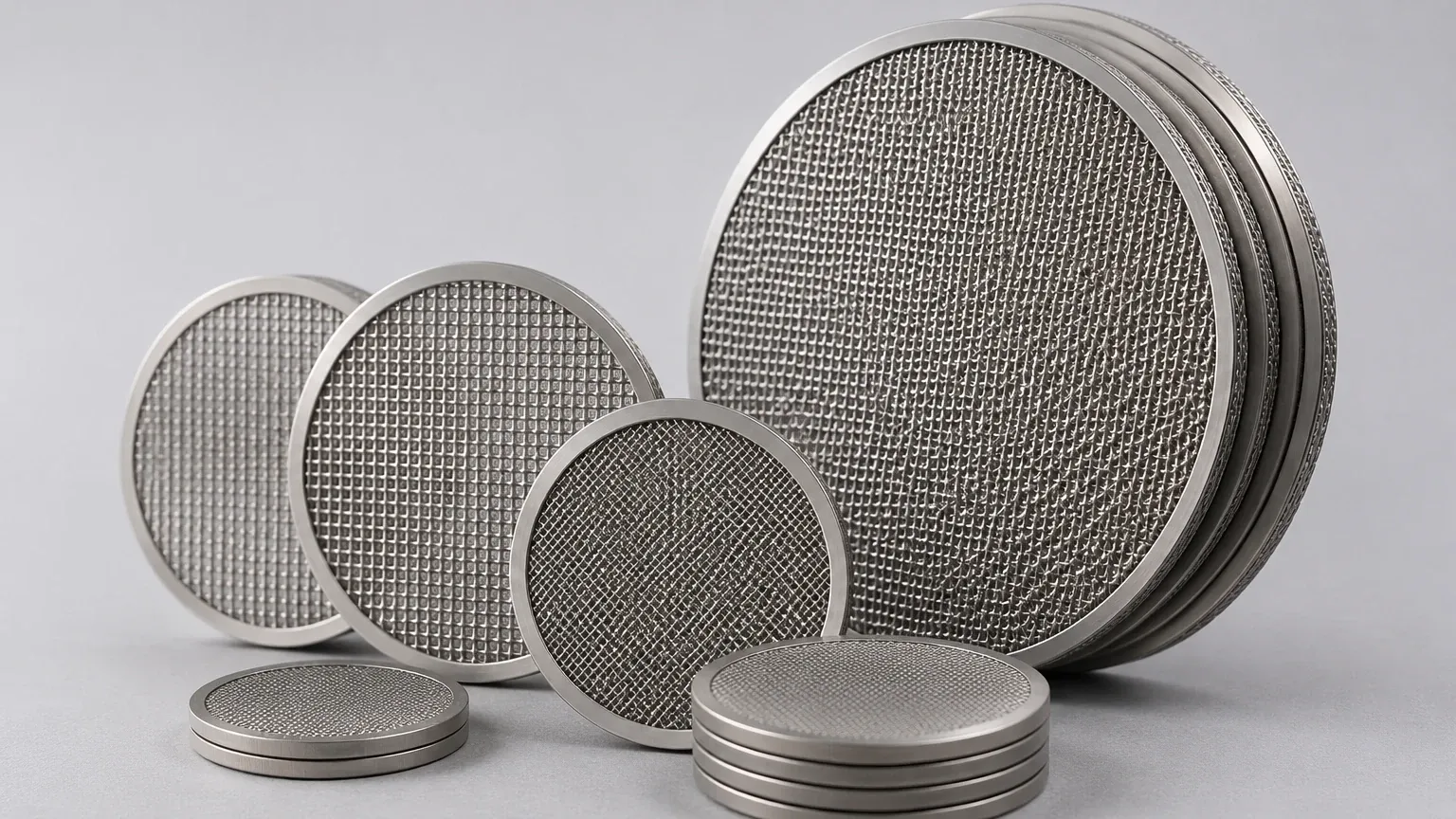
When specifying Filter Discs & Packs, engineers must also consider the construction of the mesh itself. Sintered wire mesh, where multiple layers of mesh are heat-bonded together, provides the most stable V-fold, ensuring that the pore geometry remains constant even under fluctuating pressure loads.
Comparative Analysis: V-Pleated vs. Flat Filter Discs
When evaluating filtration components, engineers often must choose between a standard flat disc and a pleated V-configuration. The decision usually hinges on the specific goals of the process.
Dirt Holding Capacity
A pleated V filter inherently possesses a higher dirt-holding capacity. In a batch process, this means longer run times between maintenance intervals. For continuous processes, it translates to smaller housing sizes, as a smaller pleated element can handle the same flow rate as a much larger flat element.
Flow Rate and Flux
Flux, or the flow rate per unit area, is optimized in V filters. Because the total area is higher, the system can handle higher total throughput without exceeding the critical pressure drop threshold. This is particularly advantageous in hydraulic systems where "v filters" are used to protect sensitive valves from particulate matter while maintaining high-speed fluid transmission.
Cleaning and Reusability
Flat discs are generally easier to clean via manual scraping or simple backwashing. V filters, due to their deep folds, require more sophisticated cleaning techniques, such as ultrasonic cleaning or high-pressure localized back-pulsing. However, the extended service life of a V-configured element often outweighs the added complexity of the cleaning process.
Applications of V-Configured Filter Discs & Packs
The versatility of V-shaped filtration allows it to be integrated into various industrial sectors. The design is particularly effective in applications where the fluid contains a high concentration of deformable or gelatinous particles.
* Polymer and Resin Filtration: In the production of plastics and fibers, V-pleated filter packs are used to remove "gels" and degraded polymer. The high surface area ensures that these sticky contaminants do not immediately blind the filter, which would otherwise cause a production halt.
* Chemical and Petrochemical Processing: V filters are used in catalyst recovery and the filtration of aggressive solvents. The robust stainless steel construction allows the V-folds to withstand the thermal expansion and contraction associated with cyclic temperature changes.
* Food and Beverage: In the filtration of syrups, oils, and juices, pleated metal elements provide a hygienic, high-flow solution that can be sterilized (SIP) and cleaned in place (CIP) more effectively than disposable synthetic filters.
Customization and OEM Considerations for V Filters
For many industrial applications, off-the-shelf filtration components are insufficient. Customization of V filters allows engineers to tailor the performance to the exact rheology of the fluid and the specific contaminants present.
Micron Rating and Layering
Custom V-configured packs can utilize multi-layer mesh designs. A common configuration includes a fine filtration layer protected by coarser drainage layers on both sides. This "sandwich" is then pleated into the V-shape. The drainage layers ensure that fluid can flow freely into and out of the pleat, preventing the mesh from collapsing against itself under pressure.
Edge Sealing and Support Structures
The integrity of a V filter is only as good as its seals. For filter packs, edge sealing via aluminum or stainless steel rims is common to prevent bypass. In larger V-bank style metal filters, internal support frames or perforated metal cores are used to maintain the V-shape against high differential pressures. When sourcing these components, it is vital to confirm that the manufacturing process—whether TIG welding, plasma welding, or resistance welding—is compatible with the end-use environment.
Maintenance and Longevity in Industrial Operations
Investing in high-quality V filters is a strategy for reducing the Total Cost of Ownership (TCO). While the initial capital expenditure for a pleated stainless steel element is higher than for a flat disc or a synthetic cartridge, the longevity and cleanability offer long-term savings.
Identifying Wear and Bypass Risks
Engineers should monitor the rate of pressure increase over time. A sudden drop in differential pressure often indicates a mechanical failure in a V-fold or a breach in the edge seal, leading to fluid bypass. Regular inspection of the pleat roots—the bottom of the V—is necessary, as this is where mechanical stress and contaminant accumulation are highest.
Cleaning Protocols
To maximize the life of stainless steel V filters, a proactive cleaning schedule is recommended. Ultrasonic cleaning is particularly effective for pleated media, as the cavitation bubbles can reach deep into the V-folds to dislodge embedded particles. Chemical cleaning with surfactants or solvents may also be required depending on the nature of the contaminant (e.g., carbonized resins or organic biofilms).
Conclusion: Strategic Selection of V-Configured Solutions
The selection of V filters represents a move toward high-efficiency, high-durability industrial processing. By leveraging the geometric advantages of the V-shape, facilities can achieve higher throughput, cleaner outputs, and reduced downtime. Whether implemented as pleated Filter Discs & Packs or as specialized wedge wire components, these elements are fundamental to modern engineering challenges.
When planning a filtration upgrade or a new system installation, engineers should focus on the specific demands of their application: the chemical compatibility of the stainless steel, the required micron rating, and the anticipated pressure loads. By working with a manufacturer that understands these technical nuances, purchasing teams can ensure they receive a filtration solution that is not only effective but also optimized for the long-term rigors of industrial operation.
