


V Filter Cartridges
In industrial filtration, the demand for high-efficiency, durable, and reusable components has led to the widespread adoption of stainless steel filtration media. Among the various configurations available to engineers, v filter cartridges—specifically those utilizing pleated stainless steel wire mesh—represent a critical solution for applications requiring high surface area and low pressure drop. Unlike disposable polymer filters, these metallic elements offer superior thermal stability and chemical resistance, making them indispensable in sectors ranging from polymer melt filtration to high-pressure hydraulic systems.
Understanding the technical nuances of v filter cartridges is essential for procurement and engineering teams aiming to optimize process uptime and reduce the total cost of ownership. This guide explores the engineering principles, material considerations, and application-specific selection criteria for these advanced filtration components.
Understanding the Engineering Principles of V Filter Cartridges
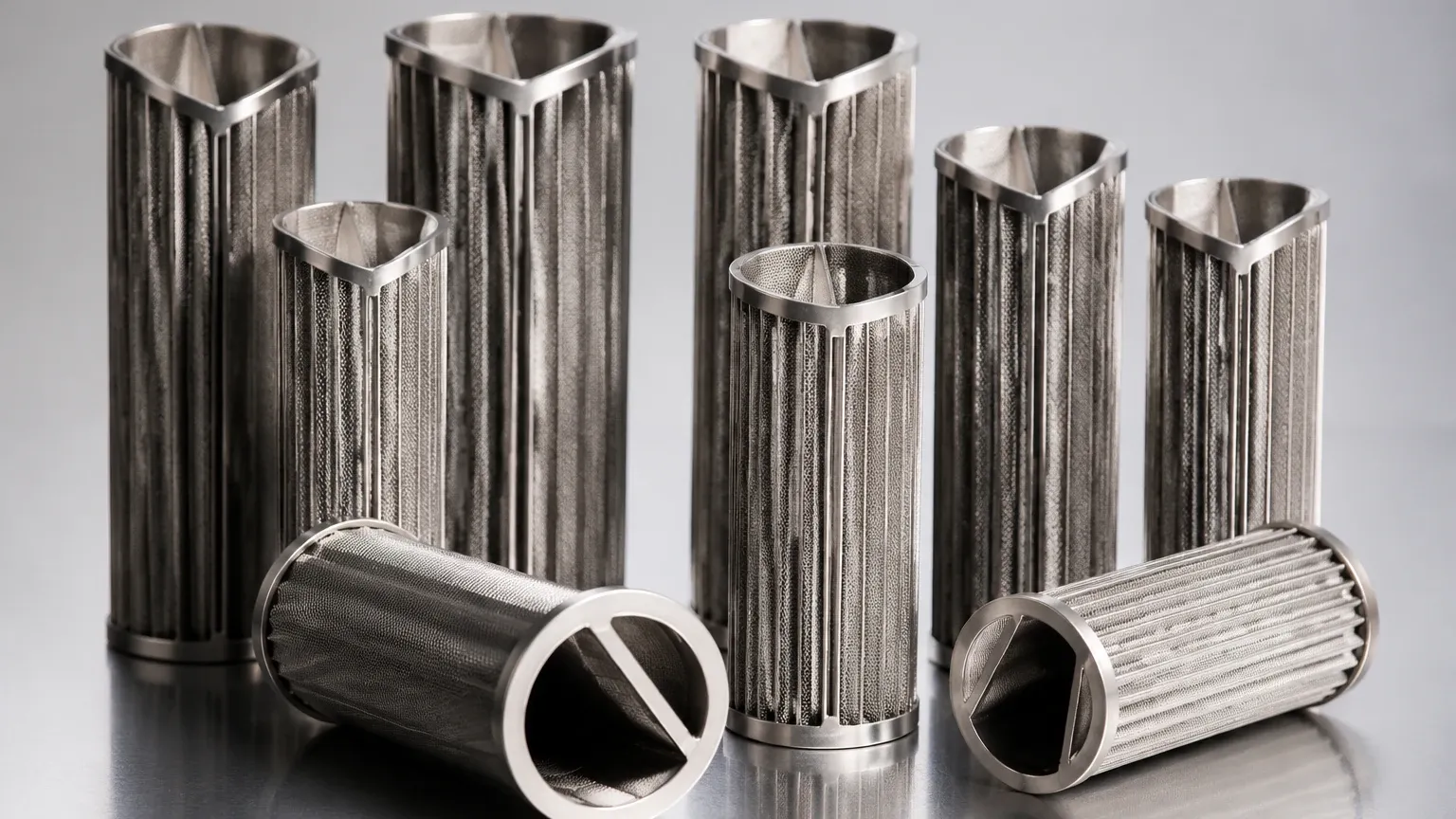
The "V" in v filter cartridges typically refers to the pleated geometry of the filter media. By folding the stainless steel wire mesh into a series of pleats, manufacturers significantly increase the effective filtration area within a standard cylindrical footprint. This design is a strategic response to the physical limitations of flat or plain cylindrical filters.
From an engineering perspective, increasing the surface area serves several functions. First, it reduces the face velocity—the speed at which the fluid passes through the mesh. Lower face velocity results in a lower initial pressure drop (Delta P) across the filter element. Second, a larger surface area provides more space for contaminant loading, which directly extends the service life of the cartridge between cleaning cycles. In high-viscosity applications, such as the processing of resins or heavy oils, the pleated structure of v filter cartridges is often the only viable way to maintain required flow rates without exceeding the structural pressure limits of the system.
Material Selection and Structural Integrity
The performance of v filter cartridges is fundamentally tied to the quality of the stainless steel used in their construction. Most industrial applications utilize AISI 304, 316, or 316L stainless steel. While 304 is suitable for general industrial use, 316L is preferred in chemical and pharmaceutical environments due to its superior resistance to pitting and corrosion, particularly in the presence of chlorides.
Beyond the alloy type, the structure of the mesh itself is critical. Engineers must choose between different weave patterns:
- Plain Weave: Offers a straightforward geometry for general-purpose filtration.
- Dutch Weave: Provides a denser structure with higher mechanical strength, suitable for fine filtration and high-pressure environments.
- Twilled Dutch Weave: Allows for the finest filtration ratings by layering wires in a complex pattern that creates a tortuous path for particles.
To ensure the pleats do not collapse under high differential pressure, v filter cartridges are often engineered with internal support cores and external guard cages. These components are typically manufactured from perforated metal or heavier wire mesh, providing the necessary rigidity to withstand the stresses of high-flow industrial processes.
Comparing V Filter Cartridges with Filter Discs & Packs
While v filter cartridges are designed for high-volume, continuous flow systems, they are part of a broader family of stainless steel filtration solutions that includes Filter Discs & Packs. Choosing between a pleated cartridge and a filter disc often depends on the specific machinery and the nature of the filtration task.
Filter discs and packs are generally used in applications where space is extremely limited or where the filtration process occurs in a flat orientation, such as in plastic extrusion or fiber spinning. In many cases, Filter Discs & Packs serve as the primary media within a larger assembly, or as a final safety screen. Conversely, v filter cartridges are the preferred choice when the system requires a high dirt-holding capacity and a long-term, cleanable solution for pipe-integrated housings.
In some sophisticated systems, these two technologies are used in tandem. For instance, a series of filter packs might provide coarse pre-filtration to protect a downstream high-precision v filter cartridge. Understanding the relationship between these components allows engineers to design multi-stage filtration systems that maximize both purity and component longevity.
Performance Metrics: Filtration Accuracy and Pressure Drop
When specifying v filter cartridges, engineers must focus on two primary performance metrics: micron rating and pressure drop.
Micron Rating: Absolute vs. Nominal
In industrial filtration, it is vital to distinguish between nominal and absolute ratings. A nominal rating refers to the ability of the filter to retain a major percentage (usually 60% to 90%) of particles of a certain size. However, for critical applications in the pharmaceutical or aerospace sectors, an absolute rating is required. This indicates that the filter will retain 99.9% or more of particles above the specified micron size. Stainless steel v filter cartridges are highly valued because their rigid pore structure ensures that the absolute rating remains consistent even under varying pressure conditions, unlike polymer filters which may bypass particles as they deform.
Pressure Drop (Delta P)
The pressure drop is the difference in pressure between the upstream and downstream sides of the filter. A high initial pressure drop limits the remaining operational window before the filter reaches its terminal pressure drop (the point at which it must be cleaned or replaced). By utilizing the pleated design of v filter cartridges, engineers can keep the initial Delta P low, ensuring that the system operates efficiently and that the pump energy consumption is minimized.
Application-Specific Configurations in Industrial Processes
The versatility of v filter cartridges allows them to be customized for a wide range of demanding environments. Each industry brings unique challenges that dictate the final design of the cartridge.
Chemical and Petrochemical Processing
In these environments, filters must withstand aggressive solvents and high temperatures. Stainless steel cartridges are often the only option that can maintain structural integrity at temperatures exceeding 300°C. Custom v filter cartridges for this sector often feature all-welded construction to eliminate the need for adhesives or gaskets that might degrade chemically.
Food and Beverage Industry
Filtration in the food and beverage sector requires compliance with strict hygiene standards. V filter cartridges used here are often designed with "easy-clean" geometries and polished surfaces to prevent bacterial growth. They are used for filtering steam, gases, and liquid ingredients, where the ability to undergo Clean-in-Place (CIP) or sterilization procedures is a major operational advantage.
Hydraulics and Lubrication
High-pressure hydraulic systems require filters that can handle rapid flow fluctuations and high viscosity fluids. The mechanical strength of stainless steel wire mesh in a pleated configuration ensures that the cartridge does not fatigue or shed media into the sensitive hydraulic components, which could otherwise lead to catastrophic equipment failure.
Maintenance, Cleaning, and Longevity of Stainless Steel Elements
One of the most significant advantages of stainless steel v filter cartridges over disposable alternatives is their cleanability. In many industrial settings, the ability to regenerate a filter element significantly reduces long-term operational costs and waste.
Common cleaning methods include:
- Backwashing: Reversing the flow of the fluid to dislodge particles trapped on the surface of the mesh.
- Ultrasonic Cleaning: Using high-frequency sound waves in a cleaning solution to remove fine particles from deep within the pleats and the wire weave.
- Chemical Cleaning: Using specialized solvents or acids to dissolve organic or inorganic deposits that cannot be removed mechanically.
- Burn-off/Pyrolysis: For polymer applications, the filter elements can be placed in a controlled oven to burn off residual plastic, followed by ultrasonic cleaning to restore original permeability.
Engineers should establish a clear protocol for when to clean a cartridge, typically based on reaching a specific differential pressure. Repeated cleaning cycles are possible, but it is important to periodically inspect the mesh for signs of mechanical wear or "blinded" areas that no longer allow flow.
Critical Factors for Custom OEM Filtration Solutions
For many original equipment manufacturers (OEMs), standard off-the-shelf filter elements are insufficient. Customization is often required to meet specific flow rates, housing dimensions, or filtration efficiencies. When partnering with a manufacturer like Kaifil for custom v filter cartridges, several technical details must be confirmed:
1. Fluid Characteristics: Viscosity, density, and chemical composition determine the required mesh type and support structure.
2. Operating Conditions: Maximum operating temperature and pressure, including potential pressure spikes, dictate the wall thickness of the core and the welding techniques used.
3. End-Cap Configuration: Whether the system requires DOE (Double Open End), SOE (Single Open End) with various O-ring styles (e.g., Code 7, Code 3), or threaded connections.
4. Target Particle Profile: Understanding the size and shape of the contaminants helps in selecting the optimal weave pattern and layer count (e.g., single-layer mesh vs. multi-layer sintered mesh).
By addressing these factors during the design phase, engineers can ensure that the resulting v filter cartridges provide reliable, long-term performance in the field. Whether the requirement is for a single high-precision element or a large-scale OEM production run, the focus remains on precision engineering and material integrity. For those seeking specialized components for different equipment geometries, exploring options like Filter Discs & Packs can also provide insights into the diverse ways stainless steel mesh is utilized to solve complex filtration challenges.
