


Engineering Guide to Metal Mesh Filter Media in Industrial Applications
In the landscape of industrial process engineering, the selection of appropriate filtration components is a critical factor in maintaining system integrity, protecting downstream equipment, and ensuring product purity. Among the various options available, metal mesh filter media stands out as a robust, versatile, and highly engineered solution. Unlike disposable polymer or paper filters, stainless steel wire mesh offers a combination of mechanical strength, thermal stability, and precise pore geometry that is essential for demanding environments such as chemical processing, hydraulic systems, and food production.
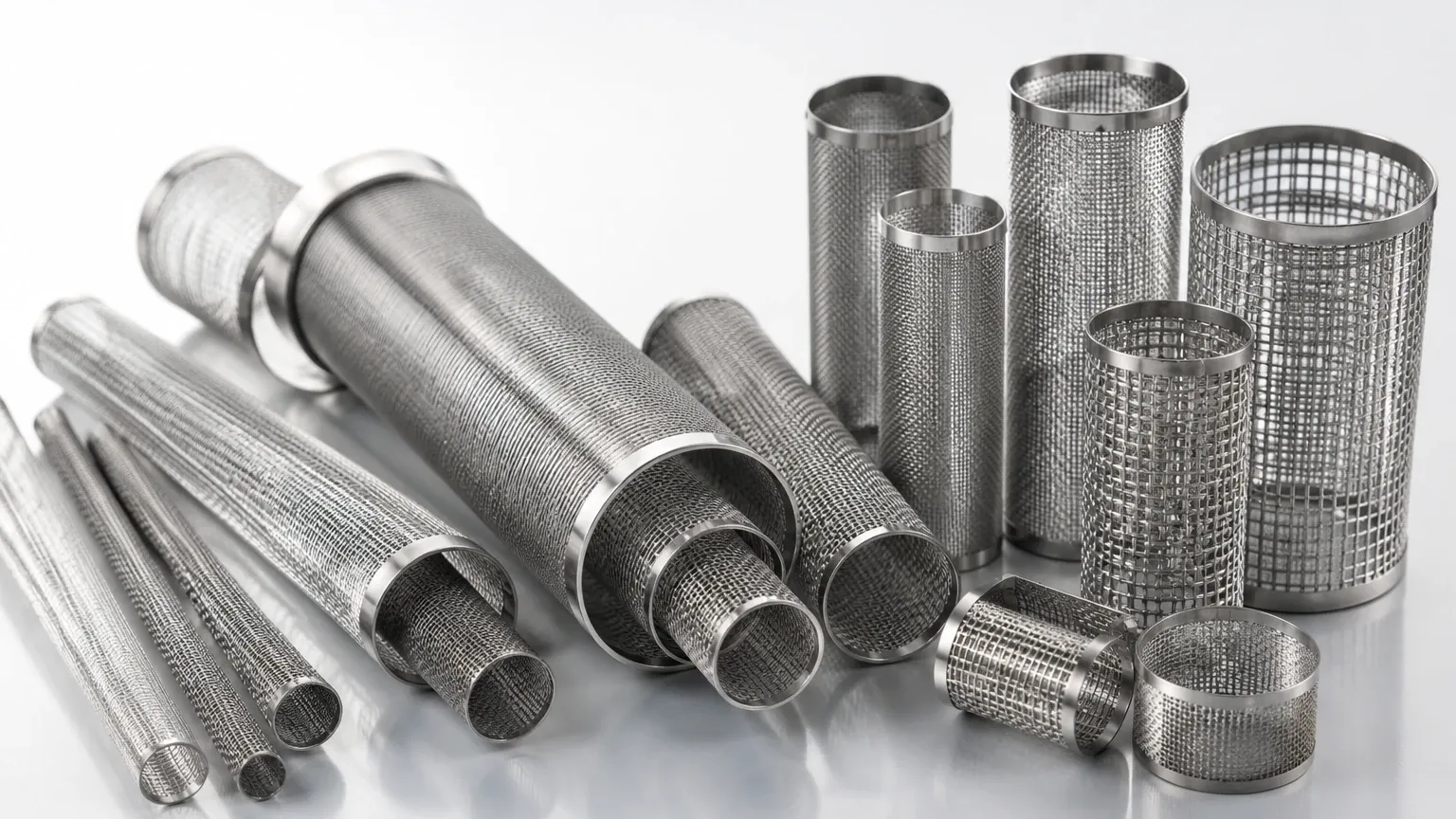
This guide examines the technical specifications, material considerations, and design configurations of Wire Mesh Filter Cylinders & Tubes, providing engineers and procurement professionals with the factual basis required to optimize their filtration processes.
1. Fundamentals of Metal Mesh Filter Media
Metal mesh filter media is manufactured by weaving metallic wires—typically stainless steel—into a structured fabric with precise openings. The performance of the filter is primarily determined by the weave pattern, wire diameter, and the resulting aperture size.
Weave Patterns and Their Characteristics
From an engineering perspective, the weave pattern dictates the flow resistance and particle retention capabilities of the media:
* Plain Weave: The most common and straightforward weave where each warp wire crosses over and under each shute wire. It provides a high percentage of open area and low pressure drop, making it ideal for high-flow applications where coarse to medium filtration is required.
* Twill Weave: Each wire passes over two and under two wires. This allows for the use of heavier wires in a given mesh count, resulting in increased strength and the ability to achieve finer filtration ratings than plain weave.
* Dutch Weave (Plain and Twilled): These weaves utilize different wire diameters for the warp and shute. The wires are tightly packed, creating a "tortuous path" for the fluid. This configuration is essential for high-pressure applications and fine micron ratings, as it offers superior mechanical stability.
* Sintered Wire Mesh: For the most extreme environments, multiple layers of metal mesh filter media are diffusion-bonded (sintered) at high temperatures. This process fuses the wires at their contact points, creating a monolithic structure that will not migrate or deform under high differential pressure.
2. Structural Design of Wire Mesh Filter Cylinders & Tubes
When the media is converted into functional components, such as Wire Mesh Filter Cylinders & Tubes, several mechanical engineering factors must be addressed to ensure the filter can withstand the operational stresses of an industrial system.
Geometric Precision and Seam Integrity
The manufacturing of a filter cylinder involves rolling the mesh and joining the edges. In high-performance filtration, the seam is often the weakest point. Industrial manufacturers like Kaifil utilize advanced welding techniques—such as Plasma Welding or TIG (Tungsten Inert Gas) welding—to create a butt-weld seam that is as strong as the parent material. This ensures that the cylinder maintains its roundness and filtration integrity even under significant backpressure.
Support Structures
In many liquid and gas applications, the metal mesh itself may not have the structural rigidity to resist collapse if the pressure drop ($ΔP$) increases due to cake buildup. Therefore, these filters are often designed with:
* Internal Perforated Cores: Provide the primary structural skeleton.
* Outer Protective Cages: Protect the delicate mesh from physical damage during installation or cleaning.
* Reinforcement Rings: Used in longer tubes to prevent bowing or vibration-induced fatigue.
3. Material Selection: Beyond Standard Stainless Steel
Material compatibility is a non-negotiable boundary in industrial engineering. The choice of alloy for the metal mesh filter media directly impacts the lifespan and safety of the filtration unit.
* AISI 304/304L: The standard choice for general industrial applications. It offers good corrosion resistance and is cost-effective for water treatment and basic hydraulic systems.
* AISI 316/316L: Contains molybdenum, which provides significantly better resistance to pitting and crevice corrosion in chloride-rich environments. This is the industry standard for pharmaceutical, food and beverage, and chemical processing.
* High-Nickel Alloys (Monel, Inconel, Hastelloy): For specialized applications involving extreme temperatures (up to 800°C) or highly aggressive acids, these alloys are used to prevent rapid degradation of the filter media.
Engineers must also consider the "L" grades (Low Carbon) when welding is involved, as these grades prevent carbide precipitation, ensuring the heat-affected zone remains corrosion-resistant.
4. Performance Metrics: Micron Ratings and Flow Dynamics
Selecting the right Wire Mesh Filter Cylinders & Tubes requires a deep understanding of filtration efficiency and fluid dynamics.
Absolute vs. Nominal Micron Ratings
* Nominal Rating: Refers to the ability of the filter to retain a majority percentage (e.g., 90% or 95%) of particles of a specific size. It is an indication of the average pore size.
* Absolute Rating: Refers to the diameter of the largest hard spherical particle that will pass through the filter under specified test conditions. In critical applications, such as protecting high-pressure fuel injectors or sensitive hydraulic valves, an absolute rating is mandatory.
Pressure Drop and Open Area
The "Open Area" is the ratio of the total area of the apertures to the total area of the mesh. A higher open area results in a lower initial pressure drop, which reduces the energy consumption of the pumps. However, a higher open area often means thinner wires, which can compromise the mechanical durability of the filter. Balancing these two factors is a core part of the customization process for OEM filtration solutions.
5. Industrial Applications and Environmental Constraints
The versatility of metal mesh filter media allows it to be deployed across a wide spectrum of industries, each with unique constraints.
* Chemical Processing: Filters must resist aggressive solvents and maintain integrity during exothermic reactions. Stainless steel cylinders are often used as catalyst recovery filters.
* Food and Beverage: Compliance with FDA and EC 1935/2004 standards is required. The smooth surface of stainless steel mesh prevents bacterial growth and allows for Clean-in-Place (CIP) sterilization.
* Hydraulic Systems: High-pressure pulses can cause fatigue in inferior filter materials. Wire mesh tubes provide the necessary fatigue resistance to protect pumps and actuators from metal shavings and environmental contaminants.
* Water Treatment: Used in intake strainers and pre-filtration for RO (Reverse Osmosis) systems to remove sand, scale, and organic debris.
6. Maintenance, Cleaning, and Total Cost of Ownership
One of the primary B2B advantages of stainless steel filtration is the transition from an operational expense (OPEX) model to a capital expenditure (CAPEX) model. While the initial cost of a stainless steel filter is higher than a disposable cartridge, the total cost of ownership (TCO) is often lower due to reusability.
Cleaning Methodologies
Unlike polymer filters that must be discarded once fouled, metal mesh filters can be cleaned and returned to service multiple times. Common methods include:
1. Backwashing: Reversing the flow of the fluid to dislodge the filter cake.
2. Ultrasonic Cleaning: Using high-frequency sound waves in a cleaning solvent to remove fine particles trapped deep within the mesh pores.
3. Chemical Cleaning: Using acids or alkalis to dissolve organic or mineral deposits, provided the mesh material is compatible with the cleaning agent.
4. Burn-off/Pyrolysis: For polymer-based contaminants, heating the filter in a controlled oven can vaporize the blockage without melting the stainless steel.
Replacement Cycles
The replacement cycle for Wire Mesh Filter Cylinders & Tubes is typically determined by the "terminal pressure drop"—the point at which cleaning no longer restores the filter to its original flow capacity. In many industrial settings, a well-maintained metal mesh filter can last for several years, significantly reducing waste and downtime.
7. Engineering Checklist for Procurement
When specifying metal mesh filter media for a new project or as a replacement component, engineers should confirm the following technical parameters with the manufacturer:
1. Fluid Characteristics: Viscosity, density, and chemical composition.
2. Operating Conditions: Maximum operating temperature and normal/peak operating pressure.
3. Filtration Target: Desired micron rating (Absolute or Nominal) and the nature of the contaminants (deformable vs. hard particles).
4. Flow Rate: Minimum and maximum flow requirements to calculate the necessary surface area.
5. Mechanical Interface: End cap configurations (e.g., DOE, SOE, Threaded, Flanged) and sealing materials (Viton, EPDM, PTFE).
By focusing on these factual engineering boundaries, technical teams can ensure that their choice of Wire Mesh Filter Cylinders & Tubes provides reliable, long-term performance in even the most demanding industrial environments. Kaifil's expertise in custom manufacturing ensures that each filtration component is tailored to the specific mechanical and chemical requirements of the application, delivering optimized filtration efficiency and durability.
