


12 Water Filter Cartridges
In industrial water treatment and process engineering, the selection of filtration components is a critical decision that impacts system uptime, product purity, and long-term operational costs. Whether a facility is sourcing a specific quantity, such as 12 water filter cartridges for a scheduled maintenance overhaul, or is seeking specialized 12-inch length stainless steel elements, understanding the technical specifications of these components is essential.
For engineers and procurement professionals, the term "12 water filter cartridges" often refers to one of two scenarios: the procurement of a standard batch size for multi-round filter housings or the specification of a non-standard length for unique industrial equipment. In both cases, the transition from disposable polymeric filters to high-performance stainless steel Filter Cartridges represents a significant shift toward durability and precision.
Engineering Specifications of Industrial Filter Cartridges
Industrial-grade filtration requires materials that can withstand aggressive chemical environments, high temperatures, and significant differential pressures. While polypropylene or pleated paper filters are common in light-duty applications, heavy industrial processes—such as chemical processing, food and beverage production, and pharmaceutical manufacturing—rely on metallic media.
Material Selection: 304 vs. 316L Stainless Steel
The choice of material is the foundation of filter performance. Most high-quality metal cartridges are constructed from either Grade 304 or Grade 316L stainless steel.
* Grade 304: Suitable for general industrial water filtration where corrosion resistance is required but the environment is not highly acidic or saline.
* Grade 316L: The "L" denotes low carbon, which provides superior resistance to intergranular corrosion after welding. This grade is essential for applications involving chlorides, high-salinity water, or aggressive chemical cleaning agents often found in CIP (Clean-in-Place) cycles.
Filtration Media Structures
The internal structure of the cartridge determines its dirt-holding capacity and flow characteristics. Common configurations include:
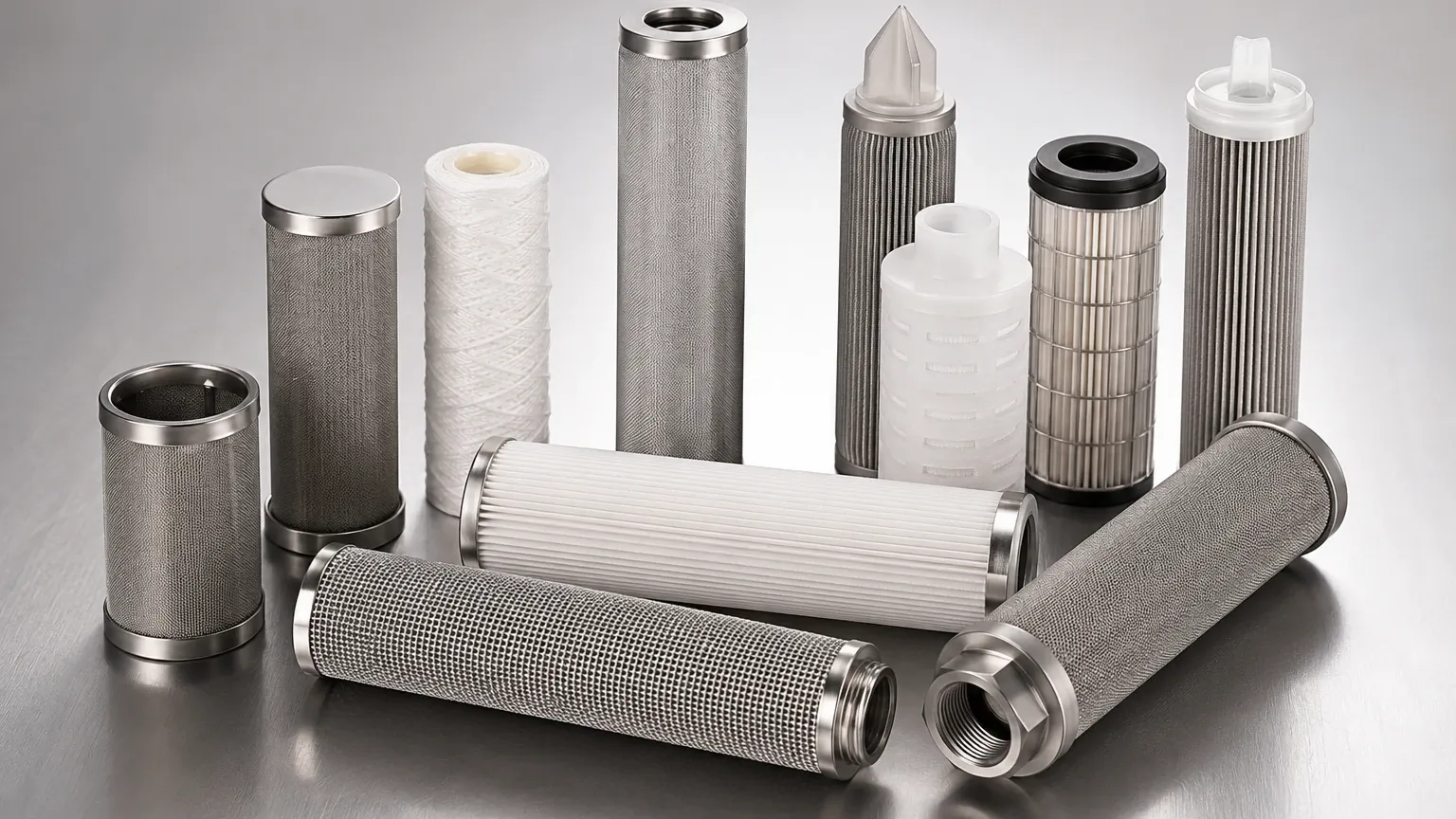
1. Sintered Wire Mesh: Multiple layers of stainless steel wire cloth are bonded through a heat-treatment process (sintering) to create a rigid, stable pore structure. This is ideal for high-pressure applications where pore migration must be avoided.
2. Pleated Metal Mesh: By pleating the mesh, manufacturers significantly increase the effective filtration area within the same footprint. This reduces the initial pressure drop and extends the time between cleaning cycles.
3. Wedge Wire: Constructed from V-shaped profiles, wedge wire cartridges are exceptionally robust and easy to backwash, making them a preferred choice for high-solids loading in water intake systems.
The Role of Standardized Dimensions in System Design
When managing a system that requires 12 water filter cartridges, compatibility with existing filter housings is the primary concern. Industrial housings are typically designed to accommodate standard lengths, usually in increments of 10 inches (e.g., 10", 20", 30", and 40"). However, specialized equipment may require 12-inch or other custom lengths to fit compact footprints or legacy systems.
Understanding End-Cap Configurations
Compatibility is not just about length; it is also about the seal. The most common end-cap configurations for industrial cartridges include:
* DOE (Double Open End): Requires gaskets on both ends to seal against the housing's knife-edge.
* SOE (Single Open End) with 222 or 226 O-Rings: These provide a more secure, leak-proof seal, which is critical in high-purity applications. The 226 configuration often includes a locking tab to prevent the cartridge from unseating during back-pressure surges.
* Threaded Connections: In high-vibration or high-pressure environments, NPT or BSP threaded connections ensure the cartridge remains fixed within the manifold.
Performance Evaluation Criteria for Procurement
When evaluating a batch of 12 water filter cartridges, engineers must look beyond the unit price. The total cost of ownership (TCO) is driven by performance metrics that dictate how often the system must be taken offline.
Micron Rating: Absolute vs. Nominal
It is vital to distinguish between nominal and absolute filtration ratings. A nominal rating refers to an approximate efficiency (e.g., 90% of particles at a certain size), whereas an absolute rating implies a much higher efficiency (typically 99.9% or higher) based on standardized glass bead testing or the bubble point test. For critical process water, absolute-rated stainless steel cartridges provide the necessary security to protect downstream equipment like RO (Reverse Osmosis) membranes or high-pressure pumps.
Differential Pressure ($ΔP$)
The clean pressure drop across a filter cartridge is a key indicator of energy efficiency. A high initial $ΔP$ means the pump must work harder from the start, leaving less headroom for the filter to load with contaminants. Stainless steel pleated cartridges are often engineered to maximize surface area, thereby minimizing the initial $ΔP$ and allowing for a longer service life before reaching the terminal pressure drop (the point at which the filter must be cleaned or replaced).
Why Industrial Applications Favor Stainless Steel Over Polymeric Options
While the initial investment for 12 stainless steel cartridges is higher than for 12 disposable polypropylene filters, the long-term benefits in industrial settings are substantial.
1. Thermal Stability: Polymeric filters often lose structural integrity or experience pore bypass when temperatures exceed 60°C (140°F). Stainless steel cartridges can operate effectively at temperatures exceeding 300°C, depending on the seal material used.
2. Chemical Compatibility: Many process waters contain trace solvents, oils, or cleaning chemicals that can degrade plastic fibers. Stainless steel is inert to a vast range of industrial chemicals.
3. Cleanability and Reuse: Disposable filters represent a continuous waste stream. Stainless steel cartridges can be cleaned via backwashing, ultrasonic baths, or chemical soaking, allowing them to be reused for years. This is a critical factor for facilities aiming to reduce their environmental footprint and waste disposal costs.
Common Risks in High-Volume Filter Procurement
Ordering a set of 12 water filter cartridges without verifying technical details can lead to several operational risks:
* Bypass Leakage: If the O-rings or gaskets are not compatible with the process fluid, they may swell or degrade, allowing unfiltered water to bypass the cartridge.
* Structural Collapse: In systems with high viscosity fluids or sudden pressure spikes, a poorly constructed cartridge may collapse. High-quality metal filters include a perforated inner core to provide the necessary hoop strength.
* Media Migration: In low-quality sintered filters, individual wires or particles of the media can break off and enter the filtrate. This is why sourcing from a manufacturer with rigorous quality control and material certification is essential.
Maintenance and Replacement Cycles
For a system utilizing 12 water filter cartridges, a structured maintenance schedule is the best way to prevent unplanned downtime.
Monitoring Pressure Gauges
Differential pressure gauges should be installed upstream and downstream of the filter housing. A common rule of thumb is to initiate a cleaning cycle when the $ΔP$ reaches 15-20 psi (approx. 1.0-1.4 bar), depending on the pump's curve and the cartridge's structural limits.
Cleaning Procedures for Stainless Steel Cartridges
When the cartridges reach their terminal pressure drop, they should be removed and cleaned.
* Ultrasonic Cleaning: High-frequency sound waves create cavitation bubbles that dislodge fine particles trapped deep within the mesh layers.
* Chemical Cleaning: Soaking in caustic or acidic solutions can dissolve organic or mineral scaling. It is imperative to ensure the cleaning agent is compatible with the 304 or 316L steel.
* Backpulsing: In automated systems, a brief pulse of clean fluid or air in the reverse direction can clear the surface of the media without removing the cartridges from the housing.
Confirming Requirements Before Purchase
Before finalizing an order for 12 water filter cartridges, technical teams should confirm the following data points with their supplier:
1. Flow Rate per Cartridge: Ensure the total flow of the system divided by 12 does not exceed the recommended flux rate for the specific micron rating.
2. Operating Temperature and Pressure: Confirm that both the media and the seals (Viton, EPDM, Silicone, or PTFE) are rated for the maximum expected conditions.
3. Fluid Characteristics: Provide the supplier with information regarding the viscosity, pH, and the nature of the solids (e.g., deformable vs. hard particles).
4. Certification Needs: For food, beverage, or pharmaceutical applications, ensure the materials meet FDA or relevant international standards for food contact.
Conclusion
Selecting the right Filter Cartridges is a balance of engineering precision and economic foresight. Whether the requirement is for a standard 10-inch element or a specialized 12-inch configuration, the move toward stainless steel media offers industrial users a robust, cleanable, and high-performance solution. By focusing on material grade, structural integrity, and proper sealing mechanisms, engineers can ensure that their filtration systems operate at peak efficiency, protecting both the product quality and the downstream infrastructure.
