


Cleaning Pool Filter Cartridges
In commercial water management and industrial-scale aquatic facilities, the maintenance of filtration systems is a critical operational requirement. The efficiency of water circulation, chemical balance, and clarity depends heavily on the integrity of the filtration media. While various filtration methods exist, pleated cartridges are widely favored for their high surface area and ability to capture fine particulates. However, the performance of these systems is not static; it degrades as contaminants accumulate. Understanding the technical nuances of cleaning pool filter cartridges is essential for facility engineers and maintenance professionals seeking to optimize system uptime and reduce total cost of ownership.
Effective maintenance goes beyond simple rinsing. It requires an understanding of the relationship between pressure differentials, flow rates, and the physical properties of the filter media. This guide provides a technical overview of the cleaning process, the indicators for intervention, and the engineering considerations for selecting and maintaining high-performance Filter Cartridges.
The Engineering Behind Pleated Filtration
To understand why cleaning pool filter cartridges is necessary, one must first look at the design of the cartridge itself. Most commercial pool filters utilize a pleated synthetic media, typically polyester, wrapped around a central core. The pleating is an engineering solution to maximize the surface area within a compact cylindrical footprint.
In a filtration cycle, water is forced through the media from the outside in. As particulates are trapped on the surface (surface filtration) and within the fibers (depth filtration), the available pathways for water diminish. This leads to an increase in hydraulic resistance. In industrial terms, this is measured as a "pressure drop" or "delta P" (ΔP). As the ΔP increases, the pump must work harder to maintain the required flow rate, leading to increased energy consumption and potential mechanical strain on the circulation system.
Indicators for Maintenance: Pressure and Flow Rates
For a maintenance engineer, the decision to initiate cleaning pool filter cartridges should be data-driven rather than based on a fixed calendar schedule. The two primary metrics are the system’s pressure gauge and the flow meter.
The 8-10 PSI Rule
Every filtration system has a "clean" baseline pressure, which is the gauge reading when the filters are new or freshly cleaned. As debris builds up, the pressure rises. The industry standard for intervention is when the pressure increases by 8 to 10 pounds per square inch (PSI) over the baseline. Operating beyond this threshold risks "bridging," where debris is forced so deeply into the media that it cannot be removed, or worse, causing a structural failure of the cartridge core.
Flow Rate Diminishment
In commercial applications where turnover rates are regulated by health codes, monitoring the flow rate (GPM – Gallons Per Minute) is equally vital. A significant drop in flow, even if the pressure hasn't reached the 10 PSI limit, indicates that the media is becoming blinded by fine oils or scale. This is a common scenario in high-occupancy commercial pools where body oils and lotions accumulate more rapidly than organic debris.
Technical Steps for Cleaning Pool Filter Cartridges
When the system indicates that maintenance is required, the cleaning process must be executed with precision to avoid damaging the delicate pleats of the filter cartridges.
1. System Deactivation and Depressurization: The circulation pump must be locked out, and the air relief valve opened to bleed pressure from the filter tank. Attempting to open a pressurized vessel is a significant safety hazard.
2. Cartridge Extraction and Inspection: Once the tank is drained, the cartridges are removed. At this stage, a visual inspection is critical. Engineers should look for "pleat bunching," which indicates high-pressure stress, or any signs of fiber migration.
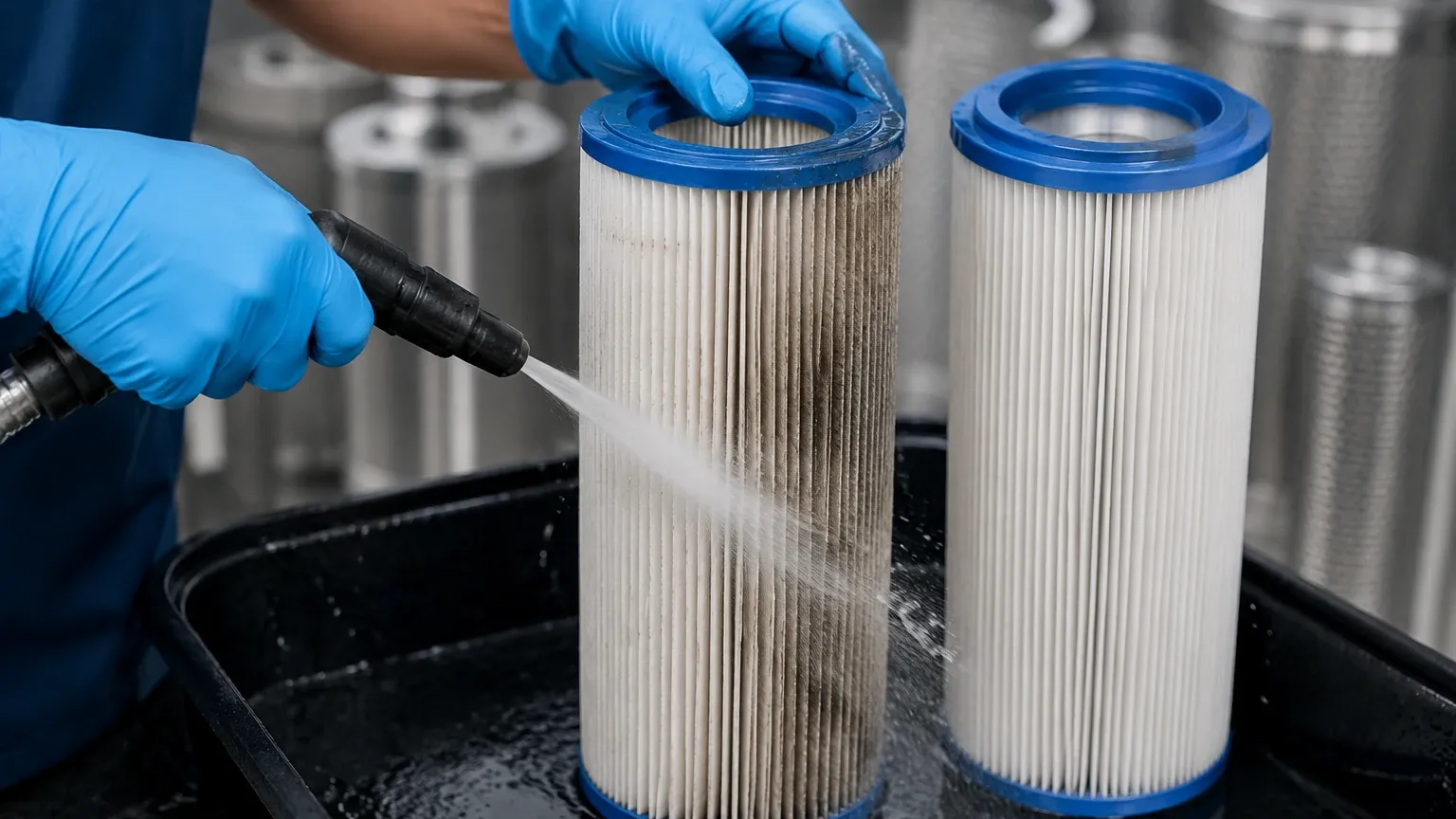
3. Initial Hydraulic Rinsing: Using a standard hose with a specialized nozzle, debris should be washed away starting from the top and working downward. The hose should be held at a 45-degree angle to the pleats. It is a common mistake to use a high-pressure power washer; the concentrated stream can tear the synthetic fibers, effectively destroying the micron rating of the media and allowing contaminants to bypass the filter.
4. Degreasing (Chemical Soak): Rinsing only removes physical debris. To remove oils, the cartridges must be soaked in a specialized degreasing solution or a mixture of water and trisodium phosphate (TSP). This step is essential because oils act as an adhesive, trapping fine particulates that water alone cannot dislodge.
5. Acid Bath for Mineral Scale: In regions with hard water, calcium carbonate scale can build up on the media, making it feel stiff or brittle. A mild muriatic acid solution (typically 1 part acid to 20 parts water) can dissolve these deposits. Note: Degreasing must always precede the acid bath. If acid is applied to an oily filter, the oil can be "set" into the fibers, creating a permanent barrier.
Risks of Improper Maintenance and Media Fatigue
While cleaning pool filter cartridges extends their service life, it is a process of diminishing returns. Each cleaning cycle, especially those involving chemical soaks, slightly alters the structure of the media.
Fiber Fuzzing and Pore Expansion
Over time, the synthetic fibers begin to break down, a phenomenon known as "fuzzing." This increases the surface area for debris to stick to, making subsequent cleanings less effective. Furthermore, the physical stress of water pressure and cleaning can cause the pores in the media to expand, reducing the filtration efficiency. A cartridge that originally had a 20-micron nominal rating may degrade to a 30 or 40-micron rating over several years of use.
Structural Failure
In high-pressure industrial or commercial environments, the plastic end caps or the inner support core of the cartridge may crack. Any breach in the structural integrity of the cartridge allows unfiltered water to bypass the media entirely, rendering the filtration system useless. During the cleaning process, engineers must verify that the gaskets and O-rings are pliable and that the end caps show no signs of stress whitening.
When to Replace: The Cost-Benefit Analysis
At some point, the labor and chemical costs associated with cleaning pool filter cartridges exceed the value of the cartridge itself. A cartridge should be replaced if:
* The baseline pressure after a thorough cleaning remains 5 PSI or more above the original "new" baseline.
* The media shows visible signs of tearing or "thinning."
* The pleats have permanently collapsed or bunched together, reducing effective surface area.
* The water clarity (turbidity) fails to reach desired levels despite proper chemical balance.
For commercial facilities, maintaining a rigorous log of cleaning dates and pressure readings is the best way to determine the optimal replacement cycle. Typically, high-quality synthetic cartridges in a commercial setting last between 12 and 24 months, depending on the bather load and water chemistry.
Industrial Alternatives: Stainless Steel Filtration
While polyester pleated cartridges are the standard for residential and light commercial pools, heavy-duty industrial water treatment and high-demand commercial aquatic systems often require more robust solutions. This is where the expertise of manufacturers like Kaifil becomes essential.
In many industrial filtration applications, synthetic media is replaced by stainless steel Filter Cartridges. These metal components offer several engineering advantages over their synthetic counterparts:
* Durability: Stainless steel mesh can withstand significantly higher pressure differentials without collapsing or tearing.
* Chemical Resistance: Metal filters are impervious to the degradation caused by high chlorine levels, ozone, or aggressive cleaning chemicals that would eventually brittle synthetic fibers.
* Backwash Capability: Unlike most pool cartridges which must be manually removed and hosed down, many stainless steel filter designs allow for automated backwashing, significantly reducing labor costs and system downtime.
* Precision Filtration: Stainless steel wire mesh can be manufactured to extremely tight tolerances, providing absolute filtration ratings that do not drift over time.
For facility managers looking to upgrade from standard pool-grade equipment to industrial-strength filtration, transitioning to customized metal filter components can provide a much longer service life and more consistent water quality.
Conclusion
Cleaning pool filter cartridges is a fundamental aspect of water system maintenance that requires a technical approach. By monitoring pressure differentials, using the correct chemical treatments, and performing regular structural inspections, maintenance teams can ensure their filtration systems operate at peak efficiency. However, it is equally important to recognize the limitations of synthetic media. As systems scale in complexity and demand, the move toward professional-grade, durable filtration solutions—such as those provided by Kaifil—becomes a strategic investment in long-term operational reliability.
For engineers and purchasing teams, selecting the right filter media is a balance of initial cost, maintenance requirements, and performance expectations. Whether maintaining a commercial pool or an industrial water loop, the principles of surface area, pressure management, and material integrity remain the cornerstones of effective filtration.
