


Different Types of Water Filter Cartridges
In industrial water treatment and process engineering, the selection of filtration components is a critical decision that impacts equipment longevity, product quality, and operational overhead. Filter cartridges serve as the primary functional unit in many pressurized filtration systems, designed to remove suspended solids, contaminants, and particulates from liquid streams. Understanding the different types of water filter cartridges is essential for engineers and procurement teams who must balance filtration efficiency with mechanical durability and chemical compatibility.
Industrial filtration requirements vary significantly across sectors such as chemical processing, food and beverage production, and pharmaceutical manufacturing. A filter that performs optimally in a low-pressure municipal water system may fail catastrophically in a high-temperature hydraulic circuit or a corrosive chemical line. This guide examines the technical specifications, material constructions, and application-specific advantages of various cartridge designs to assist in informed decision-making.
Classification by Filtration Mechanism: Depth vs. Surface Filtration
To categorize the different types of water filter cartridges, it is first necessary to distinguish between the two primary mechanisms of particulate capture: depth filtration and surface filtration.
Depth Filter Cartridges
Depth filters are designed to capture particles throughout the entire thickness of the filter medium. These cartridges typically feature a graded density structure, where the outer layers catch larger particles and the inner layers trap finer contaminants. Common examples include:
* String-Wound Cartridges: Manufactured by winding yarn (cotton, polypropylene, or fiberglass) around a central core. The winding pattern creates diamond-shaped openings that narrow toward the center.
* Melt-Blown Cartridges: Created by thermally bonding polypropylene fibers. They offer high dirt-holding capacity and are generally used as pre-filters to protect more expensive downstream components.
While effective for high-sediment loads, depth filters are typically disposable and cannot be cleaned once the internal matrix is saturated.
Surface Filter Cartridges
Surface filters trap contaminants on the exterior surface of the medium. These are often used when precise micron ratings and high flow rates are required. The most common configuration is the pleated design, which increases the available surface area within a standard cartridge footprint. Surface filters can be made from polymers or, for more demanding applications, stainless steel wire mesh. Unlike depth filters, many surface filters—particularly metal variants—can be cleaned and reused through backwashing or ultrasonic cleaning.
Stainless Steel Filter Cartridges: The Industrial Standard
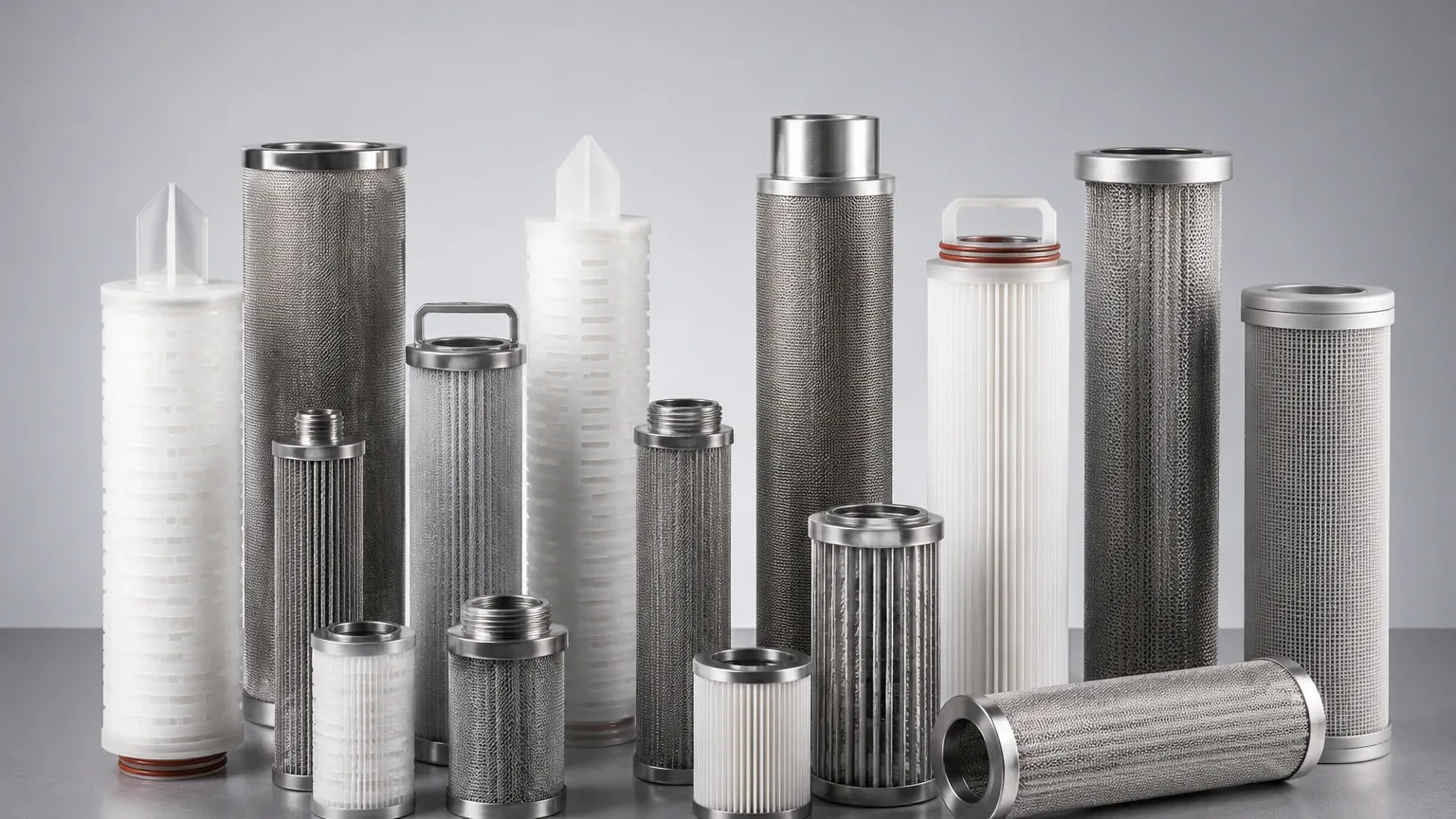
For demanding industrial environments, stainless steel Filter Cartridges represent the pinnacle of durability and performance. Unlike polymer-based filters, metal cartridges are engineered to withstand extreme temperatures, high differential pressures, and aggressive chemical solvents.
Sintered Metal Mesh Cartridges
Sintering is a process where multiple layers of stainless steel wire mesh are bonded together through heat and pressure without the use of binders. This results in a robust, porous structure with fixed pore sizes. Sintered cartridges offer excellent mechanical strength and are ideal for high-pressure applications where media migration must be avoided.
Pleated Metal Cartridges
By pleating stainless steel wire cloth, manufacturers can significantly increase the filtration area. This design is particularly effective for high-flow water systems where a low initial pressure drop is required. Pleated metal cartridges provide absolute filtration ratings and are widely used in the pharmaceutical and food industries due to their ability to be sterilized via steam-in-place (SIP) or autoclaving.
Wedge Wire Cartridges
Constructed from V-shaped stainless steel profiles welded onto support rods, wedge wire cartridges are exceptionally resistant to clogging. They are primarily used in heavy-duty industrial water intake and wastewater treatment where backwashing is a frequent requirement of the process cycle.
Comparing Different Types of Water Filter Cartridges by Material
The material of construction dictates the cartridge’s resistance to temperature and chemical degradation. When evaluating different types of water filter cartridges, engineers must match the material to the fluid properties.
1. Polypropylene (PP): The most common material for general-purpose water filtration. It offers broad chemical compatibility and is cost-effective but is limited to temperatures below 60°C (140°F) and is susceptible to structural deformation under high pressure.
2. Polyethersulfone (PES) and Nylon: Often used in membrane cartridges for sub-micron filtration in the electronics and pharmaceutical industries. These materials provide high flow rates and low protein binding but are sensitive to certain oxidizing agents.
3. Stainless Steel (304 and 316L): 316L stainless steel is preferred for water filtration involving high salinity or corrosive chemicals due to its superior molybdenum content, which prevents pitting corrosion. These cartridges can operate at temperatures exceeding 300°C and handle differential pressures that would collapse polymer filters.
Engineering Considerations for Selection
Selecting the appropriate cartridge involves more than just choosing a micron rating. Several engineering factors must be calculated to ensure the filtration system operates efficiently.
Micron Rating: Nominal vs. Absolute
* Nominal Rating: An indicative value representing the ability of the filter to retain a percentage (usually 60% to 90%) of particles of a specific size. It is common in depth filtration.
* Absolute Rating: A guarantee that 99.9% or more of particles at the specified micron size will be retained. For critical processes, such as final-stage water purification, absolute-rated pleated cartridges are mandatory.
Flow Rate and Pressure Drop (ΔP)
Every filter cartridge introduces resistance to the flow, known as pressure drop. As the filter accumulates debris, the differential pressure increases. Engineers must ensure that the initial clean pressure drop is low enough to allow for a productive service life before the "terminal pressure drop" is reached, at which point the cartridge must be replaced or cleaned.
Seal and End Cap Configurations
To prevent bypass (where unfiltered water leaks around the cartridge), the seal type must be compatible with the filter housing. Common configurations include:
* Double Open End (DOE): Requires gaskets at both ends; used in standard housings.
* Code 7 (226 O-ring/Fin): Features a locking tab and double O-rings for a high-integrity seal, often used in critical pharmaceutical applications.
* Code 3 (222 O-ring/Flat): A double O-ring seal without the locking tabs.
Maintenance, Replacement, and Total Cost of Ownership
A common mistake in procurement is focusing solely on the initial purchase price of a filter cartridge. The Total Cost of Ownership (TCO) includes the cost of downtime, labor for replacement, disposal fees for contaminated filters, and the energy costs associated with high pressure drops.
Disposable vs. Cleanable Cartridges
In high-volume industrial water applications, the frequent replacement of disposable polymer cartridges can lead to significant waste and operational costs. Stainless steel filter cartridges, while requiring a higher initial investment, often provide a lower TCO over a 2-to-5-year period. Because they can be cleaned through chemical soaking, ultrasonic baths, or back-pulsing, the "cost per gallon filtered" is often lower than that of disposable alternatives.
Monitoring Performance
To optimize the replacement cycle, systems should be equipped with differential pressure gauges. Replacing a cartridge too early wastes remaining capacity, while replacing it too late can cause "breakthrough," where pressure forces contaminants through the media, or leads to pump damage due to excessive cavitation.
Conclusion: Making an Informed Choice
Navigating the different types of water filter cartridges requires a thorough understanding of the specific application's demands. For standard, low-pressure sediment removal, disposable depth filters may suffice. However, for industrial processes where reliability, temperature resistance, and precision are non-negotiable, stainless steel and pleated metal cartridges offer the most robust solution.
When specifying a filter, engineers should confirm the chemical composition of the process fluid, the expected contaminant load, the required flow rate, and the maximum operating temperature. By aligning these variables with the appropriate cartridge technology, facilities can achieve optimized filtration performance, reduce maintenance intervals, and ensure the integrity of their downstream processes.
Download Different Types of Water Filter Cartridges as a PDF
