


Filter Cartridge Medium
In industrial filtration, the selection of the filter cartridge medium is the most critical decision an engineer or procurement specialist will make. The medium determines the efficiency, durability, and chemical compatibility of the entire filtration system. For high-performance environments—such as chemical processing, pharmaceuticals, and food production—the choice often centers on stainless steel and specialized metal alloys due to their superior mechanical properties compared to polymer-based alternatives.
Selecting the appropriate Filter Cartridges requires a deep understanding of how different media behave under varying pressures, temperatures, and fluid dynamics. This guide examines the technical characteristics of various filter cartridge media, providing the data necessary to optimize filtration performance and minimize total cost of ownership.
Types of Filter Cartridge Medium in Industrial Applications
The "medium" refers to the actual material that performs the separation of solids from liquids or gases. While many industries use disposable synthetic fibers, heavy-duty industrial applications rely on metallic media for their longevity and precision.
Stainless Steel Wire Mesh
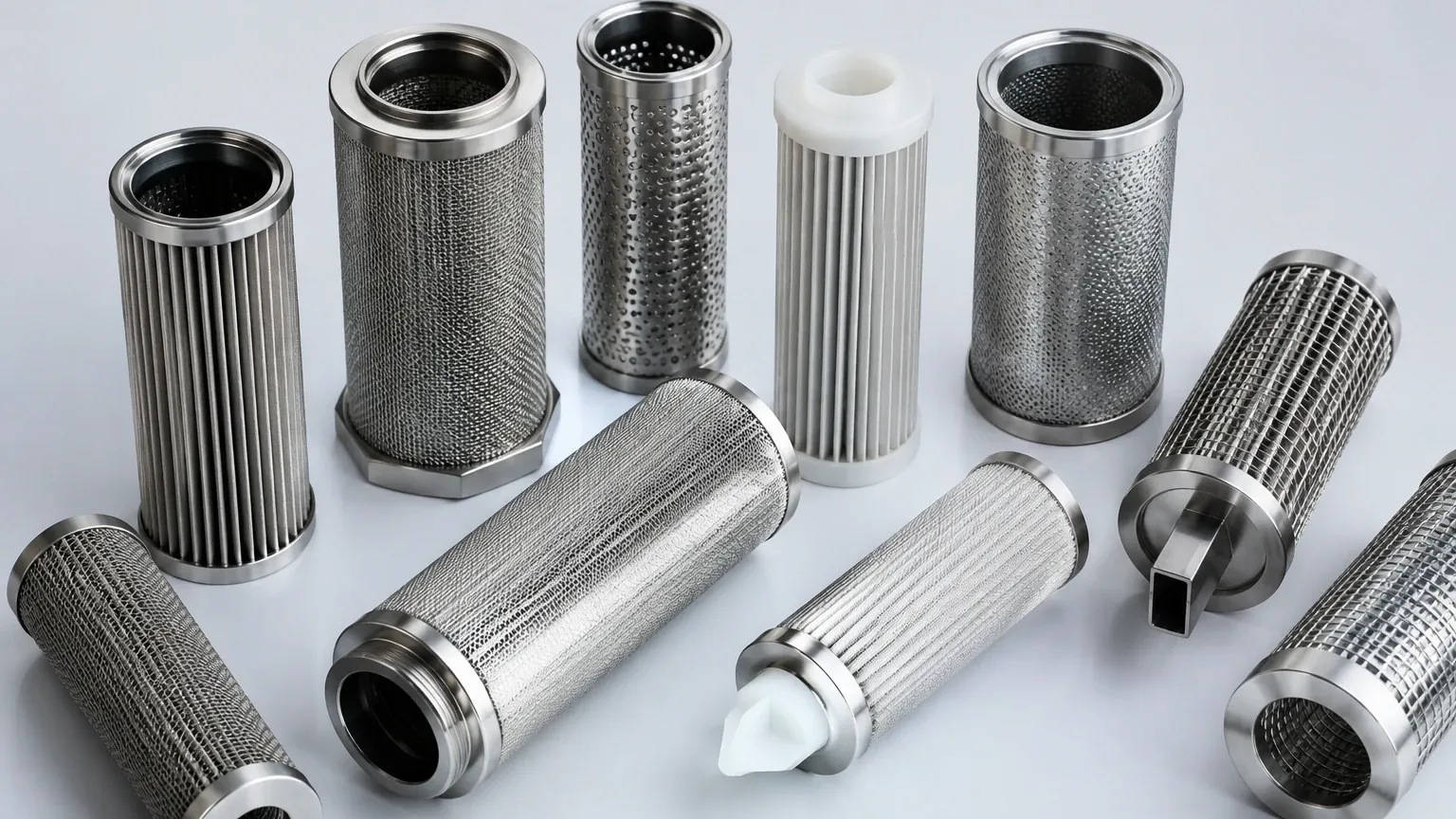
Stainless steel wire mesh is a versatile filter cartridge medium used for surface filtration. It is constructed by weaving individual metal wires into specific patterns. The most common weaves include:
* Plain Weave: A simple over-under pattern providing square openings. It is ideal for high-flow, low-pressure applications where a high percentage of open area is required.
* Dutch Weave: This utilizes larger diameter warp wires and smaller diameter shute wires, resulting in a dense, strong mesh with smaller, more tortuous paths. This is preferred for high-pressure applications requiring fine filtration.
* Twill Weave: This allows for thicker wires and a heavier mesh, providing increased strength for demanding hydraulic or mechanical loads.
Sintered Metal Media
Sintered media are created by bonding layers of wire mesh or metal powders through a heat-treatment process (sintering) without melting the base material. This creates a rigid, porous structure. Sintered filter cartridge medium is characterized by its exceptional mechanical strength and resistance to high differential pressures. It is often used in applications where the medium must remain stable under extreme heat or during aggressive backwashing cycles.
Wedge Wire
Wedge wire, or V-wire, is a robust medium constructed from V-shaped profiles welded onto support rods. While it offers lower filtration precision compared to fine mesh (typically used for particles 50 microns and larger), it provides an extremely smooth surface that is easy to clean, making it ideal for high-viscosity fluids or applications with high solid loading.
Engineering Criteria for Media Selection
When evaluating a filter cartridge medium, engineers must look beyond the micron rating. The performance of the medium is influenced by several physical and chemical factors.
Filtration Rating: Absolute vs. Nominal
Understanding the distinction between absolute and nominal ratings is vital for process integrity.
* Nominal Rating: An arbitrary value indicating the medium's ability to retain a percentage of particles of a certain size (e.g., 90% of 10-micron particles). This is often used for non-critical pre-filtration.
* Absolute Rating: The diameter of the largest hard spherical particle that will pass through the medium under specified test conditions. For critical pharmaceutical or chemical processes, an absolute-rated stainless steel medium is necessary to ensure consistent output quality.
Permeability and Pressure Drop
The permeability of the filter cartridge medium dictates the initial pressure drop across the filter. A medium with high porosity allows for higher flow rates with lower energy consumption. However, there is always a trade-off: finer filtration usually results in higher resistance. Engineers must calculate the "Clean Pressure Drop" to ensure the system’s pumps can maintain the required flow as the medium begins to load with contaminants.
Chemical and Thermal Compatibility
Stainless steel media, specifically grades 304 and 316L, are the industry standards for corrosion resistance. 316L is preferred in environments containing chlorides or acidic solutions due to the addition of molybdenum. Furthermore, unlike polymer media that may soften or degrade at temperatures exceeding 100°C, metallic media can operate effectively at temperatures up to 500°C or higher, depending on the alloy and seal materials.
Performance Metrics: Dirt-Holding Capacity and Lifecycle
The effectiveness of a filter cartridge medium is also measured by its dirt-holding capacity (DHC). This refers to the amount of contaminant the medium can trap before the pressure drop reaches a terminal level, requiring cleaning or replacement.
Surface vs. Depth Filtration
* Surface Media: Wire mesh acts primarily as a surface filter. Contaminants are trapped on the upstream side of the medium. This makes surface media easier to clean via backpulsing or ultrasonic baths.
* Depth Media: Sintered metal powder or multi-layered sintered mesh can act as a depth filter, where particles are trapped within the thickness of the material. This typically offers a higher dirt-holding capacity but can be more challenging to clean thoroughly.
Structural Integrity under Differential Pressure
In many industrial systems, the medium is subjected to high differential pressures as it becomes clogged. If the filter cartridge medium lacks structural integrity, it may deform or "bypass," allowing unfiltered fluid to pass through. Metallic media are often supported by internal cores or external cages to maintain their shape under these stresses.
Maintenance and Reusability of Metallic Media
One of the primary advantages of selecting a high-quality metal filter cartridge medium is reusability. In B2B industrial procurement, the "Total Cost of Ownership" (TCO) often favors permanent stainless steel filters over disposable ones.
Cleaning Methodologies
Because stainless steel is mechanically and chemically robust, it can withstand aggressive cleaning protocols that would destroy synthetic media:
1. Backwashing: Reversing the flow of fluid to dislodge particles from the surface.
2. Ultrasonic Cleaning: Using high-frequency sound waves in a solvent bath to remove fine particles embedded deep within the mesh or sintered pores.
3. Chemical Cleaning: Using acids, alkalis, or solvents to dissolve organic or inorganic scaling.
4. Burn-off/Pyrolysis: In specific polymer-recovery applications, the medium can be heated to burn off organic contaminants, leaving the metal structure intact.
Replacement Cycles
While the initial investment in a stainless steel filter cartridge medium is higher than that of a polypropylene or fiberglass equivalent, the lifespan is significantly longer. A properly maintained stainless steel cartridge can last for years, whereas disposable filters may need replacement weekly or even daily in high-load applications. This reduces waste, labor costs, and downtime.
Customization and OEM Considerations
No two industrial processes are identical, and often, a standard off-the-shelf solution is insufficient. Customizing the filter cartridge medium allows for optimization based on the specific rheology of the fluid and the nature of the contaminants.
Pleated vs. Cylindrical Designs
To increase the available surface area without increasing the footprint of the filter housing, the medium can be pleated. Pleating a stainless steel wire mesh can increase the filtration area by 3 to 10 times compared to a simple cylindrical design. This leads to lower flux rates (flow per unit area), which extends the time between cleaning cycles and improves filtration efficiency.
Multi-Layer Laminates
For specialized applications, manufacturers can create a composite filter cartridge medium by laminating different types of mesh. For example, a very fine inner layer for filtration can be sandwiched between coarser, heavier mesh layers that provide mechanical support and protection. This "sintered mesh laminate" combines the precision of fine weaving with the ruggedness of heavy plate.
Common Risks in Media Selection
Failure to properly match the medium to the application can lead to several industrial risks:
* Media Migration: In low-quality fiber filters, parts of the filter medium itself can break off and contaminate the downstream fluid. This is virtually eliminated when using high-quality sintered or welded stainless steel media.
* Stress Cracking: In high-vibration or high-pressure-pulsation environments, certain media may suffer from fatigue. Selecting a medium with the correct mechanical temper and support structure is essential.
* Incompatibility with Cleaning Agents: While stainless steel is resistant to many chemicals, it can be susceptible to specific agents like concentrated hydrochloric acid. Engineers must confirm that the cleaning chemicals used in the facility are compatible with the selected alloy.
Technical Confirmation Before Purchase
Before finalizing a purchase of Filter Cartridges, purchasing teams and engineers should confirm the following data points with their manufacturer:
1. Fluid Characteristics: Viscosity, density, and chemical composition.
2. Operating Conditions: Normal and maximum operating temperature, as well as maximum allowable differential pressure (PSID).
3. Contaminant Profile: The concentration and particle size distribution of the solids being removed.
4. Cleaning Infrastructure: What cleaning methods are available on-site? This will determine if a surface or depth medium is more appropriate.
5. Regulatory Compliance: Does the medium need to meet FDA, 3A, or other industry-specific sanitary standards?
By focusing on the technical specifications of the filter cartridge medium, industrial operators can ensure a reliable, efficient, and cost-effective filtration process that stands up to the rigors of demanding manufacturing environments.
