


Filter Cartridge Mspa
In the realm of pressurized water systems and specialized fluid handling, the efficiency of a filtration system is dictated by the quality and compatibility of its internal components. While many users encounter the term filter cartridge mspa in the context of portable spa maintenance, the underlying engineering principles of these cartridges share significant commonalities with industrial-grade filtration. For engineers and procurement specialists, understanding the transition from consumer-grade synthetic media to high-performance industrial Filter Cartridges is essential for optimizing system uptime and ensuring fluid purity.
Industrial filtration requires a level of durability and precision that standard paper or non-woven fabric filters often cannot provide. As systems scale in complexity—moving from simple water circulation to chemical processing or high-temperature fluid management—the selection of the filter cartridge becomes a critical engineering decision. This article explores the technical nuances of cartridge filtration, comparing standard media types with industrial stainless steel alternatives, and providing a framework for selection based on technical performance metrics.
Understanding the Role of Filter Cartridges in Water Quality
The primary function of a filter cartridge is the mechanical removal of suspended solids from a liquid stream. In systems utilizing a filter cartridge mspa, the focus is typically on removing organic debris, skin cells, and environmental contaminants to maintain clarity and hygiene. However, in an industrial context, the requirements are far more stringent.
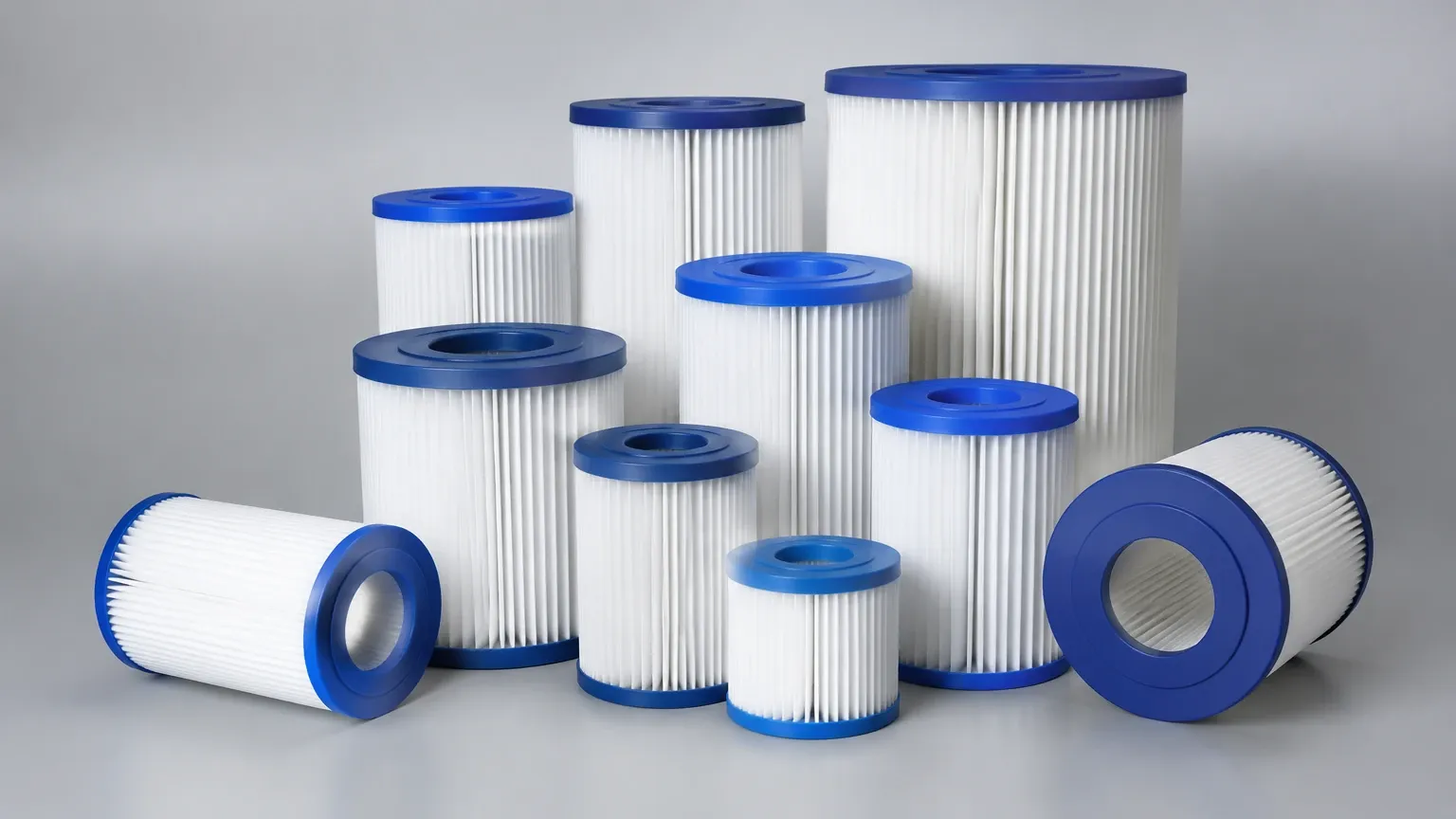
Filtration is generally categorized into surface filtration and depth filtration. Most standard cartridges used in light-duty applications rely on pleated paper or polyester media. These provide a high surface area relative to their size, allowing for high flow rates at low pressure drops. The "pleating" design is a geometric solution to increase the available filtration area within a confined cylindrical volume. When these cartridges become loaded with contaminants, the pressure differential across the media increases, eventually requiring the cartridge to be cleaned or replaced.
For industrial applications, the choice of media is governed by chemical compatibility, temperature resistance, and the required micron rating. While synthetic media are cost-effective for ambient temperature water, they often fail in the presence of aggressive solvents, high-pressure surges, or temperatures exceeding 60°C (140°F). This is where stainless steel wire mesh and sintered metal cartridges become the industry standard.
Technical Comparison: Standard Synthetic vs. Industrial Stainless Steel Cartridges
When evaluating a filter cartridge mspa or similar components for more demanding environments, engineers must weigh the trade-offs between disposable synthetic media and reusable metal media.
1. Material Integrity and Chemical Resistance
Standard cartridges often use polypropylene, polyester, or cellulose. These materials are susceptible to degradation when exposed to UV light, chlorine at high concentrations, or varying pH levels. In contrast, stainless steel cartridges (typically Grade 304 or 316L) offer near-universal chemical compatibility. They do not leach chemicals into the fluid stream and can withstand the harsh cleaning cycles required in food, beverage, and pharmaceutical processing.
2. Temperature and Pressure Thresholds
Synthetic cartridges have a defined thermal ceiling. As temperatures rise, the structural integrity of the plastic core or the media itself may soften, leading to "bypass" where unfiltered liquid escapes through gaps. Industrial stainless steel filter cartridges are designed to operate at temperatures ranging from cryogenic levels to over 300°C. Furthermore, they maintain their shape under high differential pressures (ΔP) that would cause a standard filter cartridge mspa to collapse.
3. Micron Rating and Filtration Efficiency
Filtration accuracy is measured in microns (μm). While consumer-grade filters often provide nominal filtration (meaning they catch a percentage of particles at a certain size), industrial applications often require absolute filtration. Stainless steel wire mesh can be woven to precise specifications, ensuring that no particle larger than the designated micron rating passes through the mesh. This precision is vital in protecting downstream equipment like high-pressure pumps and spray nozzles.
Engineering Considerations for Filter Cartridge Mspa Applications
Integrating a filter cartridge into a system requires more than just matching the physical dimensions. Engineers must calculate the Total Cost of Ownership (TCO) and the operational impact of the filtration cycle.
Flow Rate and Pressure Drop
The flow rate (gallons per minute or cubic meters per hour) is inversely proportional to the filtration fineness. A filter cartridge mspa designed for 10-micron filtration will naturally have a higher clean pressure drop than one designed for 50-micron filtration. If the pump is undersized, the system will fail to reach the necessary turnover rate for effective cleaning. In industrial design, we look at the "Clean ΔP" and the "Terminal ΔP." The terminal ΔP is the point at which the filter must be serviced to prevent system damage or total flow stoppage.
Dirt Holding Capacity
This refers to the total mass of contaminants a cartridge can retain before reaching its terminal pressure drop. Pleated designs, such as those found in high-quality Filter Cartridges, maximize this capacity. However, the nature of the contaminant matters. Slimy or gelatinous particles will blind a surface filter much faster than granular sand or metal shavings. In such cases, a multi-layered stainless steel mesh approach can provide graduated filtration, trapping larger particles on the outer layers and finer particles toward the core.
Maintenance and Longevity: Moving Beyond Disposable Solutions
One of the primary frustrations with standard filter cartridge mspa units is the frequency of replacement. In a B2B or industrial setting, frequent downtime for filter changes translates directly to lost production revenue.
Cleaning vs. Replacement
Disposable cartridges are intended to be discarded. While some users attempt to wash them, the structural fibers of synthetic media often fray or expand during cleaning, which compromises the micron rating. Industrial stainless steel cartridges are designed specifically for cleaning and reuse. They can be backwashed, ultrasonically cleaned, or chemically sanitized. This capability significantly reduces the long-term waste stream and the logistical burden of stocking thousands of replacement units.
Monitoring Performance
To maximize the lifespan of any filter cartridge, the installation of differential pressure gauges is mandatory. By monitoring the pressure before and after the filter housing, maintenance teams can move from a schedule-based replacement (e.g., every two weeks) to a condition-based replacement. This ensures that the cartridge is only serviced when it is actually full, preventing the premature disposal of viable media.
Customization and OEM Solutions for Specialized Filtration
Many industrial systems do not conform to the standard dimensions of a filter cartridge mspa. When a system requires a specific flow path, unique end-cap configurations (such as DOE, SOE, or threaded connections), or non-standard lengths, custom manufacturing becomes necessary.
Customization allows engineers to specify:
- Alloy Selection: Using 316L for salt-water applications or Hastelloy for extreme acid resistance.
- Reinforced Cores: For systems prone to high-pressure spikes or water hammer.
- Specific End-Fittings: Ensuring a leak-proof seal within existing housings without the need for adapters.
- Layered Media: Combining different mesh counts to achieve specific filtration profiles in a single cartridge.
By working with a specialized manufacturer, companies can develop OEM filtration components that are tailored to the exact hydraulic and chemical demands of their equipment, rather than forcing a standard off-the-shelf product to fit a specialized application.
Selection Criteria for High-Performance Filter Cartridges
When selecting a cartridge for a new project or upgrading an existing system, the following checklist should be used to ensure technical suitability:
1. Fluid Characteristics: What is the viscosity, pH, and temperature of the liquid?
2. Contaminant Profile: Are the particles hard, soft, fibrous, or abrasive? What is the particle size distribution?
3. Target Purity: Is the goal to protect a pump (coarse filtration) or to produce high-purity process water (fine filtration)?
4. Operational Environment: Will the filter be subject to vibration, pressure surges, or outdoor exposure?
5. Regulatory Compliance: Does the filter need to meet FDA, 3A, or other industry-specific standards for food or pharmaceutical contact?
For those managing systems that currently rely on standard Filter Cartridges, evaluating these criteria often reveals that a transition to more robust, metallic media can yield significant improvements in both performance and cost-efficiency over the equipment's lifecycle.
Conclusion
Whether you are maintaining a specialized water feature using a filter cartridge mspa or managing a complex industrial cooling loop, the principles of effective filtration remain the same: match the media to the environment, prioritize structural integrity, and monitor pressure differentials. While disposable synthetic cartridges have their place in light-duty, ambient-temperature applications, the rigors of industrial processing demand the durability and precision of stainless steel. By understanding the engineering trade-offs between different cartridge types, technical professionals can ensure their systems operate at peak efficiency with minimal environmental impact and maximum reliability.
