


Filter Cartridge Shower
In industrial processing, the term "shower" refers to high-pressure spray systems used for cleaning, lubricating, cooling, or chemical application. Whether in a paper mill, a food processing plant, or a metal finishing facility, the integrity of these spray systems depends entirely on the quality of the water or fluid being delivered. A single particulate can clog a precision nozzle, leading to uneven spray patterns, product defects, or costly equipment downtime. Implementing a robust filter cartridge shower system—specifically designed for industrial spray headers—is the primary defense against these operational risks.
For engineers and maintenance managers, selecting the right Filter Cartridges for these applications involves understanding the intersection of fluid dynamics, material science, and filtration efficiency. This guide examines the technical requirements of industrial shower filtration and provides an engineering perspective on optimizing system performance.
The Role of Filtration in Industrial Shower Systems
Industrial shower systems, such as those used for felt and wire cleaning in paper manufacturing or wash-down cycles in food production, utilize specialized nozzles designed to deliver specific spray patterns at high velocities. These nozzles often have very small orifices, making them highly susceptible to clogging from suspended solids, scale, or biological growth.
Protecting Precision Spray Nozzles
When a nozzle becomes partially or fully blocked, the resulting "streak" or "void" in the spray pattern can compromise the entire process. In paper mills, this leads to uneven moisture profiles in the paper web. In food processing, it results in inadequate sanitation. A dedicated filter cartridge shower setup ensures that every drop of fluid passing through the header is free of particles larger than the nozzle orifice, typically requiring a filtration grade that is 1/3 to 1/7 the size of the nozzle opening.
Maintaining Consistent Pressure and Flow
Filtration is not just about particle removal; it is about maintaining hydraulic stability. As filters accumulate debris, the differential pressure (ΔP) across the cartridge increases. If the filter is improperly sized or uses inferior media, this pressure drop can starve the shower header, reducing the impact force of the spray and rendering the cleaning cycle ineffective. High-quality stainless steel cartridges provide the structural integrity needed to handle these pressure fluctuations without bypassing or collapsing.
Technical Requirements for Shower Filter Cartridges
Selecting a filter for an industrial shower application requires more than just picking a micron rating. Engineers must evaluate several technical parameters to ensure the filter can survive the demanding environment of a pressurized spray line.
Micron Ratings and Filtration Efficiency
For most industrial shower applications, filtration requirements range from 25 to 150 microns. However, the "nominal" vs. "absolute" rating is a critical distinction. In a shower system, an absolute-rated filter is often preferred to ensure that no particles above the specified size can pass through, especially when protecting expensive tungsten carbide or ceramic nozzles.
Material Compatibility: Stainless Steel vs. Polymers
While plastic or melt-blown cartridges are common in general water treatment, they often fail in industrial shower environments due to:
* High Temperatures: Many industrial wash-down processes use heated water (above 60°C/140°F), which can soften or deform polymer filters.
* Chemical Exposure: Showers often carry surfactants, acidic cleaners, or chlorinated water. Stainless steel (304 or 316L) offers superior resistance to corrosion and chemical degradation.
* Mechanical Stress: High-pressure pulses during pump startup can cause polymer cartridges to fatigue. Stainless steel wire mesh or sintered metal components provide the necessary mechanical strength to withstand these cycles.
Comparing Stainless Steel and Disposable Cartridges
In a B2B procurement context, the choice between reusable stainless steel Filter Cartridges and disposable alternatives is often a matter of total cost of ownership (TCO) rather than just initial purchase price.
Durability in High-Pressure Environments
Industrial shower headers often operate at pressures exceeding 20 bar (300 psi). In these environments, disposable cartridges can experience "channeling," where the fluid forces its way through the media, creating bypass paths for contaminants. Stainless steel cartridges, particularly those with reinforced internal cores, maintain their pore structure even under extreme differential pressure.
Cleanability and Reusability
The primary advantage of stainless steel filtration in shower applications is the ability to clean and reuse the media. Whether through backwashing, ultrasonic cleaning, or chemical soaking, these cartridges can be restored to near-original condition. This eliminates the recurring cost of purchasing, storing, and disposing of spent plastic cartridges, which is particularly beneficial in high-solids applications where filters would otherwise need to be changed daily.
Environmental and Operational Impact
Reducing the waste stream is an increasingly important metric for modern industrial facilities. By moving away from disposables, plants reduce their environmental footprint. Operationally, this also means fewer system shutdowns for filter changes, as stainless steel elements are designed for long-term service life, often lasting several years in a well-maintained system.
Engineering Considerations for Selection and Sizing
To ensure a filter cartridge shower system performs as intended, engineers must perform a thorough analysis of the process conditions. Sizing a filter based solely on pipe size is a common mistake that leads to premature clogging and excessive pressure drop.
Flow Rate and Flux Rate
The flow rate (expressed in GPM or m³/h) must be balanced against the surface area of the filter media. This is known as the flux rate. In shower systems with high particulate loads, a lower flux rate (more surface area) is recommended to extend the time between cleaning cycles. If the flux rate is too high, particles are driven deep into the media, making the filter difficult to clean.
Particle Load and Type
Understanding the nature of the contaminants is vital. Are you filtering out sand and scale (hard particles) or biological slime and fibers (soft, deformable particles)? Hard particles are easily captured by surface filtration like wedge wire or plain square weave mesh. Soft particles may require depth filtration or sintered multi-layer mesh to prevent them from "extruding" through the filter openings under pressure.
Installation: Simplex vs. Duplex Systems
For critical shower systems that cannot be shut down, a duplex filter arrangement is essential. This configuration uses two filter housings connected by a diverter valve. When the primary filter reaches its maximum differential pressure, the flow is switched to the secondary filter, allowing the first to be cleaned or replaced without interrupting the spray process.
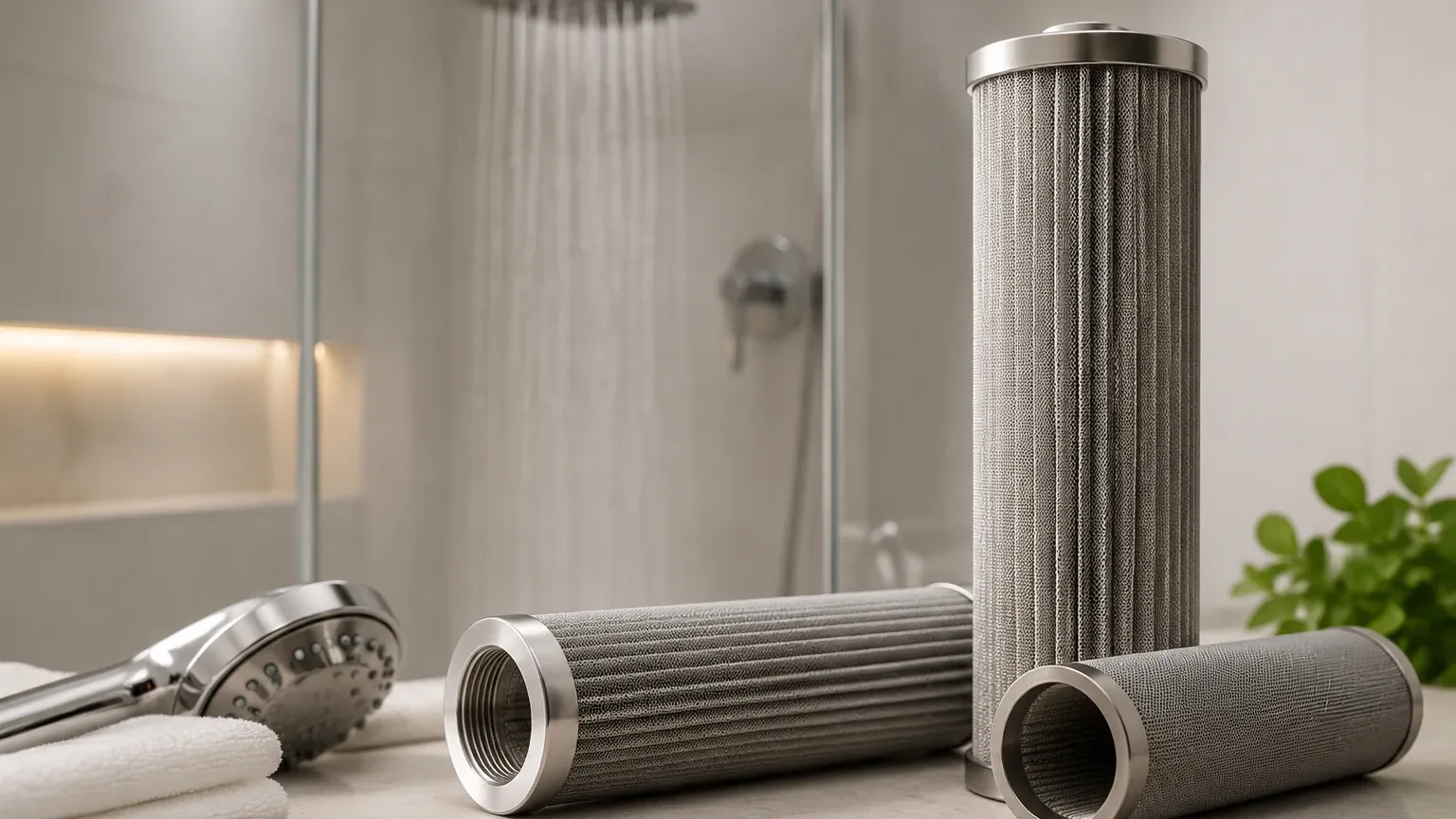
Maintenance and Cleaning Protocols
The longevity of a filter cartridge in a shower application is directly tied to the maintenance regime. A proactive approach prevents the "blinding" of the filter media, where contaminants become permanently embedded.
Monitoring Differential Pressure
Every industrial shower filter should be equipped with upstream and downstream pressure gauges. A common industry standard is to initiate a cleaning cycle when the differential pressure reaches 0.7 to 1.0 bar (10-15 psi). Waiting until the pressure drop is higher can compact the debris, making manual cleaning much more difficult.
Manual vs. Automated Cleaning
In systems with high solids loading, automated backwashing filters are often used. These systems use a portion of the filtered fluid to flush the debris out of the cartridge and into a waste line. For lower-load applications, manual cleaning of stainless steel cartridges using a high-pressure water gun or a mild detergent bath is usually sufficient. It is important to avoid using wire brushes or abrasive tools on fine mesh cartridges, as this can damage the precision-woven wires and alter the micron rating.
Customization Options for Specialized Industrial Showers
No two industrial processes are identical, and standard off-the-shelf filters often fall short in specialized shower applications. Customization allows engineers to tailor the filtration solution to the specific geometry and demands of their equipment.
End Cap Configurations
Filter housings vary significantly between manufacturers. Custom stainless steel Filter Cartridges can be engineered with specific end caps—such as Code 7 (226 O-rings), DOE (Double Open End), or threaded NPT fittings—to ensure a leak-proof seal within existing housings. A proper seal is critical; even a small bypass can allow enough debris through to clog a shower nozzle.
Reinforced Cores and Outer Guards
In applications subject to extreme hydraulic shock or "water hammer," standard cartridges may buckle. Custom filters can be built with heavy-gauge perforated inner cores and outer shrouds. These components protect the delicate filtration mesh from mechanical damage while providing the structural support necessary for high-pressure backpulsing.
Multi-Layer Sintered Structures
For applications requiring both high strength and fine filtration, multi-layer sintered mesh is an ideal choice. By bonding multiple layers of wire cloth together through a heat-and-pressure process, manufacturers can create a filter medium that combines a fine filtration layer with several support and drainage layers. This results in a cartridge that is exceptionally durable and easy to clean.
Conclusion: Optimizing Your Shower Filtration Strategy
An effective filter cartridge shower system is an investment in process stability. By moving beyond basic filtration and considering the engineering nuances of material selection, flow dynamics, and cleanability, industrial facilities can significantly reduce maintenance costs and improve product quality.
Stainless steel Filter Cartridges provide the reliability and performance required for these demanding applications. When properly sized and maintained, they protect the precision components of the shower header, ensure consistent spray performance, and offer a sustainable, long-term solution for industrial fluid handling. For engineers tasked with maintaining these systems, the focus should always remain on the total lifecycle value and the technical compatibility of the filter with the specific rigors of the industrial environment.
