


Filter Element Water
In industrial water treatment and process engineering, the performance of a system is fundamentally defined by its internal components. The term "filter element water" refers to the replaceable, functional core of a filtration housing designed to remove suspended solids, particulates, and contaminants from aqueous streams. Unlike residential water filters, industrial-grade water filter elements must withstand high flow rates, significant pressure differentials, and, in many cases, corrosive chemical environments or extreme temperatures.
Selecting the correct filter element for water applications requires a deep understanding of fluid dynamics, material science, and the specific requirements of the downstream process. Whether the goal is protecting sensitive reverse osmosis (RO) membranes, ensuring the purity of food and beverage ingredients, or managing cooling water in a power plant, the choice of filter media and construction is the primary factor in determining total cost of ownership and operational uptime.
Understanding the Role of the Filter Element in Industrial Water Systems
The filter element is the primary barrier between contaminated influent and clean effluent. In the context of industrial water, these elements are typically installed within a pressure vessel or filter housing. The fluid is forced through the media, where particles are trapped through mechanisms such as surface filtration or depth filtration.
For most industrial applications, stainless steel is the material of choice due to its mechanical strength and longevity. A high-quality filter element water solution must provide a predictable micron rating—the measure of the smallest particle size the filter can reliably capture. In critical applications, engineers distinguish between "nominal" ratings (an approximation of efficiency) and "absolute" ratings (a guaranteed capture rate, usually 99.9%), which are essential for protecting high-value equipment.
Technical Specifications of Industrial Filter Cartridges
When evaluating Filter Cartridges for water-based applications, several technical parameters must be analyzed to ensure the component is fit for purpose. These specifications go beyond simple dimensions and include the structural and hydraulic characteristics of the element.
Micron Rating and Filtration Efficiency
The micron rating determines the clarity of the water. For pre-filtration in water treatment, ratings might range from 50 to 100 microns. For fine chemical processing or pharmaceutical water, this may drop to 1 micron or less. Stainless steel wire mesh and sintered metal elements allow for highly precise control over these ratings, providing consistent performance even under varying pressure loads.
Flow Rate and Pressure Drop (Delta P)
Every filter element introduces resistance to the flow of water. This resistance is measured as the pressure drop, or Delta P. A well-designed filter element for water maximizes the surface area—often through pleating—to allow for high flow rates while maintaining a low initial pressure drop. As the filter accumulates contaminants, the Delta P increases. Monitoring this change is vital for determining the optimal time for cleaning or replacement.
Structural Integrity and Collapse Pressure
Industrial water systems can experience pressure surges or "water hammer." The filter element must be structurally reinforced, often with an internal support core and an outer cage, to prevent collapse. Stainless steel elements are particularly valued here because they maintain their shape and filtration accuracy under high-pressure conditions that would cause polymer-based filters to bypass or fail.
Material Selection for Water Filtration Elements
The chemical composition of the water being filtered dictates the material of the filter element. While plastic or fiber elements are common in low-demand scenarios, industrial processes frequently require the durability of metal.
1. 304 Stainless Steel: The standard choice for general water filtration, offering good corrosion resistance and excellent mechanical properties for treated water, cooling water, and non-corrosive process fluids.
2. 316L Stainless Steel: Contains molybdenum, which provides superior resistance to chlorides and pitting. This is the preferred material for seawater filtration, brine solutions, and high-purity pharmaceutical water systems.
3. Specialty Alloys: For highly aggressive water chemistry, such as those found in chemical leaching or high-temperature steam filtration, alloys like Monel or Hastelloy may be employed to ensure the filter element does not degrade or leach contaminants into the stream.
Advantages of Stainless Steel Wire Mesh in Water Applications
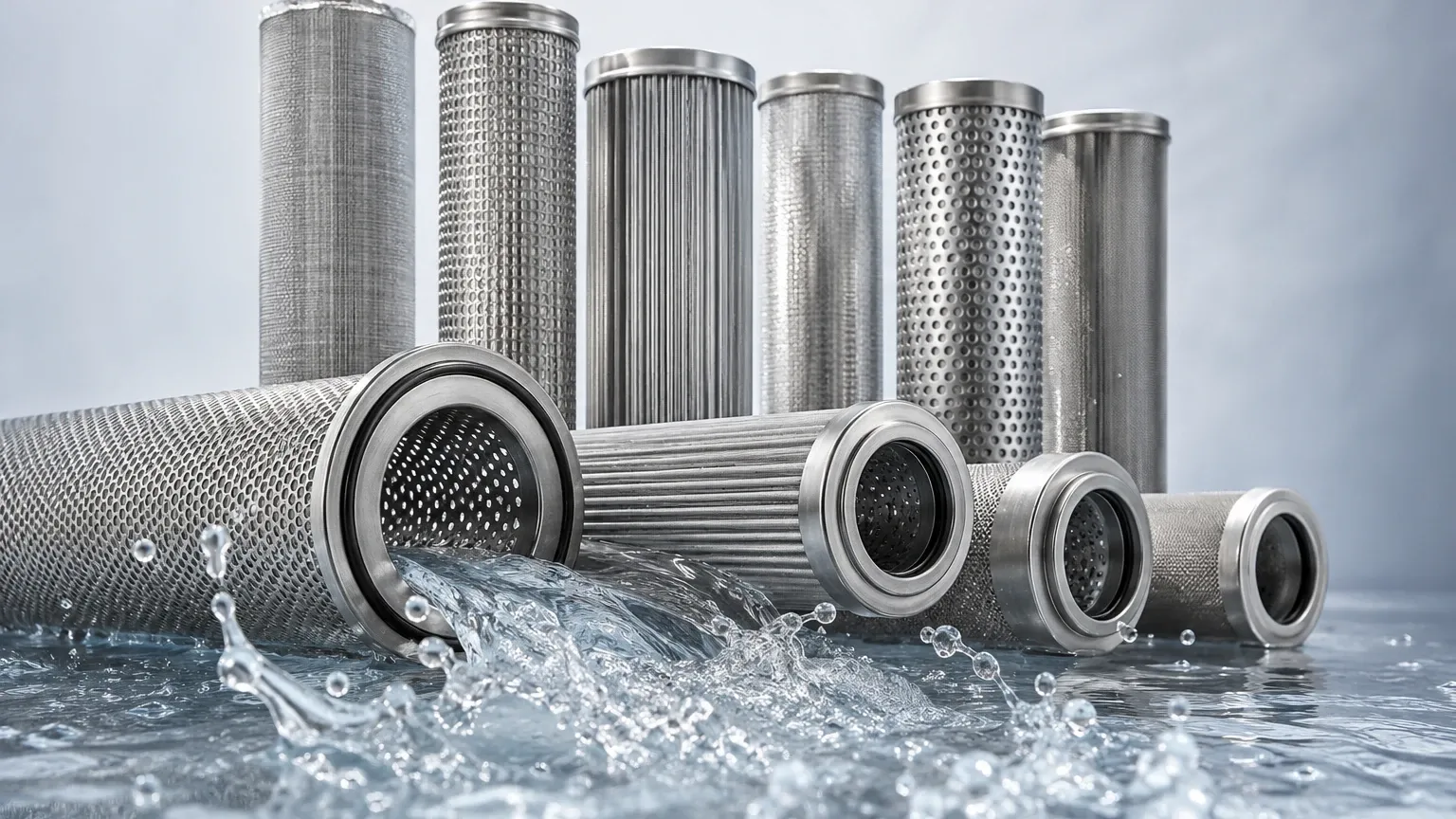
For many engineers, the transition from disposable to cleanable filter elements is a strategic decision to reduce waste and long-term costs. Stainless steel wire mesh is a primary technology used in the construction of a durable filter element water solution.
Unlike melt-blown or string-wound cartridges, wire mesh filters provide a fixed pore structure. This means the filtration accuracy does not change as the pressure increases. Furthermore, stainless steel mesh is surface-loading. Contaminants are trapped on the surface of the wire cloth rather than deep within a fiber matrix. This characteristic makes the elements highly responsive to backwashing or ultrasonic cleaning, allowing the element to be reused multiple times. This is a critical factor in applications where the cost of downtime for filter changes outweighs the initial investment in premium metal cartridges.
Engineering Considerations for System Integration
Integrating a filter element into an existing water system requires more than matching the length and diameter. Engineers must confirm the sealing mechanism and end-cap configuration to prevent "bypass"—the phenomenon where unfiltered water leaks around the element rather than passing through it.
Common end-cap configurations include:
* Double Open End (DOE): Requires gaskets at both ends; common in standard housings.
* Single Open End (SOE) with O-rings: Often features a 222 or 226 O-ring configuration with a locking tab or fin. This provides a high-integrity seal suitable for critical filtration where zero bypass is mandatory.
* Threaded Connections: Used in high-pressure hydraulic or specialized water systems to ensure the element remains seated during turbulent flow.
Maintenance and Life Cycle Management
The lifespan of a filter element water component is influenced by the solids loading of the influent and the cleaning protocol. In industrial settings, a scheduled maintenance approach is superior to a reactive one.
Cleaning Protocols
For permanent stainless steel elements, cleaning is typically performed when the differential pressure reaches a pre-set limit (often between 15 and 25 PSI, depending on the system design). Methods include:
* Backpulsing/Backwashing: Reversing the flow of water to dislodge surface contaminants.
* Chemical Cleaning: Using mild acids or bases to dissolve scale or organic bio-fouling, followed by thorough rinsing.
* Ultrasonic Cleaning: Using high-frequency sound waves in a solvent bath to remove fine particles trapped in the mesh intersections.
When to Replace
Even the most durable stainless steel filter element has a finite life. Replacement should be considered if the element shows signs of mechanical fatigue, wire shifting, or if the "clean" differential pressure begins to rise significantly after successive cleanings, indicating that the media is becoming permanently blinded by sub-micron particles.
Customization and OEM Solutions
Standard off-the-shelf filters often fail to meet the specific nuances of a unique industrial process. Customization allows for the optimization of the filter element's geometry, media layers, and reinforcement structures. For example, a multi-layer sintered mesh might be used to combine a fine filtration layer with several coarser support layers, providing both high precision and high mechanical strength in a single unit.
Working with a manufacturer that understands the complexities of metal fabrication and filtration physics is essential for developing OEM solutions. Custom-engineered elements can be designed to fit legacy housings, improve the flow characteristics of a bottlenecked system, or meet specific industry certifications such as those required for food contact or pharmaceutical purity.
Conclusion: Selecting the Right Filtration Partner
The efficiency of an industrial water system rests on the reliability of its internal components. A high-performance filter element water solution protects downstream equipment, reduces maintenance labor, and ensures the consistency of the final product. By prioritizing material quality, precise micron ratings, and robust mechanical design, engineering teams can achieve a balance between filtration performance and operational economy.
For those managing complex industrial processes, selecting a partner with expertise in stainless steel filtration is a prerequisite for success. To explore technical specifications and find the optimal configuration for your specific application, you can Review product options and application support to ensure your system operates at peak efficiency.
