


Gas Filter Cartridges
In industrial environments, gas filtration is a critical process designed to protect sensitive downstream equipment, ensure product purity, and maintain safety standards. Gas filter cartridges are specialized components engineered to remove solid particulates, moisture, and oil aerosols from compressed air or process gases. Unlike liquid filtration, gas filtration must account for the compressibility of the medium, higher flow velocities, and the potential for rapid pressure fluctuations.
For engineers and procurement professionals, selecting the appropriate gas filter cartridges involves a deep understanding of fluid dynamics, material science, and the specific demands of the operating environment. Whether the application involves sterile air in a pharmaceutical facility or high-temperature exhaust in a chemical plant, the choice of filtration media and cartridge construction directly impacts system efficiency and long-term operational costs.
Understanding the Mechanics of Industrial Gas Filtration
Gas filtration primarily relies on four mechanisms to capture contaminants: inertial impaction, interception, diffusion (Brownian motion), and electrostatic attraction. For larger particles moving at high velocities, inertial impaction occurs when the particle's momentum prevents it from following the gas stream around a filter fiber, causing it to strike and adhere to the media. Interception occurs when smaller particles follow the streamline but come close enough to a fiber to be captured.
For sub-micron particles, diffusion becomes the dominant mechanism. These tiny particles exhibit random motion due to collisions with gas molecules, increasing the likelihood that they will contact the filter media. In many industrial gas filter cartridges, the use of sintered metal or multi-layered wire mesh enhances these mechanisms by providing a tortuous path that traps contaminants throughout the depth of the media, rather than just on the surface.
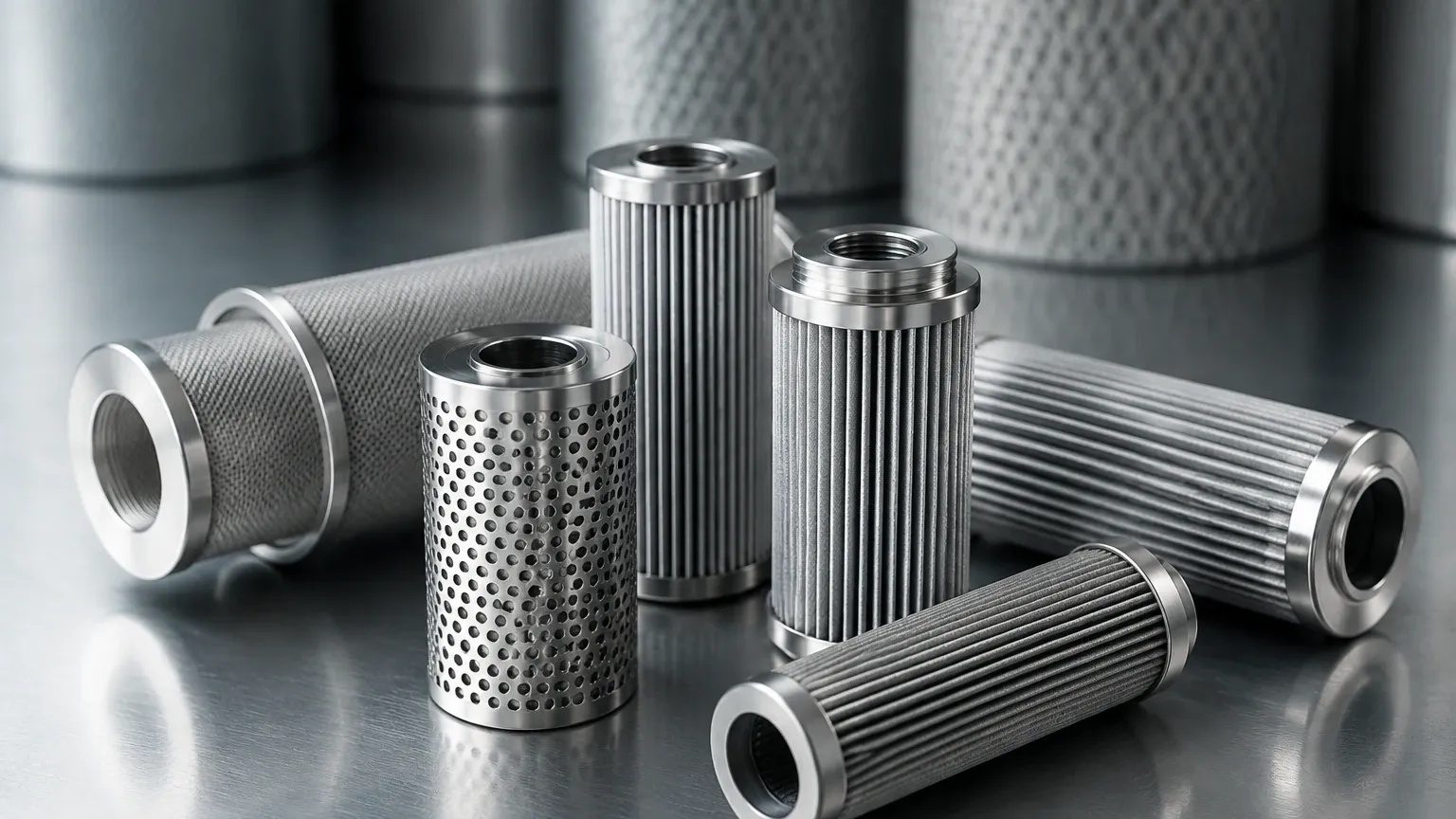
In gas systems, the presence of liquid aerosols (oil or water) adds another layer of complexity. Coalescing gas filters are designed to merge small droplets into larger ones that can be drained away. However, in applications requiring high durability and temperature resistance, stainless steel Filter Cartridges are often preferred for their ability to maintain structural integrity under mechanical stress while providing precise particulate removal.
Material Engineering: Why Stainless Steel is Standard for Gas Filter Cartridges
While polymer-based filters are common in low-temperature, non-corrosive applications, industrial gas processes often demand the resilience of metal. Stainless steel (typically 304 or 316L) is the material of choice for gas filter cartridges due to several engineering advantages:
Thermal Stability
Industrial gases are often processed at extreme temperatures. Polymer filters may soften, degrade, or outgas at temperatures exceeding 100°C. Stainless steel cartridges can operate reliably at temperatures ranging from cryogenic levels up to 500°C or higher, depending on the seal materials and housing configuration.
Chemical Compatibility
Process gases in the chemical and petrochemical sectors often contain corrosive elements such as hydrogen sulfide, ammonia, or acidic vapors. 316L stainless steel provides excellent resistance to pitting and crevice corrosion, ensuring that the filter media does not fail prematurely or contaminate the gas stream with corrosion products.
Mechanical Strength
Gas systems are prone to pressure surges and high differential pressures (ΔP). Sintered metal or pleated wire mesh cartridges offer high collapse pressure ratings. This structural rigidity prevents media migration—a phenomenon where fragments of the filter material break off and enter the downstream flow—which is a critical risk in high-purity applications.
Key Performance Metrics for Selection
When evaluating gas filter cartridges, technical specifications must be matched to the specific requirements of the gas stream. Engineers should focus on the following metrics:
Micron Rating and Efficiency
Filtration accuracy is defined as either nominal or absolute. For critical gas applications, an absolute rating is preferred, ensuring that 99.9% of particles above a specific size are captured. In gas filtration, it is also important to consider the "Beta Ratio," which provides a more detailed picture of filtration efficiency across different particle sizes.
Pressure Drop (ΔP)
The initial pressure drop across a clean filter cartridge is a major factor in energy consumption. A high initial ΔP requires the compressor to work harder, increasing utility costs. Gas filter cartridges with a pleated design offer a larger surface area, which reduces the velocity of the gas through the media (flux), thereby lowering the pressure drop and extending the time between cleaning cycles.
Flow Rate and Velocity
Gas velocity must be managed to prevent "re-entrainment," where captured particles are pushed through the media by the force of the gas. Sizing a filter housing and cartridge correctly involves calculating the actual cubic feet per minute (ACFM) based on the operating pressure and temperature, rather than relying on standard flow rates (SCFM).
Application-Specific Challenges and Solutions
Different industries impose unique requirements on gas filter cartridges. Understanding these nuances is essential for selecting the right filtration solution.
Chemical and Petrochemical Processing
In these industries, filters are often used for catalyst recovery or to protect gas compressors from pipe scale and dust. The primary challenge is the combination of high pressure and corrosive gases. Custom-designed stainless steel cartridges with reinforced inner cores are often required to withstand the mechanical stresses of these environments.
Food and Beverage Production
Gas filtration in the food industry often involves nitrogen blanketing or CO2 carbonation. The gas must be free of oil, moisture, and microbes. Stainless steel gas filter cartridges used here must be designed for easy sterilization, often through Steam-in-Place (SIP) or Clean-in-Place (CIP) procedures. The non-shedding nature of sintered metal is a significant advantage in maintaining food safety standards.
Pharmaceutical and Biotechnology
Sterile air is a requirement for fermentation and venting applications. Filters must achieve high-efficiency particulate air (HEPA) or ultra-low penetration air (ULPA) standards. Stainless steel cartridges provide the durability needed for repeated autoclave cycles, which would degrade most synthetic membranes.
Maintenance, Cleaning, and Service Life
One of the most significant advantages of stainless steel gas filter cartridges is their cleanability. Unlike disposable depth filters, metal cartridges can be restored to near-original performance levels through various cleaning methods:
* Ultrasonic Cleaning: Uses high-frequency sound waves in a cleaning solution to dislodge fine particles trapped deep within the mesh or sintered structure.
* Backwashing: Reversing the flow of clean gas or liquid through the cartridge to push contaminants out of the media.
* Chemical Cleaning: Using specific solvents or acids to dissolve organic or inorganic deposits that cannot be removed mechanically.
Determining the replacement cycle depends on the "terminal pressure drop"—the point at which the energy cost of pushing gas through a dirty filter outweighs the cost of cleaning or replacing the cartridge. In many industrial settings, monitoring ΔP via differential pressure gauges is the standard method for scheduling maintenance.
Procurement Checklist: What Engineers Must Confirm
Before finalizing a purchase of gas filter cartridges, it is vital to confirm technical details with the manufacturer to ensure the product is fit for purpose. Key questions include:
1. What is the maximum operating temperature and pressure? Ensure the cartridge and its seals (O-rings/gaskets) are compatible with the peak process conditions.
2. Is the micron rating absolute or nominal? Request efficiency data or Beta ratios for the specific gas and flow rate of your application.
3. What is the material of construction? Verify the grade of stainless steel and ensure it matches the corrosivity of the gas stream.
4. Are there customization options for end caps? Different housings require different connections (e.g., 226, 222, or DOE). Proper fitment is essential to prevent bypass leakage.
5. What is the expected service life before cleaning is required? Ask for pressure drop curves based on your specific gas type and flow requirements.
By focusing on these technical parameters, engineering teams can ensure they deploy gas filter cartridges that provide reliable protection and optimized performance. For those seeking specialized configurations, exploring high-quality Filter Cartridges designed for industrial durability is the first step toward a more efficient filtration system. Proper selection not only protects expensive machinery but also contributes to a lower total cost of ownership by reducing downtime and energy consumption.
