


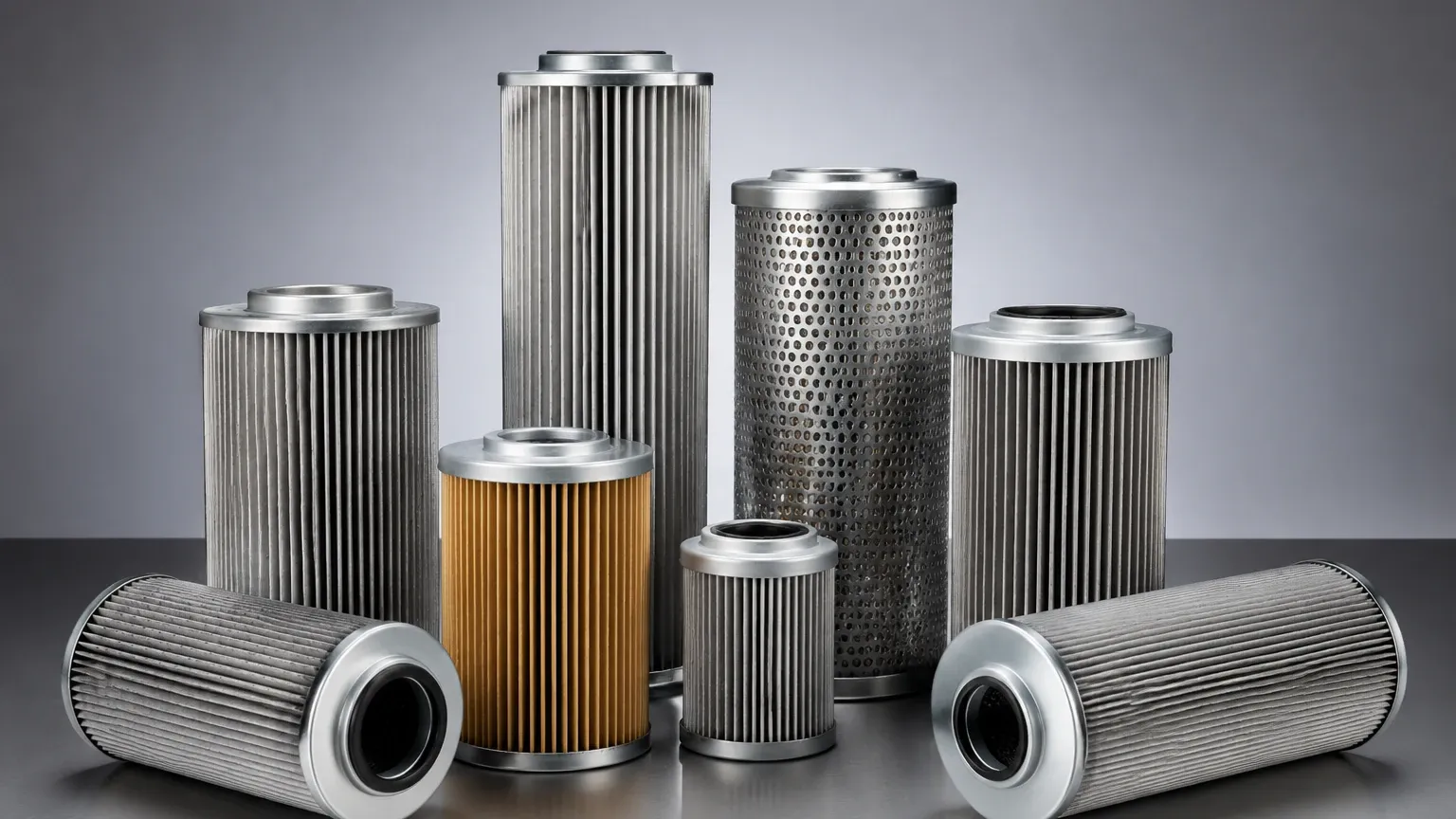
Oil Filter Cartridges
In industrial environments, the integrity of lubrication and hydraulic systems depends heavily on the efficiency of oil filter cartridges. These components are critical for removing contaminants that can lead to component wear, system failure, and unplanned downtime. For engineers and maintenance professionals, selecting the appropriate oil filter cartridges involves more than matching dimensions; it requires a deep understanding of fluid dynamics, material compatibility, and the specific demands of the operating environment.
Industrial oils—whether hydraulic fluids, lubricating oils, or fuel oils—serve as the lifeblood of machinery. However, these fluids are prone to contamination from external sources (ingression) and internal wear (generation). High-performance stainless steel filter cartridges provide a robust solution for maintaining fluid cleanliness in demanding applications where traditional disposable filters may fail due to temperature, pressure, or chemical aggression.
Understanding the Role of Oil Filter Cartridges in Industrial Systems
Oil filter cartridges are designed to capture and retain particulate matter from a fluid stream. In industrial settings, these contaminants typically include metal shavings, silica, soot, and various oxidation products. The presence of these particles can lead to abrasive wear in high-precision components like servo valves, bearings, and gearboxes.
Effective filtration is not just about removing the largest particles; it is about managing the overall particle size distribution within the system. For instance, in hydraulic systems, particles in the 3 to 10-micron range are often the most damaging because they can bridge the clearances between moving parts, leading to accelerated surface fatigue. Stainless steel filter cartridges, particularly those utilizing pleated wire mesh or sintered metal fibers, offer the precision required to target these specific particle sizes while maintaining structural integrity under high differential pressures.
Technical Specifications: Micron Ratings and Beta Ratios
When evaluating oil filter cartridges, engineers must look beyond nominal micron ratings. A "nominal" rating is an arbitrary value indicating the filter can trap a percentage of particles of a given size, but it lacks standardized consistency. For critical industrial applications, the "absolute" micron rating and the Beta Ratio ($\beta$) are the primary benchmarks for performance.
The Beta Ratio (Efficiency)
The Beta Ratio is determined through multi-pass testing (ISO 16889). it represents the ratio of particles of a given size upstream of the filter to the number of particles of the same size downstream. For example, a $\beta_{10} = 200$ means that for every 200 particles of 10 microns entering the filter, only one passes through. This equates to an efficiency of 99.5%. When sourcing Filter Cartridges, it is essential to confirm that the efficiency rating aligns with the sensitivity of the downstream components.
Surface vs. Depth Filtration
Oil filter cartridges generally utilize either surface or depth filtration mechanisms.
* Surface Filtration: Typically achieved with stainless steel wire mesh. Contaminants are trapped on the surface of the media. These filters are characterized by precise pore sizes and are often cleanable and reusable.
* Depth Filtration: Uses thicker media (like sintered metal fibers) where contaminants are trapped throughout the tortuous path of the material. This allows for higher dirt-holding capacity for a given surface area, making them ideal for systems with high levels of fine particulate contamination.
Material Selection: The Advantages of Stainless Steel
While cellulose and synthetic fiber cartridges are common in light-duty applications, industrial oil filtration often demands the resilience of stainless steel (typically 304 or 316L grades). The choice of material is dictated by several engineering factors:
Temperature Resistance
Industrial oils can operate at elevated temperatures, especially in heavy machinery or high-cycle hydraulic systems. Synthetic and cellulose media often have a maximum operating temperature of around 120°C (250°F). In contrast, stainless steel oil filter cartridges can withstand temperatures exceeding 300°C, depending on the seal materials used. This makes them indispensable for hot oil filtration in chemical processing and power generation.
Chemical Compatibility
Certain hydraulic fluids, such as phosphate esters or water-glycol mixtures, can be chemically aggressive toward standard filter media and adhesives. Stainless steel is inert to most industrial oils and additives, preventing media migration—a phenomenon where the filter material itself breaks down and enters the fluid stream, causing secondary contamination.
Pressure and Mechanical Strength
Oil filtration often involves high-viscosity fluids or cold-start conditions where the differential pressure ($\Delta P$) across the filter can spike significantly. Stainless steel cartridges possess the mechanical strength to resist collapsing or bursting under these conditions. Pleated designs further enhance this by providing a larger surface area, which reduces the flow velocity through the media and lowers the initial pressure drop.
Engineering Considerations for Viscosity and Flow Rate
One of the most common challenges in selecting oil filter cartridges is accounting for fluid viscosity. Unlike water, the viscosity of oil changes dramatically with temperature. A cartridge that performs perfectly at an operating temperature of 60°C may cause a bypass valve to open or the media to collapse during a cold start at 10°C due to the increased resistance of the thicker oil.
Sizing for Pressure Drop
Engineers must calculate the total pressure drop, which is the sum of the pressure drop across the filter housing and the pressure drop across the clean filter cartridge. As a general rule, the clean pressure drop should not exceed 10-15% of the system's bypass valve setting. If the viscosity is high, the surface area of the filter must be increased—often by using a larger cartridge or a more complex pleated geometry—to keep the flux (flow per unit area) within safe limits.
Customization and OEM Integration
In many industrial settings, standard off-the-shelf filter cartridges do not meet the unique spatial or performance requirements of the equipment. Customization is a core aspect of professional filtration manufacturing, allowing engineers to specify:
* End Cap Configurations: Options include Double Open End (DOE), Single Open End (SOE) with various O-ring codes (e.g., 222, 226), or threaded connections for high-pressure stability.
* Reinforcement: Internal support cores or external cages can be added to the cartridge to handle extreme pressure pulses or back-flushing cycles.
* Custom Dimensions: For legacy equipment where original manufacturer parts are no longer available, custom-fabricated stainless steel cartridges can be engineered to fit existing housings while providing modern filtration efficiency.
By working with a manufacturer like Kaifil, purchasing teams can ensure that their Filter Cartridges are designed specifically for the fluid type, flow rate, and contamination profile of their unique application.
Maintenance, Cleaning, and Total Cost of Ownership
A significant advantage of stainless steel oil filter cartridges is their cleanability. While the initial investment is higher than that of disposable glass fiber or paper cartridges, the total cost of ownership (TCO) is often lower in the long run.
The Cleaning Process
When the terminal pressure drop is reached—indicating the filter is loaded with contaminants—stainless steel cartridges can be cleaned using several methods:
1. Ultrasonic Cleaning: High-frequency sound waves create cavitation bubbles that dislodge particles from deep within the mesh or sintered layers.
2. Back-flushing: Reversing the flow of a clean fluid through the filter to push out trapped particles.
3. Chemical Cleaning: Using compatible solvents to dissolve resinous or organic deposits (varnish) that may have accumulated on the media.
Monitoring Performance
To maximize the lifespan of oil filter cartridges, industrial systems should be equipped with differential pressure gauges or sensors. Relying on fixed time intervals for filter changes is often inefficient; it either leads to the premature disposal of a functional filter or risks running a clogged filter in bypass mode, which allows unfiltered oil to circulate through the system.
Selection Checklist for Purchasing and Engineering Teams
Before finalizing a specification for oil filter cartridges, the following technical details should be confirmed with the manufacturer:
* Fluid Type and Viscosity: What is the ISO VG grade of the oil, and what are the minimum and maximum operating temperatures?
* Target Cleanliness Level: What is the required ISO 4406 cleanliness code for the system? This dictates the necessary micron rating and Beta ratio.
* Flow Rate: What is the maximum flow rate the filter must handle, including potential surges?
* Operating Pressure: Is the filter located on the suction side, pressure side, or return line? This determines the required collapse pressure rating.
* Seal Compatibility: Are the O-rings or gaskets (Viton, Buna-N, EPDM) compatible with the specific oil chemistry and temperature?
Conclusion
Oil filter cartridges are vital components in the preservation of industrial machinery. By prioritizing high-quality materials like stainless steel and focusing on rigorous technical specifications such as absolute micron ratings and pressure drop calculations, engineers can significantly enhance system reliability. Whether for hydraulic power units, turbine lubrication, or industrial fuel systems, the right filtration solution reduces wear, extends fluid life, and ensures optimal performance in the most demanding industrial environments.
