


Order of Water Filter Cartridges
In industrial water treatment and process engineering, the sequence in which filtration media is deployed is as critical as the media itself. The systematic arrangement, or the order of water filter cartridges, determines the overall efficiency of the system, the longevity of expensive downstream components, and the purity of the final effluent. For engineers and facility managers, understanding the technical logic behind these stages is essential for optimizing total cost of ownership (TCO) and ensuring process stability.
Multi-stage filtration is rarely a matter of redundancy; rather, it is a strategic progression from coarse to fine separation. By utilizing a graduated approach, industrial systems can handle high solids loading while maintaining high flow rates and precise particle retention. This article examines the engineering principles governing the sequence of filtration and the specific roles played by various Filter Cartridges in a professional water treatment train.
The Engineering Logic of Sequential Filtration
The fundamental principle behind the order of water filter cartridges is the protection of the most sensitive and expensive media. In any industrial fluid process, the "workhorse" filters are placed at the beginning to remove the bulk of contaminants, while the "polishing" filters are placed at the end to achieve specific purity standards.
If a high-precision membrane or a sub-micron pleated cartridge were placed at the inlet of a raw water feed, it would reach its terminal pressure drop almost instantly. This phenomenon, known as surface blinding, leads to frequent downtime and excessive operational costs. Conversely, by placing a robust, high-capacity pre-filter at the start, the system can remove larger debris—such as sand, scale, and suspended solids—allowing the downstream precision filters to focus on the microscopic particles they were designed to capture.
Stage 1: Mechanical Pre-filtration and Sediment Removal
The first stage in the order of water filter cartridges is almost always mechanical sediment filtration. This stage serves as a sacrificial barrier, protecting the entire system from catastrophic fouling or mechanical damage to pumps and valves.
Coarse Mesh and Depth Filters
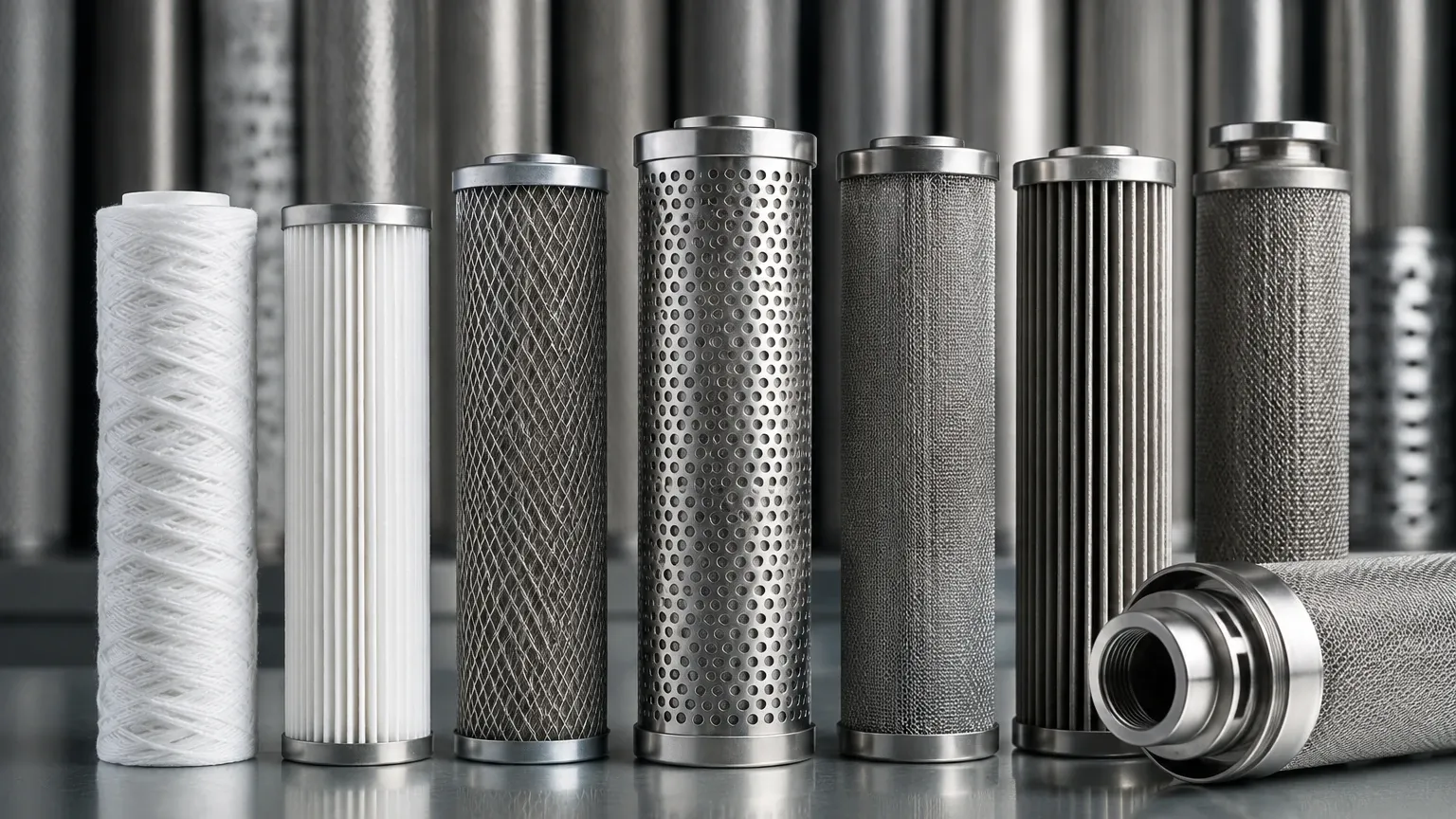
In industrial settings, this stage often utilizes stainless steel wire mesh cartridges or high-capacity depth filters. Stainless steel mesh is particularly valued for its durability and cleanability. These filters typically range from 50 to 500 microns. Their primary function is to remove large particulates that could physically abrade downstream components.
Nominal vs. Absolute Ratings
Engineers must distinguish between nominal and absolute ratings at this stage. Pre-filters are often nominally rated, meaning they catch a high percentage of particles at a specific size but allow some bypass. This is acceptable in the first stage, as the goal is mass reduction rather than total exclusion. The use of depth-style cartridges (such as melt-blown or string-wound) allows for "gradient density" filtration, where larger particles are trapped on the outer surface and smaller ones are trapped deeper within the media.
Stage 2: Adsorption and Chemical Reduction
Once the physical debris is removed, the water moves to the second stage, which typically addresses dissolved contaminants, organic compounds, and disinfectants like chlorine or chloramines. In the order of water filter cartridges, this stage is critical for protecting sensitive membranes (like Reverse Osmosis) from chemical degradation.
Activated Carbon Blocks
Activated carbon is the industry standard for this stage. Carbon block cartridges utilize a vast internal surface area to adsorb organic molecules and neutralize oxidizing agents. If chlorine is not removed at this stage, it can cause irreversible oxidative damage to thin-film composite (TFC) membranes used in later stages.
Placement Rationale
Carbon filters are placed after sediment filters because carbon is highly porous and easily clogged by physical silt. If the order were reversed, the carbon pores would be filled with sediment, rendering the chemical adsorption sites useless. By placing carbon second, the media can operate at maximum efficiency for its intended chemical purpose.
Stage 3: Fine Particulate and Precision Filtration
The third stage in the sequence involves precision Filter Cartridges designed for fine particulate removal, often in the 1 to 5-micron range. This stage acts as a bridge between the bulk pre-filtration and the final polishing or membrane stages.
Protecting Downstream Membranes
In systems utilizing Reverse Osmosis (RO) or Ultrafiltration (UF), this third stage is often referred to as the "guard filter." Its role is to catch any carbon fines that might have shed from the previous stage and to remove any remaining suspended solids that could foul the membrane surface. High-efficiency pleated cartridges are frequently used here due to their large surface area and low clean pressure drop.
Material Considerations
At this stage, the choice of material becomes more critical. While polymer-based cartridges are common, industrial processes involving high temperatures or aggressive chemicals may require stainless steel pleated cartridges. These provide the necessary micron precision while maintaining structural integrity under high differential pressures that would cause polymer filters to bypass or collapse.
Stage 4: Specialized Polishing and Microbiological Barriers
In high-purity applications—such as pharmaceutical manufacturing, electronics rinsing, or food and beverage production—a final polishing stage is required. This is the last step in the order of water filter cartridges and represents the highest level of filtration accuracy.
Sub-micron and Sterile Filtration
Final filters often have absolute ratings of 0.22 microns or smaller. These are designed to remove bacteria, cysts, and even some endotoxins. Because these filters are extremely sensitive, they rely entirely on the efficiency of the preceding three stages. If any of the earlier stages fail, the final filter will clog prematurely, leading to a loss of sterile integrity or process interruption.
UV Pre-filtration
If the system includes Ultraviolet (UV) disinfection, the filtration sequence must ensure the water is highly transparent (high UV Transmittance). Particles can "shadow" microbes from UV light, so a high-efficiency filter must be placed immediately upstream of the UV lamp to ensure 100% efficacy.
Technical Factors Influencing the Sequence
While the standard sequence (Sediment -> Carbon -> Fine -> Polish) is common, specific engineering variables can alter the order of water filter cartridges.
1. Flow Velocity and Flux: The rate at which water passes through the media (flux) must be balanced across all stages. A bottleneck in the second stage will cause backpressure issues for the first stage. Engineers must size each stage to handle the peak flow requirements of the process.
2. Differential Pressure (ΔP) Monitoring: Each stage should be equipped with pressure gauges. By monitoring the ΔP across each individual cartridge, operators can identify exactly which stage is reaching capacity. A sudden spike in ΔP in the third stage often indicates a failure or bypass in the first or second stage.
3. Total Dissolved Solids (TDS) vs. Total Suspended Solids (TSS): Cartridge filters primarily handle TSS. If the water has high TDS, the sequence may need to include ion exchange resin cartridges or scale inhibitors between the sediment and carbon stages to prevent mineral scaling on downstream precision components.
The Role of Stainless Steel in Industrial Sequences
In demanding B2B environments, the standard plastic housing and polymer cartridge approach often falls short. Stainless steel Filter Cartridges play a vital role in the industrial order of water filter cartridges for several reasons:
* Thermal Stability: In hot water loops or steam filtration, polymer cartridges will soften and lose their micron rating. Stainless steel maintains its pore structure up to several hundred degrees Celsius.
* Chemical Compatibility: When filtering process water that contains solvents, hydrocarbons, or extreme pH levels, stainless steel (304 or 316L) provides the necessary corrosion resistance that ensures the filter does not become a source of contamination itself.
* Backwashability: Unlike disposable depth filters, many stainless steel cartridges can be cleaned and reused. In the first stage of a high-load system, a backwashable stainless steel filter can significantly reduce the recurring cost of consumables.
Troubleshooting Common Sequence Errors
Incorrectly ordering water filter cartridges leads to predictable failure modes. Identifying these early can save significant operational costs.
* Premature Carbon Fouling: If the carbon block is reaching its pressure limit before its chemical capacity is exhausted, the pre-filtration (Stage 1) is likely insufficient. A finer pre-filter or a larger surface area mesh may be required.
* Membrane Scaling: If downstream RO membranes show signs of mineral scaling despite a scale inhibitor cartridge, the inhibitor may be placed after a carbon stage that is inadvertently removing the inhibitor chemicals. The sequence must be validated for chemical compatibility.
* Turbidity Spikes: If the final effluent shows intermittent turbidity, it may be due to "channeling" in an overloaded depth filter. Moving to a more rigid pleated cartridge or a multi-round stainless steel housing can provide the structural support needed to prevent bypass under pressure surges.
Conclusion for Purchasing and Engineering Teams
Optimizing the order of water filter cartridges is a balance of science and operational strategy. By adhering to a coarse-to-fine progression and protecting chemical media from physical fouling, facilities can ensure consistent water quality and minimize maintenance intervals.
When designing or retrofitting a filtration train, engineers should confirm the specific contaminant profile of the source water and the required purity of the end product. For industrial applications involving high pressures, extreme temperatures, or rigorous sanitation requirements, integrating stainless steel filtration components into the sequence provides a level of reliability that standard consumables cannot match. Selecting the right combination of depth, adsorption, and precision cartridges—and placing them in the correct technical order—is the foundation of any successful industrial water treatment strategy.
