


2 Disk Filter
In industrial filtration, the term 2 disk filter typically refers to a dual-layer filtration assembly where two distinct wire mesh discs are combined to achieve specific performance characteristics. Unlike single-layer screens, which may lack the structural integrity for high-pressure environments, or complex multi-layer sintered packs that can be cost-prohibitive for certain applications, the 2 disk filter configuration offers a balanced solution for mechanical strength and precise particle retention.
For engineers and procurement professionals, understanding the technical nuances of these components is essential for optimizing process efficiency. Whether used in polymer extrusion, hydraulic systems, or chemical processing, the selection of materials, weave patterns, and assembly methods directly impacts the lifecycle and reliability of the filtration system. This guide examines the engineering principles, application requirements, and selection criteria for Filter Discs & Packs utilizing dual-layer designs.
Engineering Principles of the 2 Disk Filter
The fundamental design of a 2 disk filter involves two layers of stainless steel wire mesh. In most industrial configurations, these layers serve distinct purposes. The primary layer, often called the filtration layer, features a fine mesh count designed to capture particles at a specific micron rating. The secondary layer, or the support layer, consists of a coarser mesh with thicker wire diameters.
Structural Support and Pressure Resistance
In high-viscosity or high-pressure applications, a single fine mesh disc is prone to deformation or "ballooning" under the force of the fluid flow. By integrating a 2 disk filter setup, the coarser mesh acts as a rigid skeleton. This support prevents the fine mesh from tearing or collapsing into the drainage channels of the filter housing. This structural reinforcement is critical in maintaining a consistent pore size during operation, ensuring that the filtration accuracy does not deviate as differential pressure increases.
Flow Dynamics and Drainage
The secondary layer in a 2 disk filter also functions as a drainage medium. By providing a gap between the fine filtration mesh and the solid surface of the filter plate, it allows the filtrate to flow laterally toward the discharge ports. Without this secondary layer, the fine mesh might sit flush against the support plate, significantly reducing the effective filtration area and increasing the initial pressure drop.
Material Selection and Chemical Compatibility
The performance of a 2 disk filter is heavily dependent on the alloys used in its construction. Stainless steel is the industry standard due to its mechanical properties and resistance to environmental degradation.
1. AISI 304 Stainless Steel: This is the most common material for general industrial use. It offers excellent strength and good corrosion resistance for water-based applications and mild chemicals.
2. AISI 316 and 316L Stainless Steel: For more demanding environments, such as pharmaceutical or chemical processing, 316L is preferred. The addition of molybdenum enhances resistance to pitting and crevice corrosion, particularly in chloride-rich environments. The "L" (low carbon) variant is essential if the filter discs are to be welded, as it prevents carbide precipitation that can lead to intergranular corrosion.
3. Specialty Alloys: In extreme cases involving high temperatures or highly corrosive acids, alloys like Monel, Inconel, or Hastelloy may be utilized. These materials ensure that the 2 disk filter maintains its structural integrity where standard stainless steels would fail.
Weave Patterns and Filtration Accuracy
The effectiveness of a 2 disk filter is determined by the weave of the wire mesh. Engineers must select the weave based on the nature of the contaminants and the required flow rate.
* Plain Weave: The most straightforward pattern where wires cross over and under each other. It provides high flow rates and is easy to clean, making it suitable for the support layer of a 2 disk filter.
* Twill Weave: Each shute wire passes successively over and under two warp wires. This allows for a heavier wire diameter for a given mesh count, increasing the strength of the disc.
* Dutch Weave (Plain and Twill): These weaves use different wire diameters in the warp and shute directions. This creates a dense, tortuous path for the fluid, allowing for very fine micron ratings (down to 5-10 microns) while maintaining high mechanical strength. A 2 disk filter often utilizes a Dutch weave for the filtration layer and a plain weave for the support layer.
Assembly Methods for Filter Discs & Packs
How the two layers are joined is a critical engineering consideration. The method of assembly affects the disc's durability, cleanability, and compatibility with the filter housing.
Spot Welding
In many 2 disk filter designs, the layers are joined via precision spot welding at several points around the circumference or across the surface. This keeps the layers aligned during installation and prevents them from shifting during backpulsing or cleaning cycles. Spot welding is cost-effective and suitable for most liquid filtration applications.
Rim Binding (Framing)
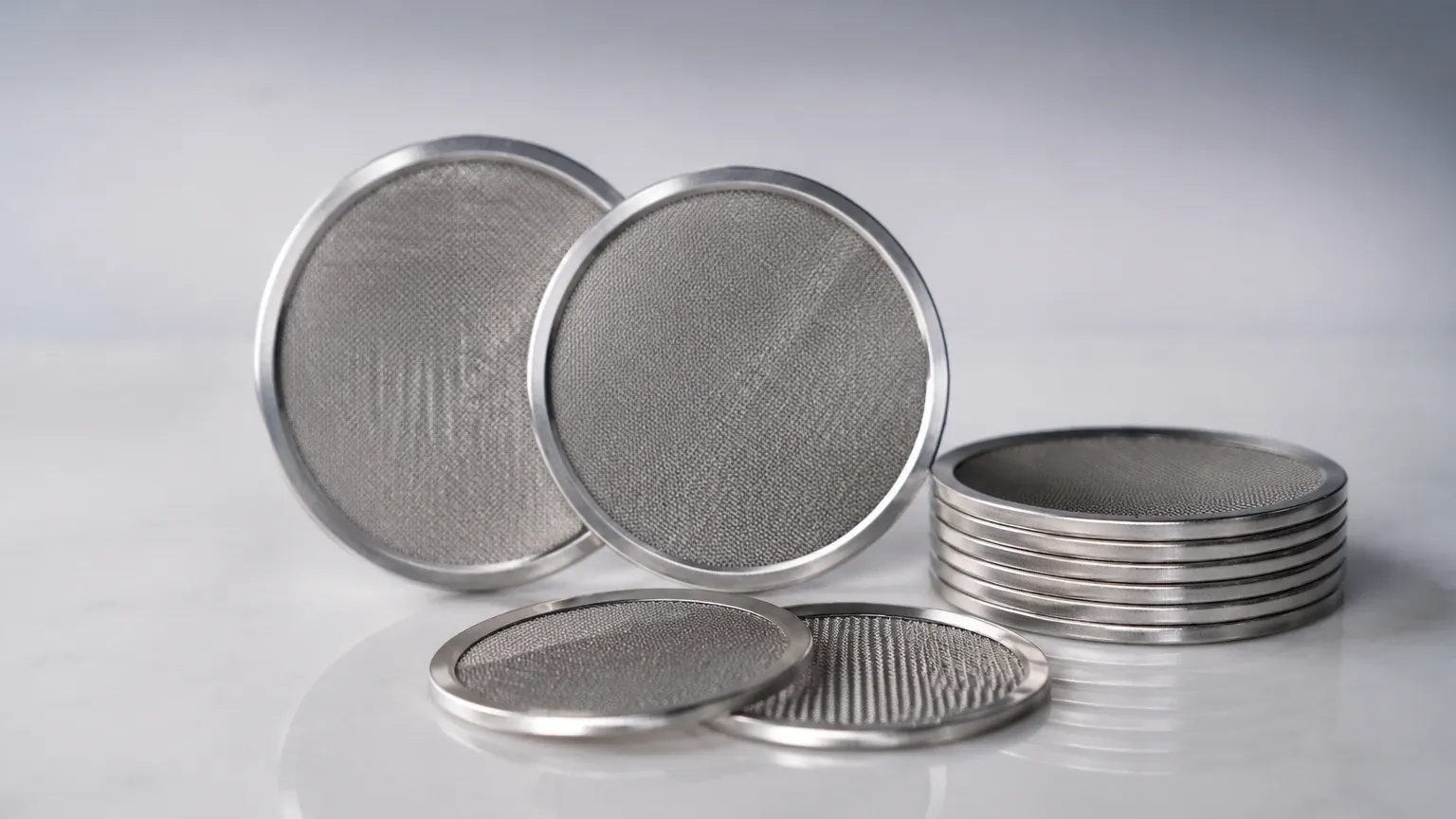
For applications where bypass must be strictly avoided, or where the edges of the mesh might fray and contaminate the process stream, rim binding is used. The 2 disk filter is encased in a metal U-section rim, typically made of aluminum, stainless steel, or copper. This frame compresses the edges of the two discs together, creating a seal and providing a smooth edge for handling and installation.
Sintering
While a standard 2 disk filter is often mechanically held or spot-welded, sintering involves heat-treating the layers until the wire contact points fuse together. This creates a monolithic structure that is extremely rigid and eliminates the risk of wire migration. Sintered dual-layer discs are used in the most demanding high-pressure environments where absolute filtration and structural permanence are required.
Key Applications for 2 Disk Filter Configurations
The versatility of the 2 disk filter makes it a staple in various industrial sectors. Its ability to provide fine filtration with built-in support is particularly valued in the following areas:
Polymer and Plastic Extrusion
In the production of films, fibers, and resins, molten polymer is forced through a breaker plate. A 2 disk filter (often as part of a larger screen pack) is used to remove "gels" and un-melted particles. The support layer is vital here because the viscosities and pressures involved are immense.
Hydraulic and Lube Oil Filtration
Hydraulic systems rely on clean oil to prevent wear on precision valves and pumps. A 2 disk filter is often used in suction strainers or pressure line filters to ensure that even under cold-start conditions (high viscosity), the mesh does not collapse.
Pharmaceutical and Food Processing
In these industries, cleanability and material purity are paramount. A 2 disk filter made of 316L stainless steel can be ultrasonically cleaned and reused, providing a more sustainable and cost-effective solution than disposable depth filters. The dual-layer design ensures the disc remains flat and easy to seat in sanitary housings.
Evaluation Criteria: What Engineers Should Confirm
Before purchasing or specifying a 2 disk filter, technical teams should confirm several parameters to ensure the component is fit for purpose:
1. Micron Rating (Absolute vs. Nominal): Confirm whether the filtration layer is rated for absolute retention (capturing 99%+ of particles at that size) or nominal retention. This distinction is critical for process validation.
2. Differential Pressure (ΔP) Limits: Determine the maximum pressure drop the 2 disk filter can withstand before the support layer fails or the filtration layer deforms.
3. Effective Filtration Area (EFA): Calculate the EFA, accounting for any area lost to rim binding or spot welding. This affects the frequency of filter changes.
4. Cleaning Protocol: If the filters are intended to be reused, confirm that the assembly method (e.g., spot welding) can withstand ultrasonic cleaning or chemical baths without delaminating.
5. Housing Compatibility: Ensure the total thickness of the 2 disk filter, including any rim or binding, fits within the tolerances of the existing filter holder or breaker plate.
Maintenance and Total Cost of Ownership
While the initial cost of a 2 disk filter is higher than a single-layer mesh disc, the total cost of ownership (TCO) is often lower. The added durability of the support layer reduces the risk of premature failure and process downtime. Furthermore, because the layers are held together securely, they are less likely to be damaged during the manual handling required for cleaning and inspection.
In many systems, the 2 disk filter can be cleaned multiple times. The use of high-quality stainless steel ensures that the mesh does not rust or degrade after exposure to cleaning solvents. For procurement teams, this longevity translates to fewer purchase orders and reduced inventory requirements over the long term.
Customization Options in Filter Discs & Packs
Industrial filtration is rarely a one-size-fits-all requirement. Manufacturers like Kaifil provide extensive OEM and customization capabilities for Filter Discs & Packs. When a standard 2 disk filter does not meet the specific needs of a unique chemical process or a new piece of machinery, custom engineering becomes necessary.
Customization can include:
* Non-standard Diameters: Precision cutting to fit proprietary housing dimensions.
* Variable Layering: Using different mesh counts for the support and filtration layers to fine-tune the balance between flow rate and particle retention.
* Specific Rim Materials: Selecting rim metals that are galvanically compatible with the filter housing to prevent corrosion.
* Complex Shapes: Producing oval, rectangular, or ring-shaped 2 disk filters for specialized equipment.
By working closely with a manufacturer that understands both the metallurgy and the fluid dynamics of filtration, engineers can develop 2 disk filter solutions that enhance product quality and protect downstream equipment from contamination. The focus should always remain on the technical requirements of the application, ensuring that the selected filter pack provides the necessary precision and durability for the intended industrial environment.
