


8 Filters
In the landscape of industrial filtration, the configuration and layering of filtration media play a pivotal role in determining the efficiency, longevity, and throughput of a system. When engineers discuss "8 filters" in the context of precision metal components, they are typically referring to multi-layered filter packs or a sequence of eight distinct filtration stages designed to handle complex contaminant profiles. These configurations, often categorized under Filter Discs & Packs, are essential in high-pressure environments such as polymer extrusion, chemical processing, and hydraulic systems where a single layer of mesh is insufficient to meet technical requirements.
Selecting the correct multi-layer assembly requires an understanding of fluid dynamics, material science, and the specific mechanical stresses of the application. This guide explores the engineering principles behind multi-layer filter packs, the technical benefits of sequential filtration, and the criteria for selecting high-performance components for demanding industrial environments.
Understanding Multi-Layer Filter Discs and Packs
A filter pack is rarely a single sheet of wire mesh. Instead, it is a composite structure where multiple layers of varying mesh counts are combined to create a gradient filtration effect. The concept of using 8 filters—or an 8-layer assembly—is rooted in the need for depth filtration. While a single surface filter captures particles on its face, a multi-layer pack allows for the distribution of particles throughout the thickness of the media.
The Gradient Density Principle
In an 8-layer configuration, the layers are typically arranged from coarsest to finest, and then back to coarse for support. For example, the outer layers may consist of a heavy-duty support mesh that protects the internal fine-filtration layers from mechanical damage and high differential pressures. The internal layers, often referred to as the "working layers," are selected based on the target micron rating. By utilizing multiple layers, the system can capture larger particles in the outer stages, preventing the fine inner mesh from blinding prematurely. This increases the overall dirt-holding capacity of the assembly.
Structural Integrity and Reinforcement
In high-viscosity applications, such as the processing of molten plastics or resins, the pressure exerted on the filter media is immense. An 8-layer pack provides the necessary structural rigidity to prevent the fine mesh from stretching or tearing. The combination of different weave types—such as plain weave for coarse support and Dutch weave for fine filtration—ensures that the pack remains stable under fluctuating flow rates.
Engineering Considerations for 8-Layer Filter Configurations
When designing or specifying a pack consisting of 8 filters, engineers must balance several competing factors: filtration accuracy, pressure drop, and mechanical strength.
Material Selection
Stainless steel is the industry standard for these components due to its thermal stability and chemical resistance.
- SS 304: Suitable for general industrial applications with moderate corrosive environments.
- SS 316L: Preferred for pharmaceutical, food and beverage, and highly corrosive chemical applications due to its superior resistance to pitting and crevice corrosion.
- Special Alloys: In extreme cases involving high temperatures or highly acidic fluids, alloys like Inconel or Hastelloy may be integrated into the pack.
Weave Types and Their Functions
The performance of the 8 filters within a pack is heavily influenced by the weave of the wire mesh.
1. Plain Weave: The most common weave, offering high open area and low pressure drop, typically used for coarse filtration or support.
2. Twill Weave: Allows for thicker wires and is used when higher mechanical strength is required for a given micron rating.
3. Plain Dutch Weave: Features a dense structure with high filtration accuracy, making it ideal for the primary filtration layers in a pack.
4. Twilled Dutch Weave: Provides the finest filtration levels (down to 1-5 microns) and is often the core component of a high-performance filter pack.
Technical Benefits of Sequential Filtration in Packs
The primary advantage of using a complex assembly like an 8-layer pack is the optimization of the filtration lifecycle. In B2B industrial procurement, the total cost of ownership (TCO) is often more important than the initial unit price.
Extended Service Life
By distributing the particle load across multiple layers, the rate of pressure buildup is significantly reduced. In a single-layer system, the surface can become blocked rapidly, leading to frequent downtime for filter changes. An 8-layer pack effectively manages the "cake" formation, allowing the system to run for longer periods between maintenance cycles.
Enhanced Filtration Precision
Multiple layers act as a redundant system. If a single wire in a fine mesh layer were to fail, the subsequent layers in the 8-filter sequence provide a secondary barrier, ensuring that downstream components remain protected. This is critical in industries like hydraulic power, where even minor contamination can lead to catastrophic pump or valve failure.
Flow Stabilization
The tortuous path created by multiple layers of mesh helps to laminarize the flow of the fluid. This reduction in turbulence can be beneficial in sensitive chemical reactions or precision coating processes where a consistent flow profile is required.
Common Applications for Complex Filter Packs
High-layer-count filter packs are utilized across sectors where fluid purity and system reliability are non-negotiable.
Polymer and Fiber Extrusion
In the production of synthetic fibers and plastic films, the melt must be filtered to remove gels and degraded polymer. These systems often use 8 filters in a "sandwich" configuration to withstand pressures exceeding 5,000 PSI while maintaining filtration levels as fine as 10 microns.
Chemical and Petrochemical Processing
Corrosive fluids and high-temperature catalysts require robust filtration solutions. Multi-layer stainless steel packs are used to recover expensive catalysts and to ensure that final products meet stringent purity standards.
Pharmaceutical and Biotechnology
In these industries, the ability to clean and reuse filter media is a significant advantage. Stainless steel Filter Discs & Packs can be sterilized and ultrasonically cleaned, providing a sustainable alternative to disposable polymer filters.
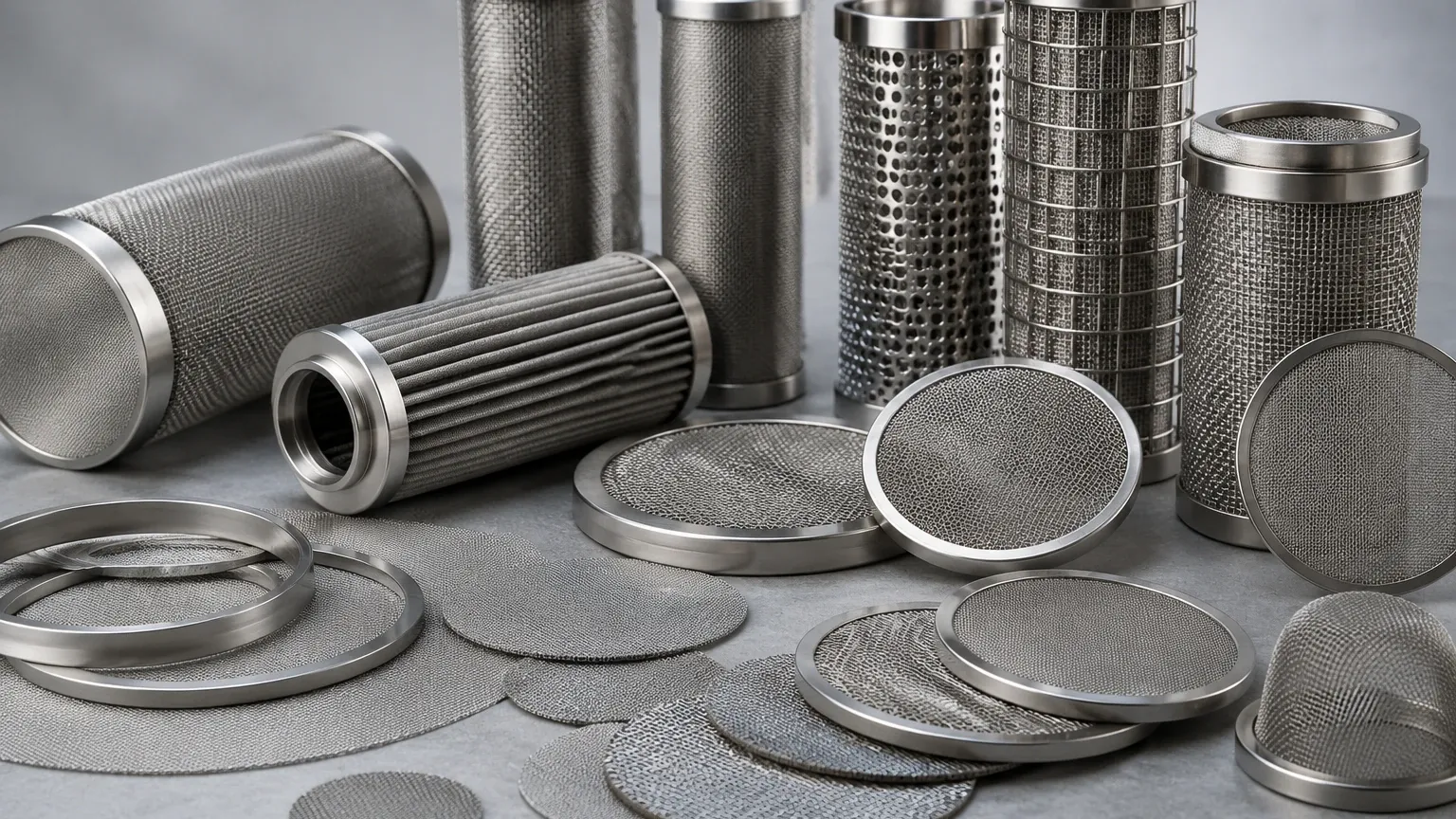
Selecting the Right Filter Discs & Packs for Industrial Systems
Choosing the optimal configuration involves more than just selecting a micron rating. Engineers must confirm several technical specifications before finalizing a purchase order.
Micron Rating vs. Absolute Filtration
It is essential to distinguish between nominal and absolute micron ratings. A nominal rating refers to the ability of the filter to retain a percentage of particles of a certain size, while an absolute rating indicates the size of the largest particle that can pass through the mesh. For 8-layer packs, the interaction between layers often results in an absolute rating that is finer than any individual layer might suggest.
Edge Treatment and Binding
The way the 8 filters are held together is critical for preventing bypass—where fluid flows around the filter rather than through it. Common methods include:
- Spot Welding: Individual layers are welded at specific points. This is cost-effective but may allow some layer separation under high pressure.
- Aluminum or Copper Rim Binding: A metal rim is compressed around the edge of the pack. This provides a superior seal and makes the pack easier to handle during installation.
- Sintering: The layers are bonded together using heat and pressure without the use of a binding agent. This creates a monolithic structure that is virtually immune to layer separation.
Pressure Drop Calculations
Engineers must calculate the clean pressure drop ($ΔP$) to ensure the pump capacity is sufficient. An 8-layer pack will naturally have a higher resistance than a single layer. However, the increased surface area provided by the internal layers can sometimes mitigate this by preventing rapid blinding.
Maintenance and Replacement Cycles
Monitoring the performance of multi-layer filters is usually done through differential pressure ($ΔP$) sensors.
1. Initial ΔP: The pressure drop when the filter is new and clean.
2. Operating Range: The period during which the pressure rises slowly as the filter captures contaminants.
3. Terminal ΔP: The point at which the pressure rises exponentially, indicating the filter is fully loaded and must be replaced or cleaned.
In many 8-filter systems, the packs are designed to be cleaned via back-flushing, ultrasonic baths, or chemical cleaning (such as burnout ovens for polymer applications). The durability of stainless steel ensures that these packs can undergo multiple cleaning cycles before the structural integrity of the mesh is compromised.
Evaluating Total Cost of Ownership (TCO)
When procuring Filter Discs & Packs, the purchasing team should look beyond the per-unit cost. A cheaper, lower-quality pack may lead to:
- Increased Downtime: Frequent changes stop production lines.
- Product Waste: Inconsistent filtration can lead to batches of product that do not meet quality standards.
- Downstream Damage: If a filter pack fails, contaminants can damage expensive equipment like extrusion dies or high-pressure pumps.
Investing in a precision-engineered 8-layer configuration ensures that the filtration system supports the overall efficiency of the manufacturing process. By working with a manufacturer that understands the nuances of mesh selection and pack assembly, companies can achieve a balance between high-performance filtration and operational economy.
In conclusion, the use of 8 filters in a coordinated pack represents a sophisticated approach to industrial filtration. By leveraging the strengths of different mesh weaves and materials, these components provide the reliability and precision required for today's most demanding industrial applications.
