


8 Pack vs 10 Pack
In the precision-driven world of industrial polymer extrusion, chemical processing, and hydraulic filtration, the configuration of filter media is a critical determinant of system efficiency. Engineers and procurement specialists often face a specific choice when sourcing multilayer filter assemblies: the 8 pack vs 10 pack configuration. While these terms can occasionally refer to packaging quantities for high-volume maintenance cycles, in a technical manufacturing context, they primarily describe the number of mesh layers integrated into a single, bound filter pack.
Selecting the right density of Filter Discs & Packs involves more than a simple numerical comparison. It requires a deep understanding of fluid dynamics, pressure drop tolerances, and the specific contaminant profiles of the media being processed. This guide examines the engineering considerations, performance trade-offs, and operational impacts of choosing between 8-layer and 10-layer filter pack configurations.
Understanding Multilayer Filter Pack Architecture
Industrial filter packs are rarely composed of a single layer of wire mesh. To achieve high-efficiency filtration while maintaining structural integrity under high pressure, manufacturers like Kaifil engineer multilayered structures. These packs typically consist of three functional zones:
1. The Support Layers: Coarse mesh layers (often 20 to 60 mesh) that provide mechanical rigidity to the assembly, preventing the finer filtration layers from collapsing or migrating under high differential pressure.
2. The Drainage Layers: Intermediate mesh that facilitates the flow of the filtrate toward the outlet, ensuring that the entire surface area of the fine mesh is utilized efficiently.
3. The Filtration Layers: The core of the pack, consisting of fine stainless steel wire cloth or metal fiber felt, which determines the micron rating and capture efficiency.
When comparing an 8 pack vs 10 pack, the primary difference lies in the graduation of these layers. A 10-layer pack allows for a more gradual transition between mesh sizes, which can significantly enhance the "depth filtration" effect, whereas an 8-layer pack offers a leaner profile that may be better suited for systems with strict housing tolerances or lower viscosity requirements.
Technical Comparison: 8 Pack vs 10 Pack Performance
Choosing between these two configurations requires an analysis of how the additional layers impact the physical and hydraulic characteristics of the filtration process.
1. Dirt-Holding Capacity and Service Life
A 10-layer pack generally offers a higher dirt-holding capacity than an 8-layer pack. By incorporating more intermediate layers, the 10-layer design creates a more complex internal tortuosity. This allows particles of varying sizes to be trapped at different depths within the pack rather than all accumulating on the surface of the finest mesh. For processes involving high levels of gel-like contaminants or irregular particulates, the 10-layer configuration can extend the intervals between filter changes, reducing downtime.
2. Pressure Drop (Delta P)
Every additional layer of mesh introduces a degree of resistance to flow. In high-viscosity applications, such as the extrusion of recycled plastics, the initial pressure drop is a vital metric. An 8-layer pack typically exhibits a lower initial pressure drop compared to a 10-layer pack of the same micron rating. If a system is operating near its pump’s pressure limit, the leaner 8-layer assembly may be the safer engineering choice to prevent premature bypass or system shutdown.
3. Structural Integrity and Blow-Out Resistance
In high-pressure environments—frequently exceeding 3,000 PSI in polymer melt filtration—the mechanical strength of the filter pack is paramount. The 10-layer pack provides superior reinforcement. The additional layers act as a buffer, distributing the mechanical load more evenly across the support structure. This reduces the risk of "screen blowout," where the fine mesh is pushed through the support layers, leading to downstream contamination.
Engineering Considerations for Layer Selection
When specifying Filter Discs & Packs, engineers must look beyond the layer count and consider the synergy between the materials and the application environment.
Viscosity and Flow Rate
The rheology of the fluid dictates the necessity of pack density. Low-viscosity fluids (like certain chemical solvents or light oils) can easily penetrate a 10-layer pack without significant pressure penalties. Conversely, high-viscosity polymers may require the streamlined path provided by an 8-layer pack to maintain consistent throughput. If the flow rate is high, the turbulence created within a 10-layer pack might lead to localized shearing of the fluid, which can be detrimental to the quality of sensitive polymers.
Micron Rating and Mesh Weave
The effectiveness of an 8 pack vs 10 pack is also influenced by the weave type of the internal layers. A pack utilizing Plain Dutch Weave (PDW) for its filtration layer will behave differently than one using Twilled Dutch Weave (TDW). In a 10-layer configuration, there is more room to combine different weave types to optimize both flow and particle retention. For instance, a 10-layer pack might include two different fine mesh layers to provide redundant protection for critical downstream components like spinnerets or precision valves.
Material Compatibility
Most industrial packs are manufactured from 304 or 316L stainless steel. While the number of layers (8 vs 10) affects physical performance, the material grade affects chemical resistance. In pharmaceutical or food-grade applications, the 10-layer pack must be carefully cleaned and passivated, as the increased number of layers creates more interstitial spaces where contaminants could potentially hide if the cleaning process is not rigorous.
Procurement and Supply Chain Logic: The "Pack" Quantity
Outside of the internal layer count, the term "8 pack vs 10 pack" frequently appears in procurement discussions regarding the quantity of units per shipping box or per machine change-out kit. Understanding this distinction is vital for inventory management.
Standardization of Maintenance Kits
Many automated screen changers operate on cycles that require a specific number of discs per shift or per week. Standardizing on a 10-pack unit quantity often aligns better with decimal-based inventory systems and high-volume production schedules. However, some specialized machinery, particularly those used in pilot plants or smaller-scale chemical processing, may be designed around an 8-unit maintenance cycle.
Cost per Unit and Total Cost of Ownership (TCO)
From a purchasing perspective, a 10-layer pack will naturally have a higher unit cost than an 8-layer pack due to the additional material and labor required for welding or framing. However, the TCO must account for:
* Change-out frequency: If a 10-layer pack lasts 25% longer than an 8-layer pack, the higher initial cost is offset by reduced labor and downtime.
* Product Quality: In high-value fiber production, the superior filtration of a 10-layer pack can prevent costly defects, making the unit cost difference negligible.
* Waste Management: Fewer change-outs mean less spent filter media to process or recycle, which is an increasingly important factor in industrial sustainability initiatives.
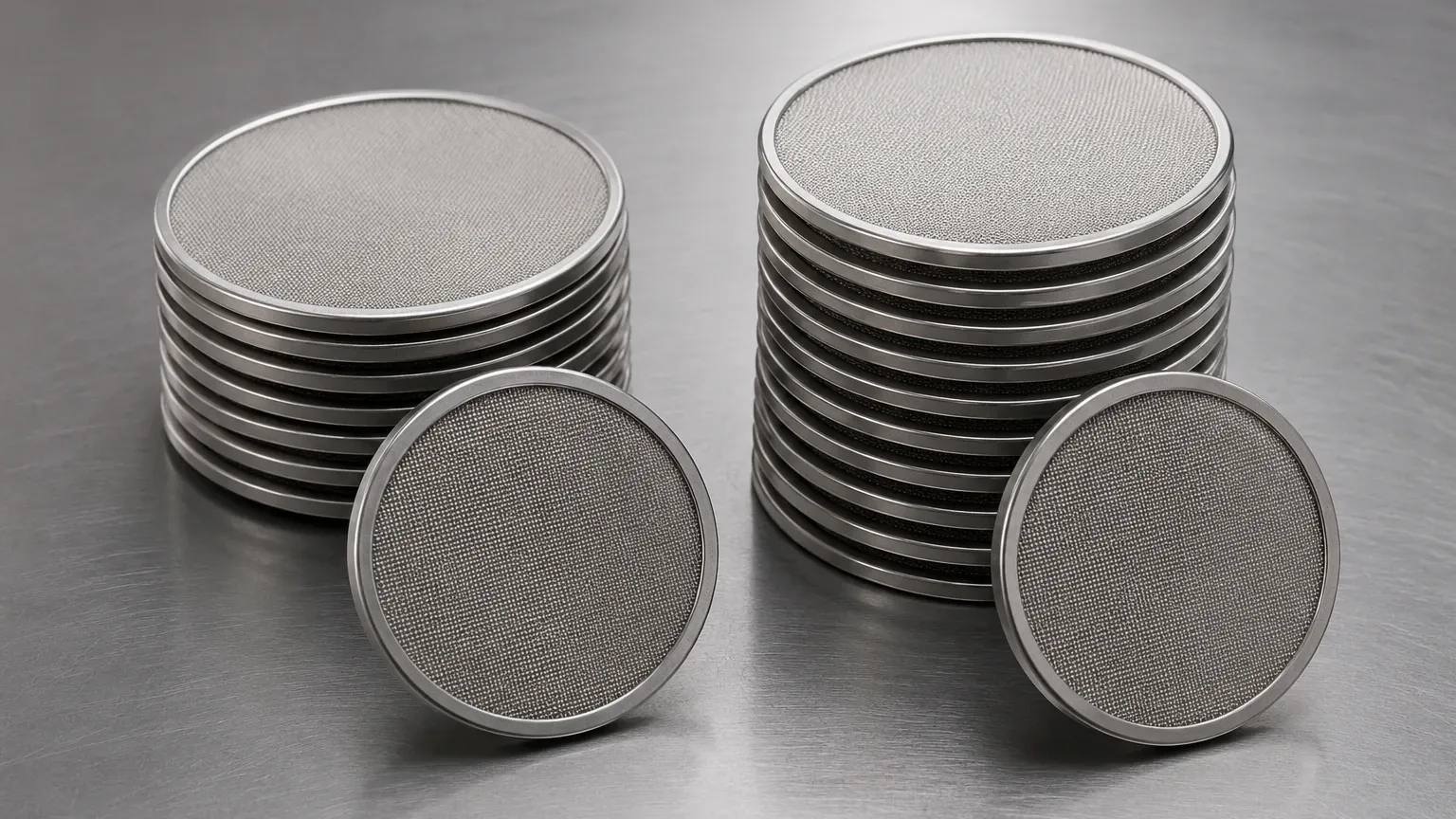
Customization Options in Filter Pack Design
At Kaifil, we recognize that the choice between an 8 pack vs 10 pack is rarely binary. Industrial filtration often requires bespoke solutions that bridge the gap between standard configurations. Customization options include:
* Rim Binding: Packs can be spot-welded or bound with an aluminum, stainless steel, or copper rim. The rim ensures that all layers stay perfectly aligned and provides a better seal within the filter housing, preventing bypass.
* Graduated Density: We can design 10-layer packs that utilize a "coarse-to-fine-to-coarse" arrangement, which maximizes the structural support while optimizing the flow path.
* Pleated vs. Flat: For applications requiring even more surface area, the multilayer pack can be pleated before being encased in a disc frame, though this is more common in cartridge-style filters than in flat discs.
Common Risks and Selection Pitfalls
Engineers should be wary of several common mistakes when deciding between 8 and 10 layers:
1. Over-Filtration: Choosing a 10-layer pack with excessively fine mesh can lead to rapid blinding (clogging) and high pressure spikes if the upstream contamination is not properly managed. Sometimes, an 8-layer pack with a slightly coarser micron rating is more efficient for the overall process.
2. Inadequate Support: Using an 8-layer pack in a high-pressure system without verifying the strength of the support mesh can lead to mechanical failure. If the pack flexes too much, the seal at the edges may break.
3. Ignoring the Housing Gap: The physical thickness of the pack is a constraint. A 10-layer pack is thicker than an 8-layer pack. It is essential to confirm that the filter holder or screen changer can accommodate the extra thickness without compromising the seal or interfering with the mechanical movement of the changer.
Conclusion: Making the Informed Choice
The decision between an 8 pack vs 10 pack configuration depends on a balanced evaluation of your specific process requirements. If your priority is maximum service life, high-pressure stability, and the finest possible filtration, the 10-layer configuration is typically the superior choice. If your system is sensitive to pressure drops, operates with high-viscosity fluids, or has limited physical space in the filter housing, the 8-layer pack offers a high-performance, streamlined alternative.
For technical teams looking to optimize their filtration processes, consulting with a manufacturer that understands the nuances of wire mesh behavior is essential. By analyzing your fluid properties and operational goals, you can select a pack configuration that ensures consistent product quality and operational efficiency. Explore the full range of Filter Discs & Packs to find the ideal match for your industrial application.
