


Black and Mild Filter Packs
In the landscape of industrial filtration, the term "black and mild filter packs" often refers to specialized filtration components constructed from black wire cloth (carbon steel) or mild steel frames. While stainless steel remains the gold standard for high-corrosion environments, these carbon-based steel variants serve critical roles in specific industrial applications where cost-efficiency and specific mechanical properties are prioritized. For engineers and procurement teams, understanding the technical distinctions between material grades, mesh configurations, and structural designs is essential for optimizing the performance of Filter Discs & Packs.
Industrial filter packs are multi-layered or single-layer components designed to remove impurities from fluids, gases, or molten polymers. The selection of materials—ranging from high-grade stainless steel to black and mild steel—directly impacts the filtration system's longevity, pressure resistance, and chemical compatibility. This guide examines the engineering considerations behind these components and how to select the right configuration for demanding industrial environments.
Understanding Material Composition: Black Wire vs. Mild Steel
When discussing "black and mild" in a B2B filtration context, the focus is typically on the metallurgical properties of the mesh and the support rims.
Black Wire Cloth (Carbon Steel)
Black wire cloth is manufactured from low-carbon steel. It is referred to as "black" because it lacks the chromium and nickel content found in stainless steel, which often results in a darker, oxidized appearance or requires a protective oil coating to prevent rust during storage. In filtration, black wire mesh is valued for its high tensile strength and affordability. It is frequently utilized in the plastic and rubber extrusion industries where the environment is relatively non-corrosive, but the mechanical stress on the filter is high.
Mild Steel Components
Mild steel, or low-carbon steel, is often used for the outer rims or frames of multi-layered filter packs. Because mild steel is more ductile and easier to weld than high-carbon steel or certain stainless grades, it provides a cost-effective structural support for the filtration media. In applications where the filter is a consumable part replaced at high frequencies, the use of mild steel rims can significantly reduce the total cost of ownership without compromising the integrity of the filtration process.
Engineering Considerations for Filter Discs & Packs
Designing an effective filtration solution requires more than just selecting a material. Engineers must evaluate several technical parameters to ensure the filter pack can withstand the operational rigors of the machinery.
Mesh Count and Micron Rating
The filtration accuracy is determined by the mesh count (the number of openings per linear inch) and the wire diameter. For black and mild filter packs used in polymer melt filtration, the mesh count can range from coarse (20 mesh) to very fine (up to 500 mesh). The micron rating must be precisely matched to the particle size of the contaminants to be removed. A finer mesh provides higher purity but results in a higher initial pressure drop.
Weave Types
The weave pattern of the wire cloth affects both flow rate and strength:
* Plain Weave: The most common pattern, offering a straightforward path for fluid and consistent pore sizes.
* Dutch Weave: Uses larger diameter wires in the warp and smaller wires in the shute, creating a denser, stronger mesh suitable for high-pressure applications.
* Twilled Weave: Allows for thicker wires in a given mesh count, increasing the durability of the disc.
Pressure Drop and Flow Capacity
Every filter introduces a resistance to flow, known as pressure drop ($ΔP$). In industrial systems, maintaining a stable flow rate is critical. Engineers must calculate the effective filtration area (EFA) of the Filter Discs & Packs to ensure that the system does not exceed the maximum allowable pressure, which could lead to media migration or mechanical failure of the filter pack.
Structural Design of Multilayer Filter Packs
Single-layer discs are often insufficient for complex industrial processes. Multilayer filter packs are engineered to provide graduated filtration and enhanced structural support.
Layer Sequencing
A typical multilayer pack consists of several layers of varying mesh counts. The sequence usually follows a "coarse-fine-coarse" arrangement. The coarse layers act as support (protecting the fine mesh from deforming under pressure) and as a pre-filter (capturing larger particles before they reach the primary filtration layer). This graduated approach extends the service life of the pack by preventing the fine mesh from blinding prematurely.
Bonding and Edging Techniques
To ensure the layers remain intact during high-pressure flow, several bonding methods are employed:
* Spot Welding: Individual layers are welded at specific points. This is common for simple disc stacks.
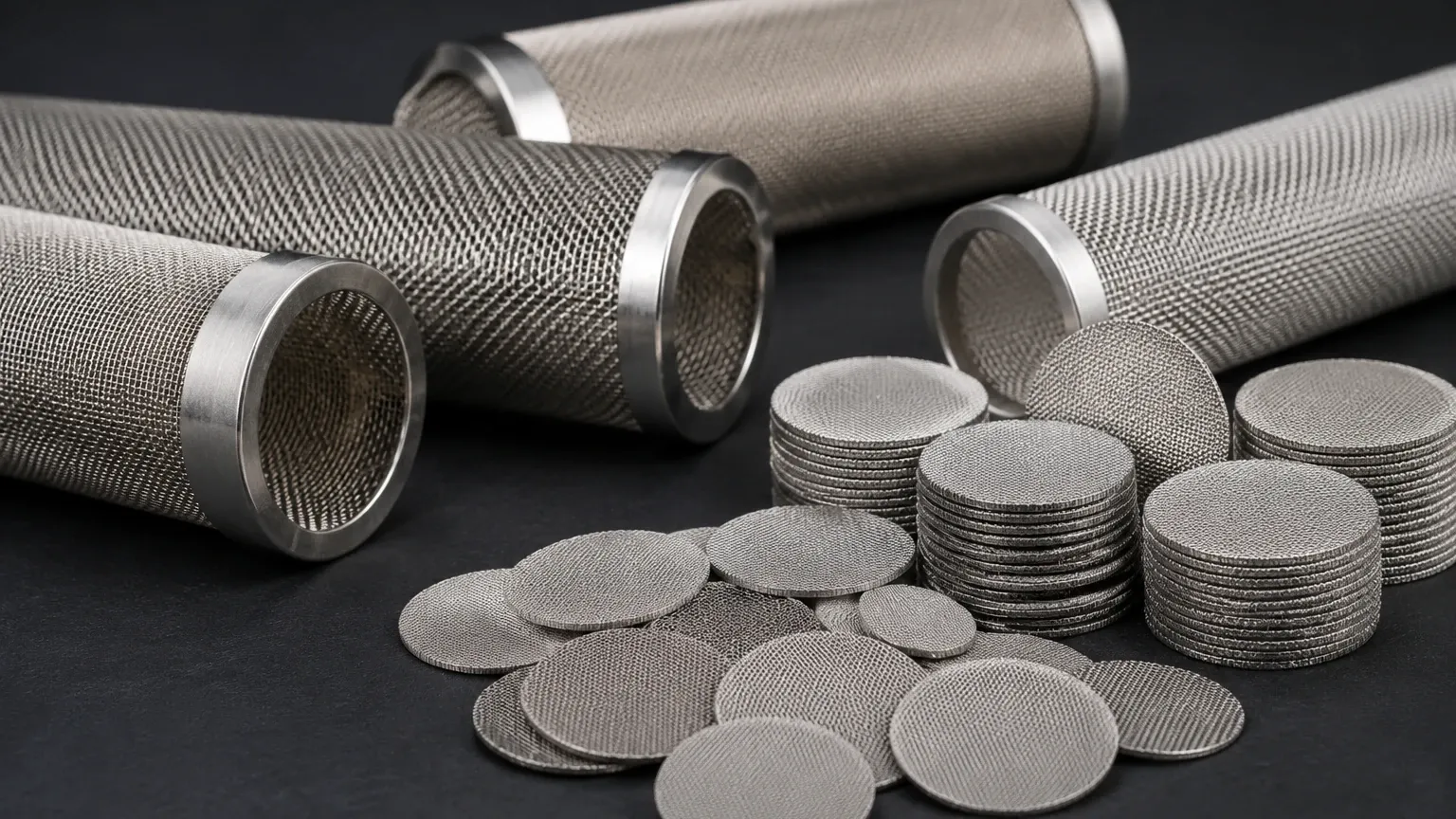
* Rimmed Edges: The layers are encased in a metal rim (often mild steel, aluminum, or copper). The rim provides a secondary seal, preventing fluid bypass at the edges and making the pack easier to handle during installation.
* Sintering: For the most demanding applications, layers are diffusion-bonded (sintered) in a vacuum furnace. This creates a monolithic structure that will not delaminate even under extreme heat or reverse flow conditions.
Performance Evaluation and Common Risks
When implementing black and mild filter packs, technical professionals must be aware of the inherent risks and performance trade-offs compared to stainless steel alternatives.
Corrosion and Oxidation
The primary risk with carbon-based steel filters is oxidation. If the process fluid contains water, oxygen, or corrosive chemicals, black wire mesh will rust. This not only destroys the filter but also introduces iron oxide contaminants into the downstream product. Therefore, these filters are strictly reserved for oil-based fluids, polymers, or dry gas applications where moisture is absent.
Media Migration
In low-quality filter packs, individual wires may break and enter the flow stream. This is known as media migration. To mitigate this, engineers should specify "clean-cut" edges or rimmed designs that secure the wire ends. High-quality manufacturing processes, such as those utilized by Kaifil, ensure that the integrity of the mesh is maintained throughout the production cycle.
Thermal Stability
Carbon steel and mild steel have different thermal expansion coefficients than stainless steel. In high-temperature extrusion (exceeding 300°C), the expansion of the filter pack must be accounted for in the housing design to prevent bypass or jamming.
Customization and OEM Capabilities
Industrial filtration is rarely a one-size-fits-all solution. Customization is often required to meet the specific geometry of the filter changer or the unique viscosity of the fluid.
Custom Geometries
While circular discs are standard, many machines require oval, rectangular, or kidney-shaped filter packs. Precision stamping and laser cutting technologies allow for the production of these shapes with high dimensional accuracy, ensuring a perfect fit within the machinery housing.
Material Hybridization
In some cases, a hybrid approach is the most effective. For instance, a filter pack may utilize stainless steel fine mesh for its chemical resistance, supported by mild steel coarse mesh to reduce costs. This type of customization allows companies to balance performance requirements with budgetary constraints.
OEM Specifications
For original equipment manufacturers (OEMs), consistency is paramount. B2B suppliers like Kaifil provide documented quality control, ensuring that every batch of Filter Discs & Packs meets the exact wire diameter, mesh count, and metallurgical specifications required by the equipment design.
Maintenance, Lifecycle, and Cost Considerations
The total cost of filtration includes not only the purchase price but also the cost of downtime, labor for replacement, and the potential cost of product contamination.
Replacement Cycles
Black and mild filter packs are typically treated as disposables. Unlike heavy-duty stainless steel cartridges that can be ultrasonically cleaned and reused, carbon steel mesh is difficult to clean without inducing rust. Therefore, the replacement cycle is determined by the pressure differential. Once the $ΔP$ reaches a predetermined threshold, the pack is swapped for a new one.
Storage and Handling
Due to the susceptibility of carbon steel to environmental moisture, these filter packs must be stored in VCI (Volatile Corrosion Inhibitor) packaging or kept in a climate-controlled, low-humidity environment. Proper handling with gloves is also recommended to prevent skin oils from initiating localized corrosion.
Economic Impact
For high-volume operations, such as recycled plastic pelletizing, the cost difference between stainless steel and black wire cloth can be substantial. When the process allows for it, switching to a high-quality mild steel or black wire filter pack can reduce annual consumable spend by 20-40% without sacrificing filtration quality.
Conclusion: Selecting the Right Solution
Choosing between stainless steel and black and mild filter packs requires a thorough analysis of the operating environment, the required filtration precision, and the economic goals of the facility. While stainless steel offers superior longevity and chemical resistance, carbon-based steel components provide a robust and cost-effective alternative for specific oil-based and high-heat applications.
Engineers should confirm the following before finalizing a purchase:
1. Chemical Compatibility: Is the fluid non-corrosive to carbon steel?
2. Pressure Requirements: Does the pack design (rimmed vs. spot-welded) support the expected $ΔP$?
3. Micron Accuracy: Does the mesh count align with the purity standards of the end product?
4. Dimensional Tolerance: Will the pack fit the existing filter changer without bypass?
By partnering with an experienced manufacturer like Kaifil, technical teams can access the expertise needed to design and source reliable Filter Discs & Packs that optimize industrial throughput and protect sensitive downstream equipment.
