


Brita Microdisc Replacement Filter Discs
In the realm of point-of-use water treatment and specialized industrial fluid processing, the geometry of the filter medium significantly influences both performance and system design. The concept of the "Microdisc" represents a specific engineering approach to filtration: maximizing surface area within a minimal footprint. While many users encounter this technology through consumer applications such as brita microdisc replacement filter discs, the underlying principles of disc-based filtration are foundational to high-precision industrial processes.
For engineers and procurement professionals, understanding the mechanics of these compact filtration components is essential when evaluating performance expectations, replacement cycles, and material compatibility. Whether the application involves municipal water refining or complex chemical processing, the selection of Filter Discs & Packs requires a deep dive into material science and fluid dynamics.
The Engineering Logic Behind Disc Filtration
Disc filtration is favored in systems where space is at a premium and high flow rates must be maintained without a significant pressure drop. In a traditional cylindrical cartridge, fluid often travels through multiple layers of media, which can increase resistance. In contrast, a disc-shaped filter provides a direct, perpendicular path for the fluid, which optimizes the contact time with the media while keeping the physical profile of the housing slim.
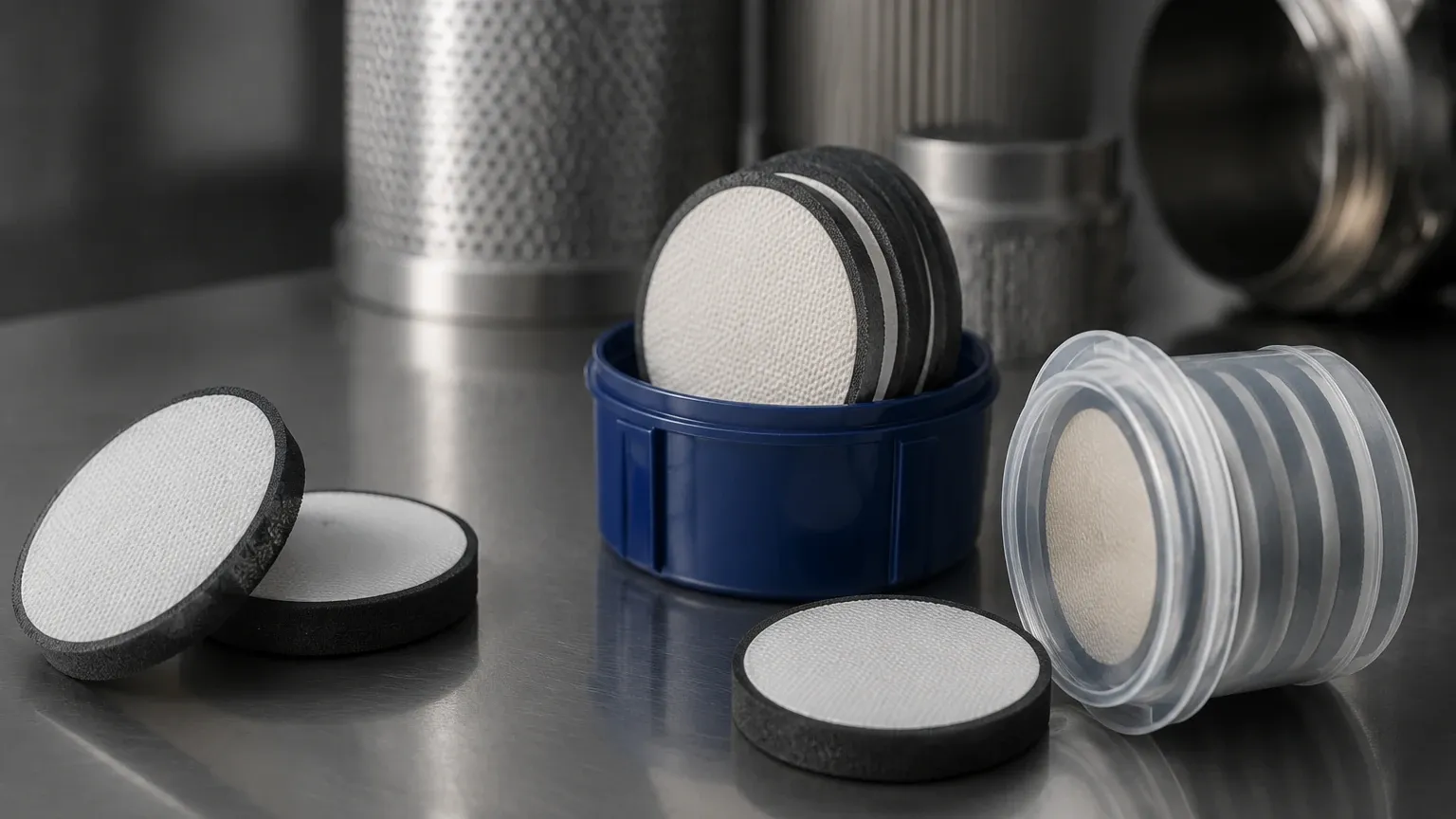
When analyzing brita microdisc replacement filter discs, the primary mechanism is adsorption and mechanical straining. These discs typically utilize compressed activated carbon blocks. From an industrial perspective, this is a form of depth filtration where the tortuous path within the carbon matrix traps organic compounds and chlorine. In industrial settings, however, these discs are often replaced or augmented by stainless steel wire mesh or sintered metal discs to handle higher pressures, temperatures, and aggressive chemical environments.
Key Advantages of the Disc Form Factor:
* Space Efficiency: Allows for slim-profile housings in both handheld and inline configurations.
* Uniform Flow Distribution: Reduces the risk of "channeling," where fluid bypasses the filter media through paths of least resistance.
* Modularity: Multiple discs can be stacked into "packs" to increase filtration capacity without redesigning the entire system.
Material Science: Carbon vs. Metallic Media
The effectiveness of brita microdisc replacement filter discs is largely due to the use of ActivSelect technology, which focuses on reducing chlorine and micro-particles while preserving essential minerals. This is a specific requirement for potable water. However, in B2B and industrial contexts, the material requirements shift toward durability and chemical resistance.
Activated Carbon Discs
Carbon-based discs are excellent for removing taste, odor, and organic contaminants. They function through a process of adsorption, where pollutants stick to the vast internal surface area of the carbon. The limitation of these discs in an industrial environment is their structural fragility and susceptibility to clogging if high levels of suspended solids are present. This is why replacement cycles for brita microdisc replacement filter discs are strictly defined—usually by a specific gallonage or time frame (e.g., four weeks).
Stainless Steel Filter Discs
For industrial engineers, stainless steel is often the material of choice for Filter Discs & Packs. Unlike carbon discs, which are disposable, stainless steel discs offer:
* High Temperature Resistance: Capable of operating in environments exceeding 400°C.
* Mechanical Strength: Withstands high differential pressures without deforming.
* Cleanability: Can be backwashed or ultrasonically cleaned, extending the service life significantly compared to a standard brita microdisc replacement filter discs.
Performance Metrics and Micron Ratings
When selecting a replacement filter disc, the micron rating is the most critical technical specification. It defines the size of the particles that the filter can successfully intercept.
In the case of brita microdisc replacement filter discs, the focus is on micro-particles and specific contaminants like chlorine. In industrial applications, the micron rating must be precisely matched to the process requirements. A rating that is too fine will lead to premature clogging and increased maintenance costs, while a rating that is too coarse will allow contaminants to pass through, potentially damaging downstream equipment like high-pressure pumps or sensitive nozzles.
Understanding Absolute vs. Nominal Ratings
* Nominal Rating: An approximate value indicating that the filter can intercept a major percentage of particles of a certain size.
* Absolute Rating: A guaranteed value where 99.9% of particles above a specific size are retained.
Industrial-grade metal filter discs are often rated absolutely, providing the level of certainty required in pharmaceutical or food and beverage manufacturing. When engineers evaluate brita microdisc replacement filter discs, they are essentially looking at a specialized nominal filter designed for a specific set of municipal water parameters.
Replacement Cycles and Total Cost of Ownership (TCO)
One of the most common questions regarding filtration is: "When should the filter be replaced?" For consumer products like brita microdisc replacement filter discs, the answer is usually simplified for the end-user. However, in a B2B environment, the replacement cycle is determined by the "Terminal Pressure Drop."
As a filter disc captures contaminants, the pores become restricted. This leads to an increase in the pressure required to push fluid through the disc. Once this pressure reaches a predetermined limit, the disc must be replaced or cleaned.
Factors Influencing Replacement Frequency:
1. Contaminant Loading: The concentration of solids in the influent fluid.
2. Flow Velocity: Higher flow rates can compress the contaminant cake, leading to faster clogging.
3. Fluid Viscosity: Thicker fluids create higher initial pressure drops, shortening the effective life of the disc.
From a TCO perspective, while the unit price of a single brita microdisc replacement filter discs may seem low, the cumulative cost of frequent replacements in a high-volume industrial setting can be substantial. This is why many facilities opt for custom-engineered stainless steel Filter Discs & Packs that offer a higher initial investment but a much lower long-term cost due to their durability and reusability.
Customization and OEM Solutions
In many industrial scenarios, off-the-shelf solutions do not meet the specific needs of a unique fluid path. This is where OEM (Original Equipment Manufacturer) capabilities become vital. While brita microdisc replacement filter discs are standardized for specific consumer carafes and bottles, industrial discs can be customized in several ways:
* Layering: Combining different mesh counts (e.g., a coarse outer layer for structural support and a fine inner layer for precision filtration).
* Edge Treatment: Discs can be spot-welded, bound with aluminum or stainless steel rims, or sintered to ensure no loose wires or fibers migrate into the filtrate.
* Shape and Diameter: Beyond simple circles, discs can be produced in oval, rectangular, or complex geometric shapes to fit specialized machinery.
For a design engineer, the ability to specify the exact alloy (such as 316L for superior corrosion resistance) and the precise mesh weave (such as Dutch weave for high-pressure applications) is what separates a standard consumer filter from a high-performance industrial component.
Technical Considerations for Installation and Maintenance
Proper installation is paramount to ensure that the fluid does not bypass the filter disc. In systems using brita microdisc replacement filter discs, the housing is designed to create a tight seal around the perimeter of the disc. In industrial housings, this is often achieved through mechanical clamping or the use of gaskets.
Installation Checklist for Engineers:
* Orientation: Ensure the disc is installed with the correct side facing the flow if it is a multi-layered or asymmetric pack.
* Seal Integrity: Inspect the housing seats for any debris that could prevent a flush fit.
* Venting: Ensure that air is bled from the system after a replacement to prevent air-locking or pressure spikes.
Maintenance protocols should also include regular monitoring of the differential pressure. By logging these values, maintenance teams can predict the remaining life of the filter and schedule replacements during planned downtime, rather than reacting to a system failure.
Conclusion: Selecting the Right Filtration Component
Whether you are maintaining a fleet of office water dispensers using brita microdisc replacement filter discs or managing a large-scale chemical refinery, the principles of effective filtration remain the same. It is a balance of material compatibility, micron precision, and economic viability.
For those requiring robust, high-precision, and customizable solutions, industrial-grade Filter Discs & Packs provide the reliability needed for demanding environments. By understanding the technical nuances of disc filtration—from the adsorption properties of carbon to the mechanical strength of stainless steel—engineers can optimize their systems for peak performance and longevity.
When evaluating your next filtration requirement, consider not just the immediate replacement cost, but the total performance profile of the disc. Choosing a high-quality component ensures that your process remains clean, your equipment stays protected, and your operational costs remain predictable.
