


Ceramic Filter Discs
In the demanding landscape of industrial filtration, material selection is often the determining factor between operational efficiency and frequent system failure. While stainless steel remains the industry standard for a wide range of applications, certain environments—characterized by extreme temperatures, highly corrosive chemicals, or specific purity requirements—necessitate the use of ceramic media. Ceramic filter discs represent a specialized segment within the broader category of Filter Discs & Packs, providing engineers with a robust solution for deep-bed and surface filtration where metallic or polymer-based media might reach their physical limits.
Understanding the technical nuances of ceramic filter discs is essential for procurement teams and plant engineers. This guide examines the material properties, engineering considerations, and application-specific advantages of ceramic media, while also exploring how they integrate into comprehensive filtration systems alongside traditional metal components.
Understanding Ceramic Filter Discs in Industrial Applications
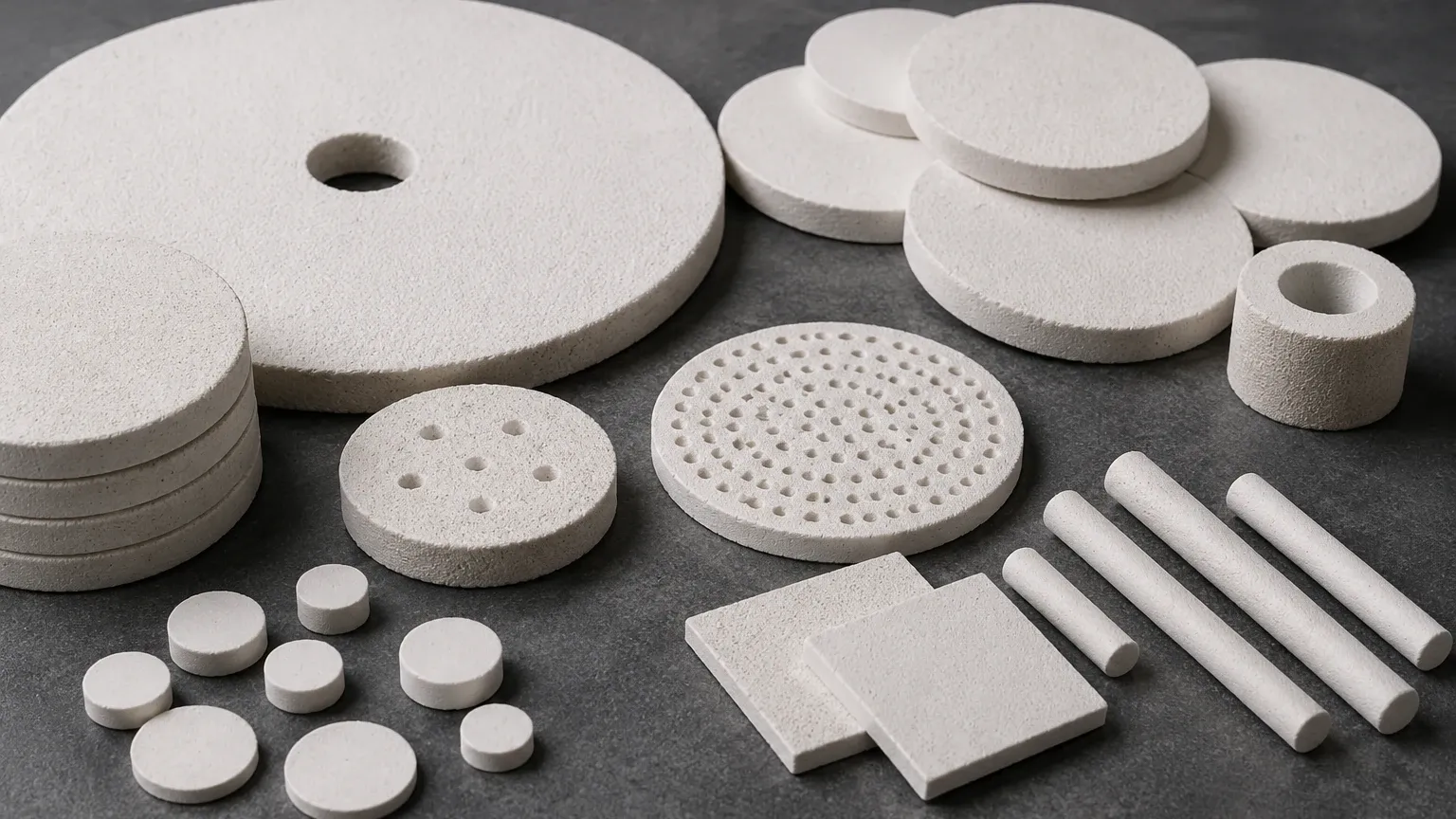
Ceramic filter discs are porous structures manufactured through the controlled sintering of inorganic, non-metallic materials. Unlike woven wire mesh, which relies on a geometric weave pattern, ceramic discs utilize a complex, three-dimensional pore network. This structure allows for high-efficiency particle retention through both surface sieving and depth filtration mechanisms.
From a manufacturing perspective, these discs are produced by mixing ceramic powders with organic binders and pore-forming agents. The mixture is pressed into a disc shape and fired at high temperatures. During the firing process, the binders burn off, leaving behind a rigid, interconnected pore structure. The resulting component is characterized by high porosity (often between 30% and 50%), exceptional hardness, and a high degree of chemical inertness.
In the context of industrial filtration, these discs are frequently used as standalone elements or as part of multi-stage filter assemblies. Their rigidity ensures that the pore structure remains stable even under high differential pressure, preventing the "unloading" of captured contaminants—a common failure mode in flexible filter media.
Material Composition and Technical Specifications
The performance of a ceramic filter disc is primarily dictated by its base material. Engineers must select the material based on the specific chemical and thermal profile of the process fluid.
Alumina (Al2O3)
Alumina is the most widely used material for ceramic filtration. It offers a balanced profile of mechanical strength, wear resistance, and cost-effectiveness. Alumina discs are suitable for temperatures up to 1,500°C and exhibit excellent resistance to most acids and alkalis, making them a staple in chemical processing and pharmaceutical manufacturing.
Silicon Carbide (SiC)
Silicon carbide is preferred for applications involving extreme thermal shock. It possesses high thermal conductivity and a low coefficient of thermal expansion, allowing it to withstand rapid temperature fluctuations that might crack alumina. SiC is frequently used in hot gas filtration and molten metal processing.
Zirconia (ZrO2)
Zirconia is utilized when maximum fracture toughness is required. It is highly resistant to chemical erosion and is often used in specialized biotechnology and medical applications where high-purity filtration is non-negotiable. Zirconia also performs exceptionally well in high-temperature environments where oxygen ion conductivity is required, such as in certain electrochemical sensors or fuel cell components.
Comparing Ceramic and Stainless Steel Filter Discs
For many engineering teams, the primary decision point is choosing between ceramic media and stainless steel Filter Discs & Packs. Both materials offer distinct advantages, and the choice depends on the specific operational constraints.
Thermal Limits
Stainless steel filters (typically 304 or 316L) are generally rated for continuous use up to 400°C–500°C in oxidizing atmospheres. Beyond these temperatures, oxidation and loss of mechanical strength become concerns. Ceramic discs, by contrast, are inherently stable at much higher temperatures, often exceeding 1,000°C, making them the only viable choice for high-temperature exhaust gas cleaning or molten glass filtration.
Chemical Compatibility
While 316L stainless steel offers excellent resistance to many industrial fluids, it can succumb to pitting or stress corrosion cracking in the presence of high concentrations of chlorides or strong oxidizing acids at elevated temperatures. Ceramic materials are virtually immune to these types of corrosion, providing a longer service life in aggressive chemical environments.
Mechanical Characteristics
The most significant drawback of ceramic filter discs is their brittleness. Unlike stainless steel, which can withstand vibration, mechanical impact, and high tensile stress, ceramic discs are susceptible to cracking if mishandled or if the housing is not properly designed to accommodate their rigid nature. Stainless steel filter packs are often preferred in high-vibration environments or applications where the filter must be frequently removed and cleaned manually.
Engineering Considerations for Selection
Specifying a ceramic filter disc requires a detailed analysis of the process parameters. Engineers should focus on the following technical criteria to ensure optimal performance:
Pore Size and Distribution
Ceramic discs are available in a wide range of micron ratings, from sub-micron (0.1 μm) for sterile filtration to several hundred microns for coarse pre-filtration. However, the *distribution* of pore sizes is just as critical as the nominal rating. A narrow pore size distribution ensures consistent filtration efficiency and predictable flow rates. In depth filtration, the thickness of the disc also plays a role in the total dirt-holding capacity.
Permeability and Pressure Drop
The interconnected nature of ceramic pores creates a tortuous path for the fluid. While this increases filtration efficiency, it also results in a higher initial pressure drop compared to thin-layered wire mesh. Engineers must calculate the required surface area to maintain the desired flow rate without exceeding the maximum allowable differential pressure ($ΔP$) for the system.
Sealing and Mounting
Because ceramics do not deform, achieving a leak-proof seal in a metal housing requires careful engineering. Thermal expansion mismatch between the ceramic disc and the metal holder is a common cause of failure. High-temperature gaskets, such as graphite or specialized elastomers, are typically used to provide a cushion and ensure a tight seal without applying localized stress to the ceramic edge.
Critical Applications for Ceramic Filtration
Ceramic filter discs are utilized across diverse industries where standard filtration media fail to meet the performance requirements.
* Chemical Processing: Used for the filtration of concentrated acids, organic solvents, and corrosive catalysts. Their ability to withstand chemical attack ensures that the filtrate remains free of metallic ions that could contaminate the final product.
* Hot Gas Filtration: In power generation and waste incineration, ceramic discs are used to remove particulate matter from flue gases at temperatures exceeding 600°C. This protects downstream equipment like heat exchangers and turbines from erosion and fouling.
* Molten Metal Filtration: In foundries, ceramic discs (often SiC) are used to filter impurities from molten aluminum or iron before casting. This reduces defects in the final cast parts and improves mechanical properties.
* Biotechnology and Pharmaceuticals: Ceramic media are used in the production of high-purity chemicals and active pharmaceutical ingredients (APIs). Their inert nature prevents leaching, and their ability to withstand steam sterilization (SIP) and clean-in-place (CIP) cycles makes them ideal for aseptic processes.
Maintenance and Cleaning Protocols
The total cost of ownership for ceramic filter discs is often lower than disposable options due to their cleanability. However, the cleaning process must be handled with precision to avoid thermal or mechanical shock.
Backwashing and Backpulsing
Many industrial systems utilize automated backwashing, where a reverse flow of fluid or gas is used to dislodge the filter cake. Ceramic discs are well-suited for this because their rigid structure does not flex or distort during the pressure pulse, ensuring that the pores are effectively cleared.
Thermal Regeneration
In applications involving organic contaminants, ceramic discs can be cleaned through a "burn-off" process. By heating the disc in a controlled furnace, organic matter is oxidized and removed, restoring the original permeability of the media. This is a significant advantage over metal filters, which may undergo metallurgical changes if subjected to the temperatures required for complete organic removal.
Chemical and Ultrasonic Cleaning
For inorganic scaling, ceramic discs can be soaked in strong acids or bases that would destroy other filter types. Ultrasonic cleaning is also effective, provided the frequency and power are calibrated to avoid inducing micro-cracks in the ceramic matrix.
Customization and Integration
While ceramic discs offer unique benefits, they are often used in conjunction with metal filtration components to create a complete solution. For example, a system might use a coarse stainless steel mesh as a pre-filter to protect a fine ceramic disc from large debris, or a ceramic disc might be encased in a stainless steel protective shroud to improve its mechanical handling characteristics.
As a manufacturer of custom filtration solutions, Kaifil provides a wide range of Filter Discs & Packs designed to meet specific industrial requirements. Whether the application calls for the durability of multi-layer stainless steel mesh or the specialized properties of ceramic media, the selection process must be guided by technical data and application-specific constraints.
When evaluating ceramic filter discs for your next project, it is essential to confirm the chemical composition of the process fluid, the maximum operating temperature, and the expected mechanical loads. By aligning these factors with the appropriate ceramic material and pore structure, engineers can achieve reliable, long-term filtration performance in even the most challenging environments.
