


Difference Between Screen Filter and Disc Filter
In industrial filtration, selecting the appropriate media is a critical engineering decision that directly impacts process efficiency, equipment longevity, and product purity. Two of the most common technologies employed across chemical processing, water treatment, and hydraulic systems are screen filters and disc filters. While both serve the fundamental purpose of removing suspended solids from a fluid stream, they operate on different physical principles and offer distinct advantages depending on the nature of the contaminants.
Understanding the technical difference between screen filter and disc filter systems allows engineers to optimize filtration performance while minimizing the total cost of ownership. This guide examines the engineering considerations, material properties, and application-specific factors that differentiate these two filtration methods.
The Fundamentals of Screen Filtration
Screen filters are primarily characterized by their use of a thin, perforated, or woven medium to capture particles. In industrial settings, these are frequently constructed from stainless steel wire mesh, which provides high mechanical strength and thermal resistance. The filtration process occurs almost entirely on the surface of the medium.
Mechanism of Action
Screen filters operate via surface filtration. When a fluid passes through the mesh, any particle larger than the mesh opening (the micron rating) is physically blocked. This creates a clear-cut separation based on particle size. Over time, as particles accumulate on the surface, they may form a "filter cake," which can actually increase filtration efficiency but also leads to a rapid increase in pressure drop.
Construction and Formats
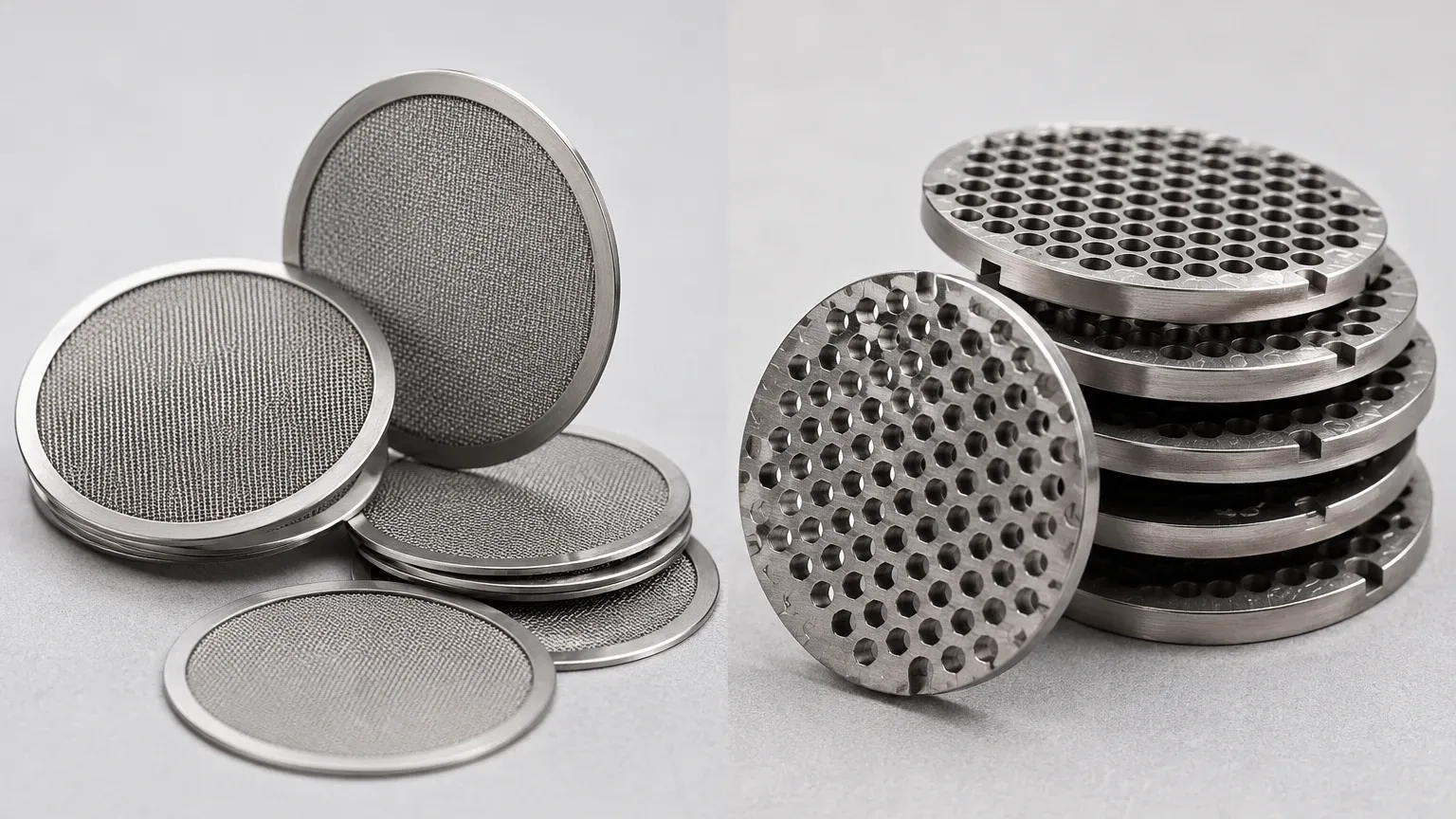
Screen filters are highly versatile in their physical configuration. They can be manufactured as cylindrical cartridges, pleated elements, or Filter Discs & Packs. The use of multi-layer sintered wire mesh is common in high-pressure applications, where several layers of mesh are bonded together to provide both fine filtration and structural support. This construction is particularly effective for removing hard, spherical, or granular particulates.
The Fundamentals of Disc Filtration
Disc filters represent a hybrid between surface and depth filtration. They consist of a stack of thin, grooved discs compressed together on a central spine. The grooves on the surface of each disc are cut to a specific micron size, and when stacked, the grooves of adjacent discs intersect to create a complex network of traps.
Mechanism of Action
As fluid enters the disc stack from the outside, it is forced through the channels created by the compressed grooves. Unlike the single-layer barrier of a screen, a disc filter forces the fluid to travel through a three-dimensional path. This allows the filter to capture particles not only on the outer surface but also within the depths of the disc stack. This depth filtration capability makes disc filters exceptionally effective at handling organic matter, algae, and irregularly shaped contaminants that might otherwise "needle" through a flat screen.
Construction and Compression
The efficiency of a disc filter is highly dependent on the compression force applied to the stack. In many industrial designs, a spring or hydraulic mechanism keeps the discs tightly packed during the filtration cycle. During the cleaning or backwash cycle, the compression is released, allowing the discs to separate and spin, which facilitates the centrifugal removal of trapped debris.
Key Engineering Comparisons: Difference Between Screen Filter and Disc Filter
When evaluating the difference between screen filter and disc filter technologies, engineers must look beyond the basic micron rating and consider how the filter interacts with the specific particulate profile of the process fluid.
1. Filtration Geometry: Surface vs. Depth
The most significant technical difference is the geometry of the filtration path. Screen filters provide a two-dimensional barrier. This is ideal for applications where the particulate size is consistent and the goal is absolute retention of particles above a certain size. However, if the fluid contains a high concentration of "slimy" or organic solids, a screen can blind (clog) quickly.
Disc filters provide a three-dimensional filtration volume. By utilizing the space between the stacked discs, they offer a much higher dirt-holding capacity for deformable or fibrous materials. While a screen filter might plug when a layer of algae covers its surface, a disc filter can continue to function as the contaminants are distributed throughout the depth of the grooves.
2. Pressure Drop and Flow Characteristics
Screen filters typically exhibit a lower initial pressure drop ($ΔP$) because of their high open-area ratio. The fluid encounters very little resistance as it passes through the thin mesh. This makes them preferable for high-flow systems where energy consumption and pump head are critical constraints.
Disc filters generally have a higher initial pressure drop due to the tortuous path the fluid must take. However, their pressure drop often increases more slowly than that of a screen filter when processing fluids with high organic loads, leading to longer intervals between cleaning cycles in specific environments.
3. Cleaning and Maintenance Cycles
Screen filters are relatively easy to clean, especially when using automated backwashing systems. Because the debris is trapped on the surface, a simple reversal of flow or a rotating suction scanner can effectively dislodge the particles. In manual systems, Filter Discs & Packs can be removed and ultrasonically cleaned or replaced.
Disc filters require a more complex backwashing mechanism. To clean a disc stack effectively, the discs must be decompressed so that the trapped particles within the grooves can be flushed out. While this process is highly effective, it often requires a higher backwash pressure and more moving parts within the filter housing.
Material Selection and Chemical Compatibility
Material science plays a pivotal role in the performance of both filter types. In industrial B2B environments, the choice of material is dictated by the temperature, pressure, and chemical nature of the fluid.
* Stainless Steel (304, 316L, 904L): This is the standard for screen filters in the chemical, pharmaceutical, and food industries. Stainless steel wire mesh offers excellent corrosion resistance and can withstand extreme temperatures that would melt polymer-based filters. Kaifil specializes in these high-durability metallic solutions, ensuring that the filter media does not react with the process fluid.
* Polypropylene and Specialized Polymers: Many disc filters are manufactured from high-grade plastics. These are excellent for water treatment and irrigation because they are immune to rust. However, they are limited by temperature and may not be suitable for aggressive solvent filtration or high-pressure hydraulic circuits where metallic screen filters excel.
Application-Specific Selection Criteria
To determine which technology is best for a specific project, engineers should confirm the following parameters before procurement:
Particulate Type and Concentration
If the contaminants are hard, inorganic solids (like sand, metal shavings, or scale), a screen filter is usually the most efficient choice. The precise pore size of a stainless steel mesh ensures that these solids are captured reliably. If the contaminants are organic, soft, or varied in shape (like algae, oils, or biological waste), the depth filtration of a disc filter is superior.
Required Filtration Accuracy
Screen filters offer very precise absolute micron ratings. Because the mesh is manufactured to tight tolerances, you can be certain that no particle larger than the specified opening will pass through. Disc filters are often rated for "nominal" filtration, meaning they capture a high percentage of particles at a certain size, but the depth-based nature of the grooves allows for some variability.
Operational Continuity
In continuous process industries, the time required for backwashing is a key metric. Screen filters often have shorter backwash cycles, which minimizes the interruption to downstream flow. Disc filters may take longer to clean but can operate for longer periods between cleanings if the particulate load is predominantly organic.
The Role of Customization in Filtration Performance
In many industrial scenarios, a standard off-the-shelf filter may not meet the specific demands of the application. This is where customized engineering becomes essential. For instance, in polymer filtration or high-viscosity chemical processing, a standard screen might collapse under pressure. In these cases, engineers often specify reinforced Filter Discs & Packs that utilize sintered layers or specialized support frames to maintain structural integrity while providing fine filtration.
Customization options include:
* Layer Configuration: Combining different mesh counts to create a graduated filtration effect within a single screen pack.
* Edge Treatment: Using aluminum, stainless steel, or copper rims to ensure a bypass-free seal within the filter housing.
* Surface Coatings: Applying specialized treatments to improve the release of the filter cake during cleaning.
Summary of Differences
| Feature | Screen Filter | Disc Filter |
| :— | :— | :— |
| Filtration Type | Surface (2D) | Depth (3D/Hybrid) |
| Best For | Hard, inorganic particles | Soft, organic, or fibrous particles |
| Micron Precision | High (Absolute) | Moderate (Nominal) |
| Initial Pressure Drop | Low | Moderate to High |
| Dirt Holding Capacity | Lower (per unit area) | Higher (for organic loads) |
| Material | Primarily Stainless Steel Mesh | Primarily Grooved Polymers/Metal |
| Cleaning Method | Surface flush/Suction | Decompression and spinning |
Conclusion
The choice between a screen filter and a disc filter is not a matter of one being universally better than the other, but rather which technology aligns with the physical characteristics of the fluid and the operational goals of the facility. Screen filters, particularly those utilizing high-quality stainless steel mesh, remain the gold standard for precision and durability in demanding industrial environments. Their ability to provide absolute filtration and withstand harsh conditions makes them indispensable in chemical and mechanical engineering.
For engineers and purchasing teams, the next step involves evaluating the specific particulate morphology and flow requirements of the system. By understanding the fundamental difference between screen filter and disc filter mechanisms, you can ensure that your filtration system provides the reliability and performance necessary for optimized industrial production.
Download Difference Between Screen Filter and Disc Filter as a PDF
