


Disc Filter vs Screen Filter
In industrial filtration, selecting the appropriate media is a critical engineering decision that directly impacts operational efficiency, maintenance frequency, and the purity of the final product. Two of the most common technologies employed across chemical processing, hydraulic systems, and water treatment are disc filters and screen filters. While both serve the fundamental purpose of removing solid contaminants from a fluid stream, their internal architectures, filtration mechanisms, and performance characteristics differ significantly.
For engineers and procurement teams, the choice between a disc filter vs screen filter often depends on the specific nature of the suspended solids, the required micron rating, and the allowable pressure drop within the system. This guide provides a technical comparison of these technologies to assist in making an informed selection for demanding industrial applications.
Understanding Screen Filters: Surface Filtration Mechanics
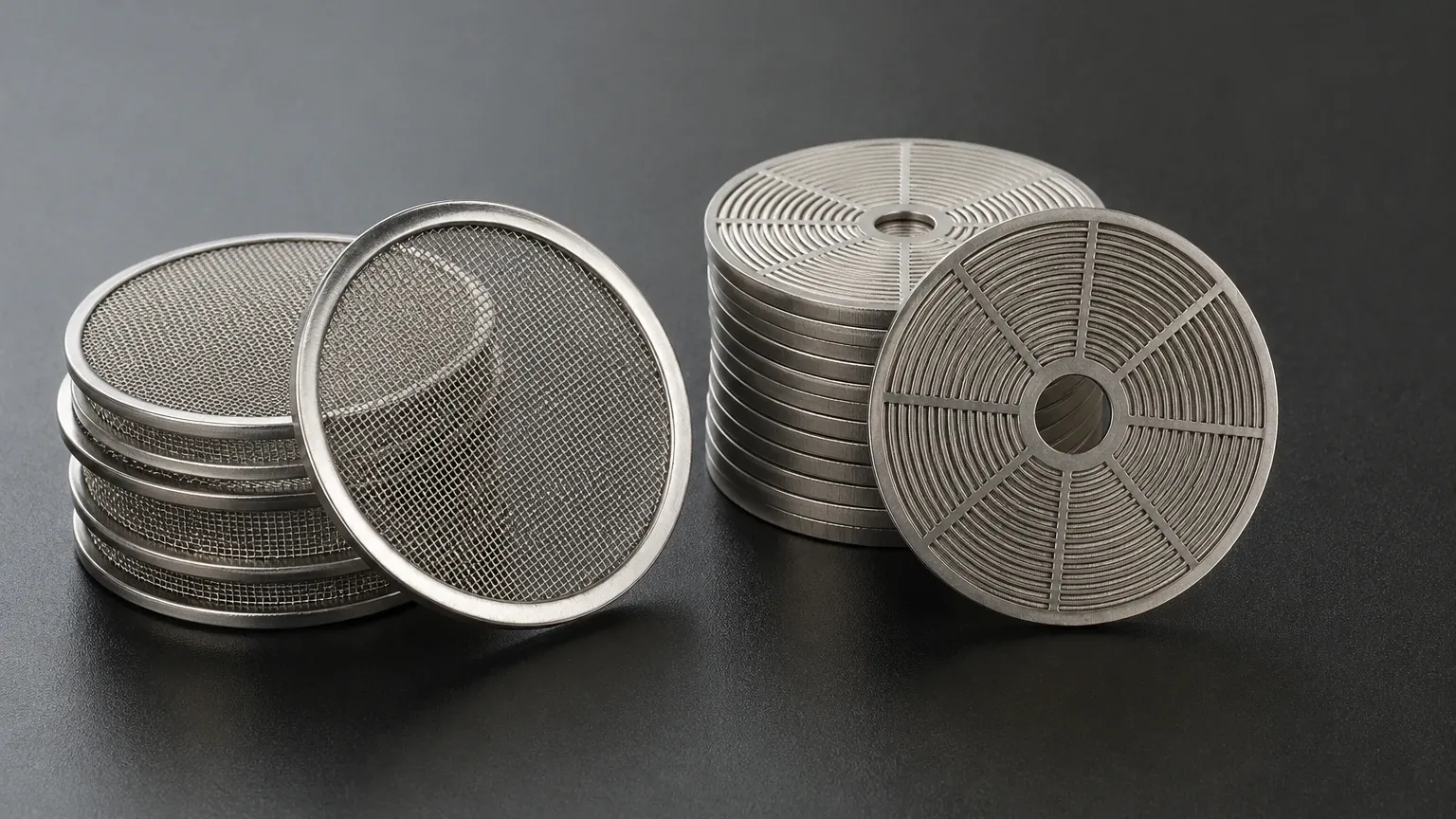
Screen filters are perhaps the most straightforward form of mechanical filtration. They typically consist of a single layer or a simple laminate of stainless steel wire mesh. The filtration process is primarily surface-based; particles larger than the mesh openings are trapped on the upstream side of the screen, while the fluid and smaller particles pass through.
Construction and Mesh Weaves
Industrial screen filters utilize high-grade stainless steel, such as 304 or 316L, to ensure corrosion resistance and structural integrity. The performance of a screen filter is largely determined by its weave type:
* Plain Weave: The simplest form where wires cross over and under each other. It provides high flow rates but is generally limited to coarser filtration.
* Twill Weave: Each shute wire passes successively over and under two warp wires, allowing for a heavier wire diameter and finer mesh counts.
* Dutch Weave: This weave uses a larger diameter warp wire and a smaller diameter shute wire driven closely together. This creates a dense, strong mesh capable of high-pressure resistance and fine filtration ratings.
Advantages and Limitations
Screen filters are valued for their high open area, which translates to low initial pressure drops and high flow capacities. They are ideal for removing rigid, spherical, or granular particles. However, they are susceptible to "blinding" or "plugging" when faced with organic or flexible contaminants, such as algae or soft polymers, which can extrude through the mesh or coat the surface, rapidly increasing the differential pressure.
Understanding Disc Filters: Depth and Stacked Filtration
Disc filters represent a more complex approach to particle separation. In many industrial contexts, particularly in polymer melt and chemical processing, these are referred to as Filter Discs & Packs. These components are often composed of multiple layers of wire mesh, sometimes combined with metal fiber felt or sintered metal, stacked and secured with a rim or spot-welded.
The Depth Filtration Effect
Unlike the single-layer surface filtration of a standard screen, a multi-layer disc pack provides a degree of depth filtration. As the fluid travels through the successive layers of the disc, particles are trapped not just on the surface, but within the tortuous paths of the internal structure. This design significantly increases the dirt-holding capacity compared to a single-layer screen of the same surface area.
Structural Integrity
Filter discs are engineered to withstand extreme pressures and temperatures. In applications like plastic extrusion or hydraulic filtration, the discs must maintain their shape under high differential pressure. The use of a reinforced rim (often made of aluminum or stainless steel) ensures that the edges of the mesh do not fray and that the assembly remains seated correctly within the housing.
Key Differences: Disc Filter vs Screen Filter
When evaluating a disc filter vs screen filter, several technical parameters must be compared to determine the best fit for a specific process.
1. Filtration Mechanism and Efficiency
Screen filters offer absolute filtration based on the physical dimensions of the mesh opening. If a particle is smaller than the hole, it passes. Disc filters, especially those utilizing sintered metal or multiple graduated layers, offer both absolute and nominal filtration. The depth provided by the stacked discs allows them to capture a wider range of particle sizes and shapes, including irregular or deformable contaminants that might otherwise bypass a simple screen.
2. Dirt-Holding Capacity
This is perhaps the most significant differentiator. Because screen filters rely on surface area alone, they can become clogged quickly if the contaminant load is high. Disc filters utilize the three-dimensional space within the stack to store trapped solids. This typically results in longer intervals between cleaning or replacement cycles, reducing downtime in continuous industrial processes.
3. Pressure Drop and Flow Characteristics
Initially, a screen filter will usually exhibit a lower pressure drop than a disc filter of the same micron rating because it presents less physical resistance to the flow. However, as contaminants accumulate, the pressure drop across a screen filter increases exponentially. Disc filters may have a slightly higher initial clean pressure drop, but the rate of increase is often more linear, providing more predictable performance over the life of the filter.
4. Cleaning and Reusability
Screen filters are relatively easy to clean via backwashing or manual rinsing because the contaminants are located on the surface. Disc filters, particularly those used in heavy industrial applications like chemical fiber production, require more intensive cleaning methods such as ultrasonic baths, chemical cleaning, or pyrolysis (burn-off) to remove particles embedded within the layers. While both are generally reusable if made from stainless steel, the cleaning protocol for disc packs is more rigorous.
Material and Engineering Considerations
For B2B applications, material selection is non-negotiable. Both filter types are primarily manufactured from stainless steel alloys to meet the demands of harsh environments.
* Stainless Steel 304: Suitable for general industrial use, providing good strength and basic corrosion resistance.
* Stainless Steel 316L: Preferred for pharmaceutical, food and beverage, and marine applications due to its superior resistance to pitting and chloride-induced corrosion.
* Specialty Alloys: In highly corrosive chemical environments, alloys like Hastelloy or Monel may be used in the construction of filter discs to ensure longevity.
Engineers must also consider the "micron rating." In a screen filter, this is a direct measurement of the mesh opening. In a disc pack, the rating might be influenced by the finest layer in the stack or the combined effect of the layered media. It is essential to confirm whether the rating is "absolute" (100% retention of particles at that size) or "nominal" (a percentage of retention).
Industrial Application Suitability
When to Choose Screen Filters
Screen filters are the optimal choice for applications where:
* The fluid has a low concentration of solids.
* The particles are rigid and relatively uniform in size.
* High flow rates are required with minimal space for the filter housing.
* Frequent, automated backwashing is the preferred maintenance method (e.g., cooling water loops).
When to Choose Filter Discs & Packs
Filter Discs & Packs are better suited for:
* High-viscosity fluids, such as polymers, resins, and heavy oils.
* Applications requiring very fine filtration (below 20 microns) where structural support is needed for the fine mesh.
* Processes where the contaminant load is unpredictable or consists of deformable particles.
* High-pressure environments where a single layer of mesh would likely fail or deform.
Maintenance and Lifecycle Costs
The Total Cost of Ownership (TCO) for filtration involves more than just the initial purchase price. Engineers must factor in the cost of downtime, the labor required for cleaning, and the lifespan of the media.
Screen filters are generally less expensive upfront. However, if they are misapplied in a high-load environment, the cost of frequent cleaning and potential mesh failure can quickly exceed the savings. Disc filters, while often more expensive due to their complex construction and assembly, can offer a lower TCO in demanding applications by extending the time between maintenance interventions and protecting downstream equipment more effectively.
In the polymer industry, for example, the use of precision-engineered filter discs is standard. The ability of these discs to maintain integrity under the immense pressure of an extruder while providing consistent melt purity is essential for preventing fiber breakage or film defects.
Selection Checklist for Engineers
Before finalizing a specification between a disc filter vs screen filter, technical teams should confirm the following data points:
1. Fluid Properties: What is the viscosity, temperature, and chemical compatibility (pH levels)?
2. Contaminant Profile: Are the solids hard, soft, fibrous, or gel-like? What is the expected concentration (PPM)?
3. Flow Requirements: What is the maximum and minimum flow rate? What is the maximum allowable pressure drop (ΔP)?
4. Filtration Goal: Is the objective to protect a high-value downstream component (e.g., a nozzle or pump) or to achieve a specific purity grade for the final product?
5. Operational Constraints: Is the system continuous or batch? Is manual cleaning feasible, or is an automated solution required?
Conclusion
The debate of disc filter vs screen filter does not result in a universal winner; rather, it identifies the most efficient tool for a specific industrial challenge. Screen filters offer simplicity and high flow for surface-level debris removal, while disc filters provide the robust, multi-layered defense necessary for complex fluids and high-pressure cycles. By understanding the mechanical differences and engineering requirements of each, purchasing teams can ensure they select a solution that optimizes both performance and long-term operational costs.
