


Disc Filter 1.5 Inch
In industrial filtration, precision and material integrity are the primary factors determining the success of a separation process. The disc filter 1.5 inch (approximately 38.1 mm) is a standard component utilized across a variety of high-pressure and high-temperature environments. Whether used as a standalone screen or as part of a complex multi-layer assembly, these filters provide the necessary particulate retention required to protect sensitive downstream equipment and ensure product purity.
As a specialized manufacturer, Kaifil produces high-performance Filter Discs & Packs designed to meet the rigorous demands of chemical processing, polymer extrusion, and hydraulic systems. Understanding the technical specifications, material options, and engineering considerations of a 1.5-inch disc filter is essential for procurement teams and engineers looking to optimize their filtration efficiency.
Understanding the Role of the 1.5 Inch Disc Filter in Industrial Systems
The 1.5-inch diameter is a common specification for circular filter media because it fits standard small-bore piping, laboratory testing equipment, and specialized extrusion heads. In these applications, the filter acts as a barrier against contaminants, ranging from large scale and debris to microscopic particulates.
The effectiveness of a disc filter 1.5 inch is not merely a function of its size but of its geometry and the precision of its manufacture. In high-pressure systems, even a minor deviation in the diameter can lead to "bypass," where the fluid flows around the edges of the filter rather than through the mesh. This bypass can lead to catastrophic failure in precision components like hydraulic valves or fuel injectors. Therefore, industrial-grade discs are typically stamped or laser-cut with tight tolerances to ensure a perfect fit within the housing or recessed seat.
Material Selection: Stainless Steel Grades and Alloys
The choice of material is perhaps the most critical decision in the selection of a disc filter. While various metals can be used, stainless steel remains the industry standard due to its mechanical strength and resistance to corrosion.
Stainless Steel 304
SS304 is the most common grade used for general industrial applications. It offers excellent resistance to atmospheric corrosion and many organic and inorganic chemicals. For standard water treatment or basic hydraulic oil filtration, SS304 provides a cost-effective solution with high durability.
Stainless Steel 316L
For more demanding environments, such as pharmaceutical manufacturing or chemical processing involving chlorides, SS316L is preferred. The addition of molybdenum increases its resistance to pitting and crevice corrosion. The "L" denotes low carbon content, which is vital if the filter discs are to be welded into packs, as it prevents carbide precipitation that could lead to intergranular corrosion.
Specialized Alloys
In extreme cases involving highly acidic or high-temperature environments, alloys like Hastelloy, Inconel, or Monel may be used. These materials are selected when standard stainless steel would succumb to rapid oxidation or chemical degradation.
Weave Types and Filtration Precision
The performance of a disc filter 1.5 inch is largely determined by the weave pattern of the wire mesh. Different weaves offer varying balances between flow rate (permeability) and filtration fineness (micron rating).
Plain Weave
This is the simplest and most common weave, where each warp wire crosses over and under each weft wire. It provides a consistent pore size and is easy to clean, making it ideal for surface filtration where particles are trapped on the top of the mesh.
Twill Weave
In a twill weave, each warp wire passes over and under two weft wires. This allows for the use of heavier wires for a given mesh count, resulting in a stronger filter disc that can withstand higher differential pressures without deforming.
Dutch Weave (Plain and Twill)
Dutch weaves utilize different diameters for warp and weft wires. This creates a dense, wedge-shaped opening that provides much finer filtration than standard weaves. A Dutch weave disc filter 1.5 inch is often used in applications requiring high-pressure retention of very fine particles, such as in polymer melt filtration.
Structure and Configuration: Single Layer vs. Multi-Layer Packs
Depending on the application, a 1.5-inch filter may be configured as a single layer of mesh or as a multi-layer pack.
Single Layer Discs
Single-layer discs are typically used for simple straining or as a support layer for finer media. They are cost-effective and easily replaceable. However, they lack the "depth" required for high-dirt-holding capacity.
Multi-Layer Filter Packs
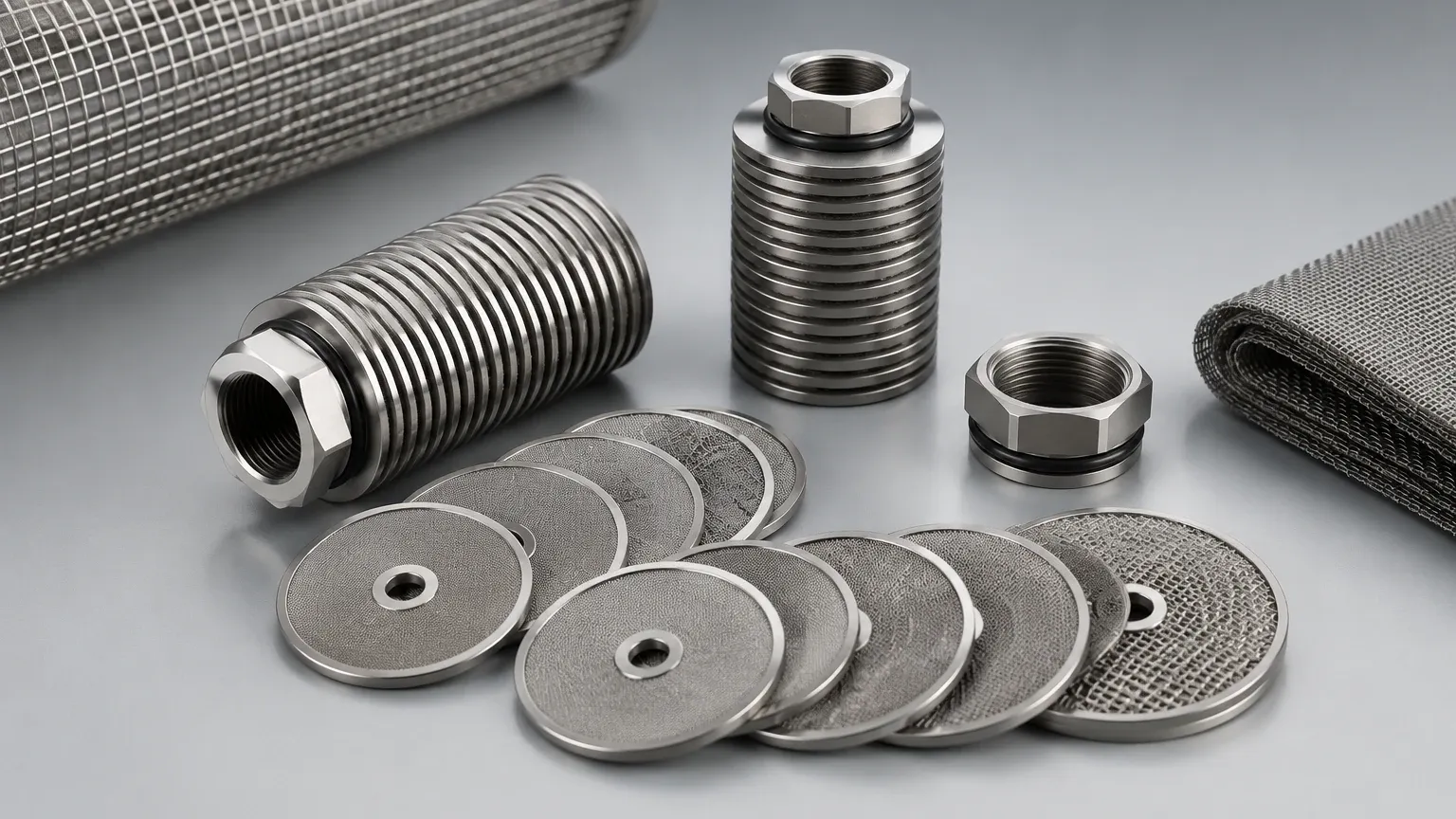
To improve filtration performance and structural integrity, multiple layers of mesh are often combined into a single pack. These Filter Discs & Packs are usually arranged with a coarse mesh on the outside for support and a fine mesh in the center for precise filtration.
* Spot Welded Packs: The layers are joined at specific points using resistance welding. This keeps the layers aligned during installation.
* Rimmed/Bound Packs: The edges of the multi-layer stack are enclosed in a metal rim (typically aluminum, stainless steel, or copper). This rim provides a superior seal against the filter housing and prevents the individual mesh layers from fraying or separating under high flow rates.
Key Performance Indicators for 1.5 Inch Filters
When evaluating a disc filter 1.5 inch, engineers must look beyond the physical dimensions and consider several performance metrics:
1. Micron Rating: This defines the size of the particles the filter is intended to remove. It is important to distinguish between "nominal" (approximate) and "absolute" (guaranteed) micron ratings.
2. Pressure Drop (ΔP): This is the difference in pressure between the upstream and downstream sides of the filter. A high initial pressure drop indicates low permeability, which can reduce system efficiency and increase energy costs.
3. Effective Filtration Area (EFA): For a 1.5-inch disc, the total surface area is fixed. However, the EFA can be maximized by selecting a weave with a higher percentage of open area, provided it meets the strength requirements.
4. Dirt Holding Capacity: This refers to the amount of contaminant the filter can trap before the pressure drop reaches a critical level, necessitating cleaning or replacement.
Critical Applications Across Industrial Sectors
The versatility of the disc filter 1.5 inch makes it a staple in several key industries:
Polymer and Plastic Extrusion
In the production of films, fibers, and resins, molten polymer is forced through a series of filter discs (often called screen packs). The 1.5-inch size is frequently found in laboratory-scale extruders or small-batch production lines. These filters remove un-melted resin, gels, and foreign contaminants that would otherwise cause defects in the final product.
Hydraulic and Lubrication Systems
Precision hydraulic systems rely on clean oil to prevent wear on pumps and valves. A 1.5-inch disc filter is often placed in-line or at the suction point to capture metallic wear particles and environmental dust.
Pharmaceutical and Biotechnology
In these industries, stainless steel filter discs are used for the clarification of liquids and the recovery of expensive catalysts. The ability to sterilize SS316L discs via autoclaving or SIP (Steam-In-Place) processes is a significant advantage over disposable plastic filters.
Chemical Processing
Filtering corrosive fluids requires materials that can withstand chemical attack. A disc filter 1.5 inch made from specialized alloys ensures that the filtration process remains consistent even when exposed to aggressive solvents or acids.
Engineering Considerations for Customization and OEM
While standard sizes exist, many industrial applications require customized filtration solutions. When working with a manufacturer like Kaifil, engineers can specify several variables to optimize performance:
* Custom Tolerances: For high-precision housings, the outer diameter (OD) may need to be held to tolerances as tight as +/- 0.1 mm.
* Layer Sequencing: Engineers can design custom multi-layer packs with specific sequences of mesh counts to handle unique particle size distributions.
* Material Certification: For regulated industries (FDA, aerospace), providing material mill certificates and compliance documentation is essential for quality assurance.
By customizing the disc filter 1.5 inch, companies can achieve a longer service life and better protection for their capital equipment, ultimately reducing the total cost of ownership.
Maintenance, Cleaning, and Replacement Protocols
One of the primary benefits of using stainless steel Filter Discs & Packs is their cleanability. Unlike synthetic media, metal mesh can often be restored to near-original performance levels through various cleaning methods:
* Ultrasonic Cleaning: High-frequency sound waves create cavitation bubbles that dislodge deeply embedded particles from the mesh pores. This is the most effective method for fine Dutch weave filters.
* Chemical Cleaning: Soaking the discs in compatible solvents or acids can dissolve organic build-up or scale.
* Burn-off/Pyrolysis: For polymer extrusion filters, heating the discs in a vacuum oven can carbonize the trapped plastic, which is then removed via ultrasonic cleaning.
However, there is a limit to how many times a disc can be cleaned. Repeated cleaning cycles and high-pressure differentials can eventually lead to "mesh migration" or mechanical fatigue. Monitoring the pressure drop after each cleaning cycle is the best way to determine when a disc filter 1.5 inch has reached the end of its functional life and requires replacement.
Conclusion
The disc filter 1.5 inch is a critical component in the maintenance of industrial fluid purity. By selecting the appropriate material, weave, and pack configuration, engineers can ensure their systems operate at peak efficiency with minimal downtime. As a leader in custom filtration, Kaifil provides the technical expertise and manufacturing precision necessary to produce high-quality filter discs that meet the most exacting industrial standards. Whether for a standard application or a highly specialized OEM project, focusing on the technical fundamentals of filtration media is the key to long-term operational success.
