


Disc Filter 3d
In modern industrial engineering, the transition from conceptual design to physical production relies heavily on the accuracy of digital assets. For engineers designing complex machinery—such as plastic extruders, hydraulic systems, or chemical processing units—the integration of filtration components requires precise spatial planning. The search for a disc filter 3d model or CAD file is often the first step in ensuring that a filtration component will fit seamlessly within a housing or assembly without interfering with other mechanical parts.
However, a 3D model is only as useful as the physical product it represents. In the realm of high-precision manufacturing, Filter Discs & Packs must be engineered to meet exact tolerances, material specifications, and filtration efficiencies. Understanding the relationship between the digital disc filter 3d representation and the physical performance of stainless steel mesh is critical for optimizing industrial processes.
The Role of 3D Modeling in Filtration System Design
When an engineer incorporates a disc filter 3d asset into a larger assembly, they are looking for more than just a geometric shape. They are defining the boundary conditions for fluid flow, pressure drop, and mechanical support. In industrial B2B procurement, the 3D model serves as a technical bridge between the design team and the manufacturer.
Dimensional Accuracy and Tolerances
For filter discs, the outer diameter (OD) and inner diameter (ID) are the most critical dimensions. Even a fraction of a millimeter in deviation can lead to bypass—where unfiltered fluid escapes around the edges of the disc—or physical interference during installation. By utilizing a precise disc filter 3d model, designers can simulate the fit within the filter changer or housing, accounting for thermal expansion and compressed thickness when multiple layers are used.
Visualizing Multi-Layer Configurations
Many industrial applications require multi-layer filter packs rather than single-layer discs. A 3D model allows engineers to visualize the stack-up of different mesh counts. For instance, a common configuration might include a fine filtration layer sandwiched between two coarser support layers. The 3D representation helps in calculating the total thickness of the pack, which is essential for determining the depth of the recessed seat in the machinery.
Engineering Fundamentals of Filter Discs & Packs
To move from a digital model to a functional component, one must understand the structural variations of Filter Discs & Packs. These components are typically manufactured from high-quality stainless steel wire mesh (AISI 304, 316, or 316L) to ensure corrosion resistance and mechanical strength under high pressure.
Mesh Weave Types and Their Impact
The performance of a filter disc is largely determined by the weave of the wire mesh used. When selecting or specifying a disc in a CAD environment, the following weave types are standard:
* Plain Weave: The most common type, where each warp wire crosses over and under each weft wire. It offers a high open area and is suitable for general filtration.
* Twill Weave: Each weft wire passes over and under two warp wires. This allows for a heavier wire diameter and is often used for finer filtration requirements where strength is needed.
* Dutch Weave: This weave uses a larger diameter for the warp wires and a smaller diameter for the weft wires. This results in a much denser mesh with very small triangular openings, providing superior filtration accuracy and high pressure resistance.
Single-Layer vs. Multi-Layer Construction
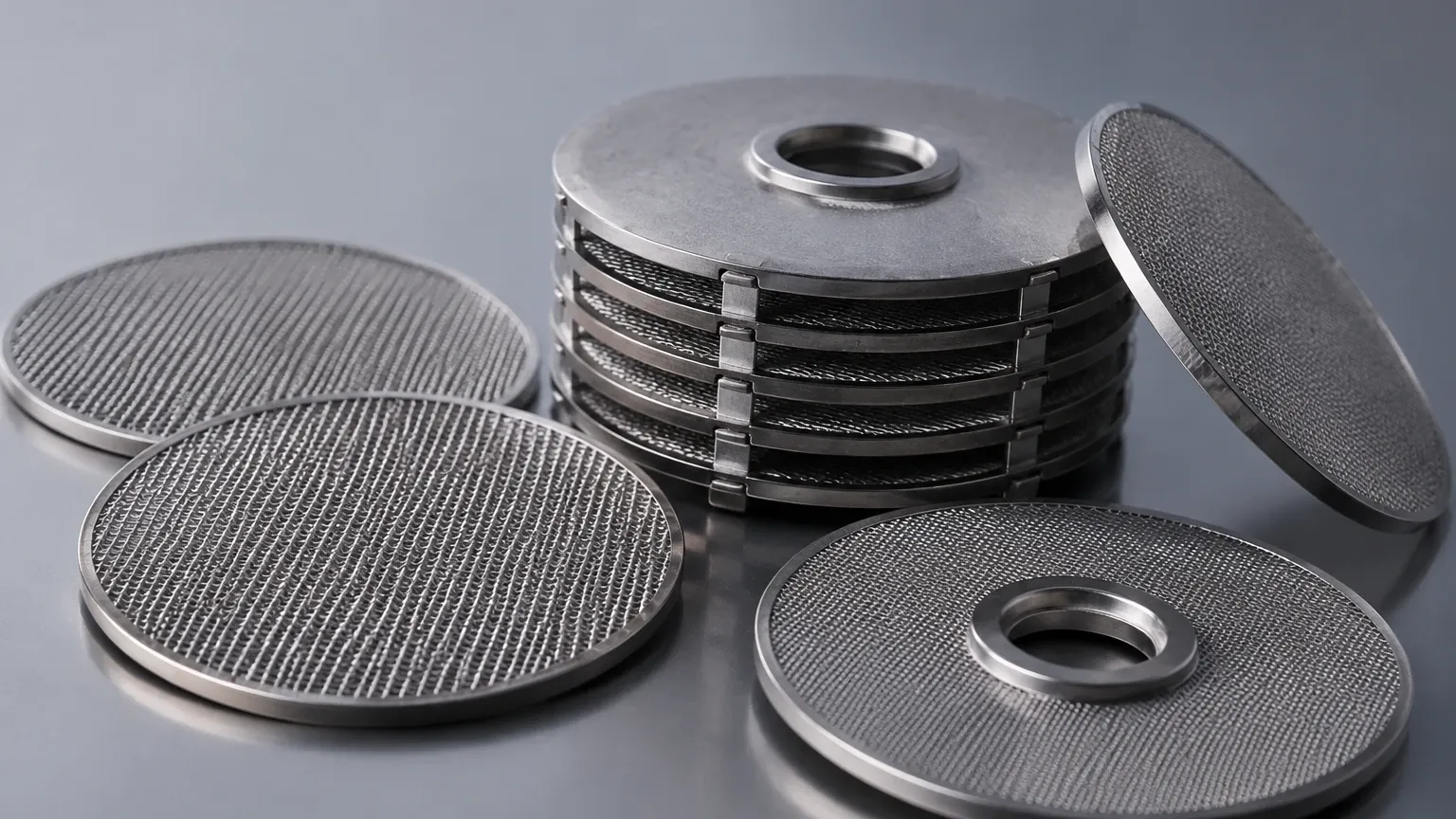
Single-layer discs are often used in low-pressure applications or as a primary screen. However, in high-viscosity applications like polymer melt filtration, multi-layer Filter Discs & Packs are the industry standard. These packs are often spot-welded together to ensure they remain as a single unit during installation and operation, preventing individual layers from shifting or becoming misaligned.
Technical Specifications for Disc Filter 3D Integration
When requesting a disc filter 3d file or preparing a technical drawing for a custom order, several parameters must be confirmed to ensure the physical product matches the design intent.
1. Filtration Rating (Micron Rating)
The filtration rating defines the size of the particles the disc is intended to capture. This can range from 1 micron to over 200 microns. While the micron rating doesn't change the 3D footprint of the disc, it significantly impacts the flow resistance and the internal structure of the mesh layers.
2. Edge Processing and Rims
To prevent fraying and to provide a better seal, filter discs often feature specialized edge treatments. Common options include:
* Spot Welding: Keeping multiple layers together at specific points.
* Aluminum or Stainless Steel Rims: A metal U-binding is crimped around the edge of the disc pack. This provides a rigid structure and a flat sealing surface. In a disc filter 3d model, the thickness and width of this rim must be accurately represented, as it affects the overall diameter and the seating of the filter.
3. Material Selection
Corrosion resistance is paramount in chemical and food processing. 304 stainless steel is standard for many industrial uses, but 316L is preferred for pharmaceutical or highly acidic environments due to its superior resistance to pitting and crevice corrosion. For specialized high-temperature applications, alloys like Inconel or Monel may be used.
Common Applications for Precision Filter Discs
The utility of Filter Discs & Packs spans across numerous sectors where fluid purity is non-negotiable. By integrating accurate 3D data early in the design phase, companies in these industries can reduce prototyping time and avoid costly manufacturing errors.
Plastic and Rubber Extrusion
In the plastics industry, filter discs (often called screen packs) are used in the extruder to remove contaminants from the molten polymer. These discs must withstand extreme pressures and temperatures. The 3D design must account for the specific shape of the breaker plate where the discs are seated.
Chemical Fiber Production
The production of synthetic fibers requires ultra-fine filtration to prevent nozzle clogging. Multi-layer packs with Dutch weave layers are frequently employed here to ensure the consistency of the fiber diameter.
Oil and Gas Filtration
In hydraulic systems and fuel lines, filter discs protect sensitive valves and pumps from particulate matter. The compact nature of a disc filter makes it ideal for inline filtration where space is limited, making the disc filter 3d model essential for tight packaging in aerospace or automotive engineering.
Evaluating Risks in Filter Disc Procurement
For purchasing teams and engineers, selecting a supplier for Filter Discs & Packs involves evaluating more than just the price. Low-quality filtration components can lead to significant operational risks:
* Material Substitution: Using lower-grade stainless steel that lacks the necessary corrosion resistance, leading to premature failure and contamination of the process fluid.
* Inaccurate Mesh Counts: If the mesh count is inconsistent, the filtration rating will vary across the surface of the disc, allowing oversized particles to pass through.
* Poor Edge Sealing: If the rim or welding is not precise, the disc may deform under pressure, causing a bypass or damaging the internal components of the machinery.
To mitigate these risks, it is essential to work with a manufacturer like Kaifil that provides detailed technical documentation and can verify that the physical product adheres to the dimensions specified in the disc filter 3d design.
Customization and OEM Capabilities
Industrial filtration is rarely a one-size-fits-all solution. Customization is often required to meet the specific demands of a unique piece of equipment. When standard circular discs do not suffice, manufacturers can produce various shapes, including:
* Kidney-shaped discs
* Oval or rectangular packs
* Annular (ring-shaped) filters
* Conical or pleated disc inserts
Providing a disc filter 3d STEP or IGES file to the manufacturer allows for the creation of precise tooling and dies, ensuring that the custom shape is reproduced with high repeatability. This digital-to-physical workflow is the cornerstone of modern OEM filtration solutions.
Conclusion: From Digital Design to Industrial Performance
The integration of a disc filter 3d model into your engineering workflow is a best practice that ensures mechanical compatibility and streamlines the procurement process. However, the ultimate success of the filtration system depends on the quality of the Filter Discs & Packs themselves.
By focusing on material integrity, precise mesh selection, and robust edge construction, engineers can achieve reliable performance in even the most demanding industrial environments. When preparing for your next project, ensure that your technical specifications—from micron ratings to rim materials—are clearly defined and verified against the physical manufacturing capabilities of your supplier. This rigorous approach minimizes downtime, protects downstream equipment, and ensures the purity of the final product.
