


Disc Filter Bag
In the landscape of industrial liquid and gas separation, the disc filter bag represents a critical component for high-precision filtration and solid-liquid separation. Often utilized in rotary disc filters, horizontal pressure leaf filters, or specialized polymer melt filtration systems, these components are engineered to withstand rigorous industrial environments while maintaining strict filtration accuracy. For engineers and procurement specialists, understanding the technical nuances of material selection, construction, and performance metrics is essential for optimizing process efficiency and minimizing downtime.
As a specialized manufacturer, Kaifil provides advanced Filter Discs & Packs designed to meet the demanding requirements of modern industrial applications. This guide examines the engineering principles behind the disc filter bag, its relationship with stainless steel wire mesh technologies, and the factors that influence its selection in B2B environments.
Technical Overview of Disc Filter Bag Construction
A disc filter bag is rarely a standalone item; it is a sophisticated assembly of filtration media, support structures, and sealing mechanisms. Depending on the specific application—whether it is for water treatment, chemical processing, or food production—the construction may vary significantly.
Material Selection: Stainless Steel and Beyond
The primary material for high-performance disc filter bags is stainless steel wire mesh, typically in grades 304, 316, or 316L.
* Grade 304: Suitable for standard industrial applications where basic corrosion resistance is required.
* Grade 316/316L: Preferred for pharmaceutical and chemical processing due to its superior resistance to chlorides and organic acids. The "L" (low carbon) variant is essential for components that require welding, as it prevents carbide precipitation that can lead to intergranular corrosion.
* Specialty Alloys: For extreme environments involving high temperatures or highly corrosive media, alloys like Monel, Hastelloy, or Inconel may be utilized.
Multi-Layer Design and Sintering
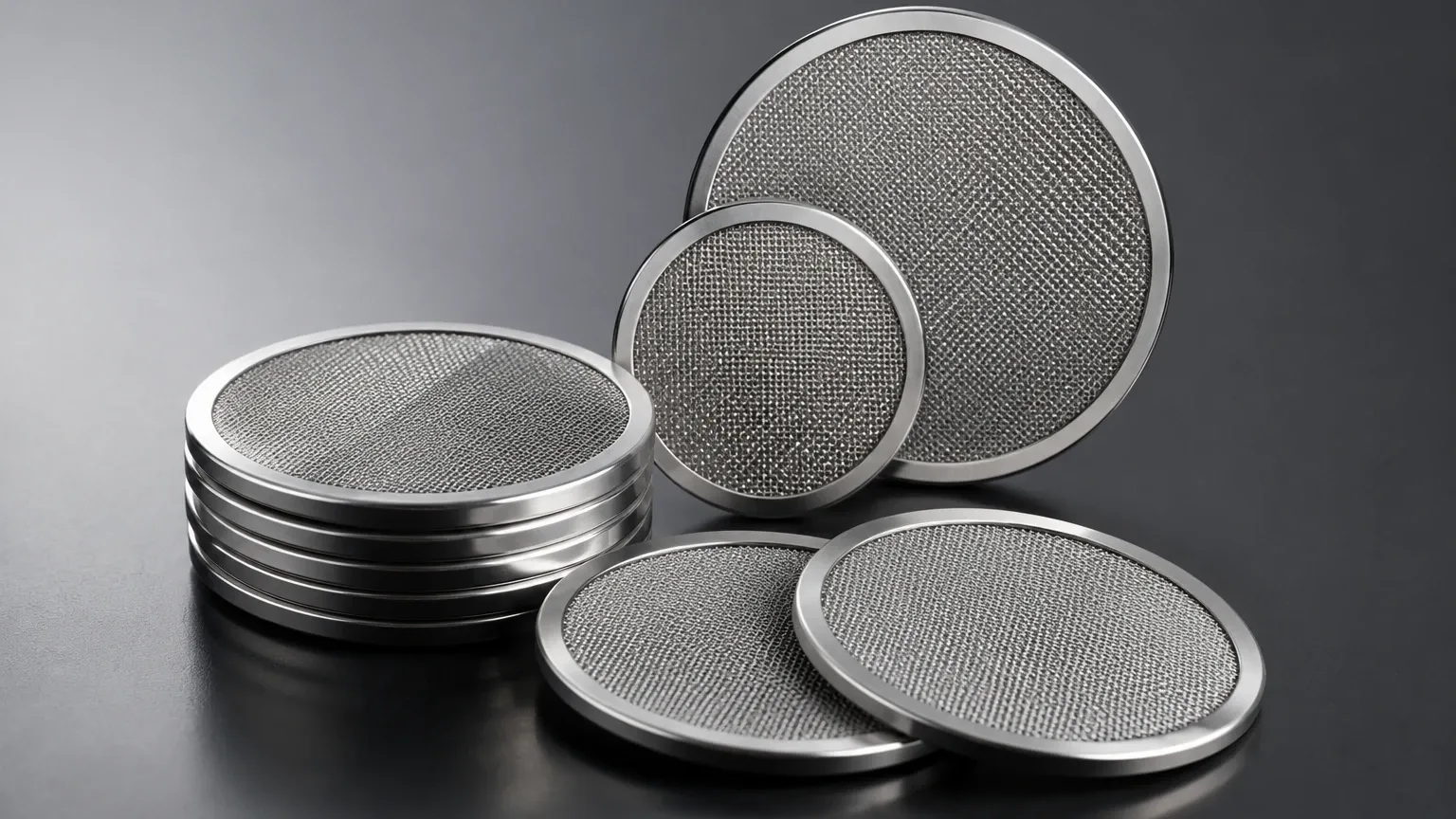
To achieve the necessary mechanical strength and filtration precision, many disc filter bags utilize multi-layer Filter Discs & Packs. A typical configuration includes:
1. Filtration Layer: The fine mesh layer that determines the micron rating.
2. Protective Layer: A slightly coarser mesh that protects the filtration layer from mechanical damage during cleaning or installation.
3. Support Layer: A heavy-duty mesh or perforated metal plate that provides structural integrity, preventing the filtration media from deforming under high differential pressure.
In many high-pressure applications, these layers are sintered together. Sintering involves heating the layers in a vacuum furnace until the contact points of the wires fuse, creating a monolithic structure that is highly durable and easy to clean.
Key Performance Metrics for Industrial Engineers
When evaluating a disc filter bag for a specific process, engineers must look beyond simple dimensions. Performance is governed by the interaction between the fluid properties and the physical characteristics of the filter media.
Micron Rating: Absolute vs. Nominal
One of the most common points of confusion in filtration procurement is the distinction between absolute and nominal micron ratings.
* Nominal Rating: An approximate value indicating that the filter will retain a majority of particles of a certain size (e.g., 90% of 10-micron particles).
* Absolute Rating: A definitive value indicating the largest spherical particle that can pass through the mesh (e.g., 99.9% retention). For critical pharmaceutical or chemical processes, absolute ratings are generally required to ensure consistency.
Permeability and Pressure Drop
The efficiency of a disc filter bag is also measured by its clean pressure drop (Delta P). A well-designed filter should offer high permeability, allowing for high flow rates with minimal energy consumption. As the filter cake builds up on the surface of the disc filter bag, the pressure drop increases. Engineers must determine the "terminal pressure drop"—the point at which the filter must be cleaned or replaced to prevent system failure or media breakthrough.
Applications of Disc Filter Bags in Modern Industry
The versatility of the disc filter bag allows it to be integrated into various industrial sectors, each with unique challenges.
Chemical and Petrochemical Processing
In chemical manufacturing, filtration components must withstand aggressive solvents and high temperatures. The disc filter bag is often used in catalyst recovery and the removal of impurities from polymer melts. The use of stainless steel Filter Discs & Packs ensures that the filter does not react with the chemical media, maintaining the purity of the final product.
Food and Beverage Industry
Hygiene and cleanability are the priorities in this sector. Disc filter bags used in beverage clarification or edible oil filtration must comply with food-grade standards. Stainless steel is the material of choice because it can be sterilized using steam or chemical CIP (Clean-In-Place) cycles without degrading. The smooth surface of the metallic mesh also prevents bacterial growth and particle entrapment.
Water and Wastewater Treatment
Large-scale rotary disc filters are common in municipal and industrial wastewater treatment. In these systems, the disc filter bag acts as the primary separation barrier for suspended solids. These bags must be highly resistant to abrasion from sand and grit while maintaining a high throughput to handle large volumes of water.
Customization and Engineering Considerations
Off-the-shelf filtration solutions often fail to meet the specific needs of complex industrial systems. Customization is a core part of the manufacturing process at Kaifil, where we focus on providing tailored solutions for OEM and end-user requirements.
Edge Treatment and Framing
A critical aspect of disc filter bag design is the edge treatment. Without proper framing, the edges of the wire mesh can fray, leading to bypass and contamination. Common edge treatments include:
* Spot Welding: Joining multiple layers at the perimeter for basic stability.
* Aluminum or Stainless Steel Binding: Crimping a metal U-channel around the edge to provide a secure seal and structural rigidity.
* Resin Bonding: Used in lower-temperature applications to create a leak-proof seal.
Geometric Precision
In automated filtration systems, the tolerances for disc filter bags are extremely tight. Even a millimeter of deviation can prevent a proper seal within the filter housing, leading to fluid bypass. Precision cutting—often using laser or CNC punching—ensures that each disc fits perfectly within its designated assembly.
Maintenance, Cleaning, and Replacement Cycles
The total cost of ownership (TCO) of a disc filter bag is heavily influenced by its service life and cleanability. Unlike disposable synthetic bags, stainless steel disc filter bags are designed for long-term use.
Cleaning Methods
To restore the flow rate and reduce pressure drop, several cleaning methods can be employed:
1. Backwashing: Reversing the flow of fluid to dislodge particles trapped on the surface.
2. Ultrasonic Cleaning: Using high-frequency sound waves in a cleaning solution to remove fine particles from within the mesh pores.
3. Chemical Cleaning: Using acids or alkalis to dissolve organic or inorganic scaling, provided the mesh material is compatible.
4. Burn-off/Pyrolysis: Used for polymer melt filters to remove hardened resins by heating the filter in a controlled environment.
Identifying Replacement Needs
While durable, metal filter bags are not permanent. Signs that a disc filter bag needs replacement include:
* Permanent Deformation: Warping of the support structure due to excessive pressure spikes.
* Media Blinding: When particles become permanently lodged in the mesh, and cleaning no longer restores the original pressure drop.
* Mechanical Damage: Tears or holes in the mesh that compromise filtration integrity.
Selecting the Right Partner for Filtration Solutions
Choosing a manufacturer for a disc filter bag requires more than just comparing prices. It requires a partner who understands the engineering challenges of your specific industry. Kaifil combines extensive manufacturing experience with technical expertise to deliver high-quality Filter Discs & Packs that enhance process reliability.
When consulting with a manufacturer, engineers should be prepared to provide the following data:
* Fluid Characteristics: Viscosity, temperature, and chemical composition.
* Contaminant Profile: Particle size distribution and concentration.
* Operating Conditions: Flow rate, maximum operating pressure, and allowable pressure drop.
* Housing Specifications: Dimensions and sealing requirements.
By focusing on these factual boundaries and technical requirements, purchasing teams can ensure they acquire filtration components that provide the best balance of performance, durability, and cost-effectiveness. Whether for a new installation or a replacement for an existing system, the right disc filter bag is a fundamental investment in industrial operational excellence.
