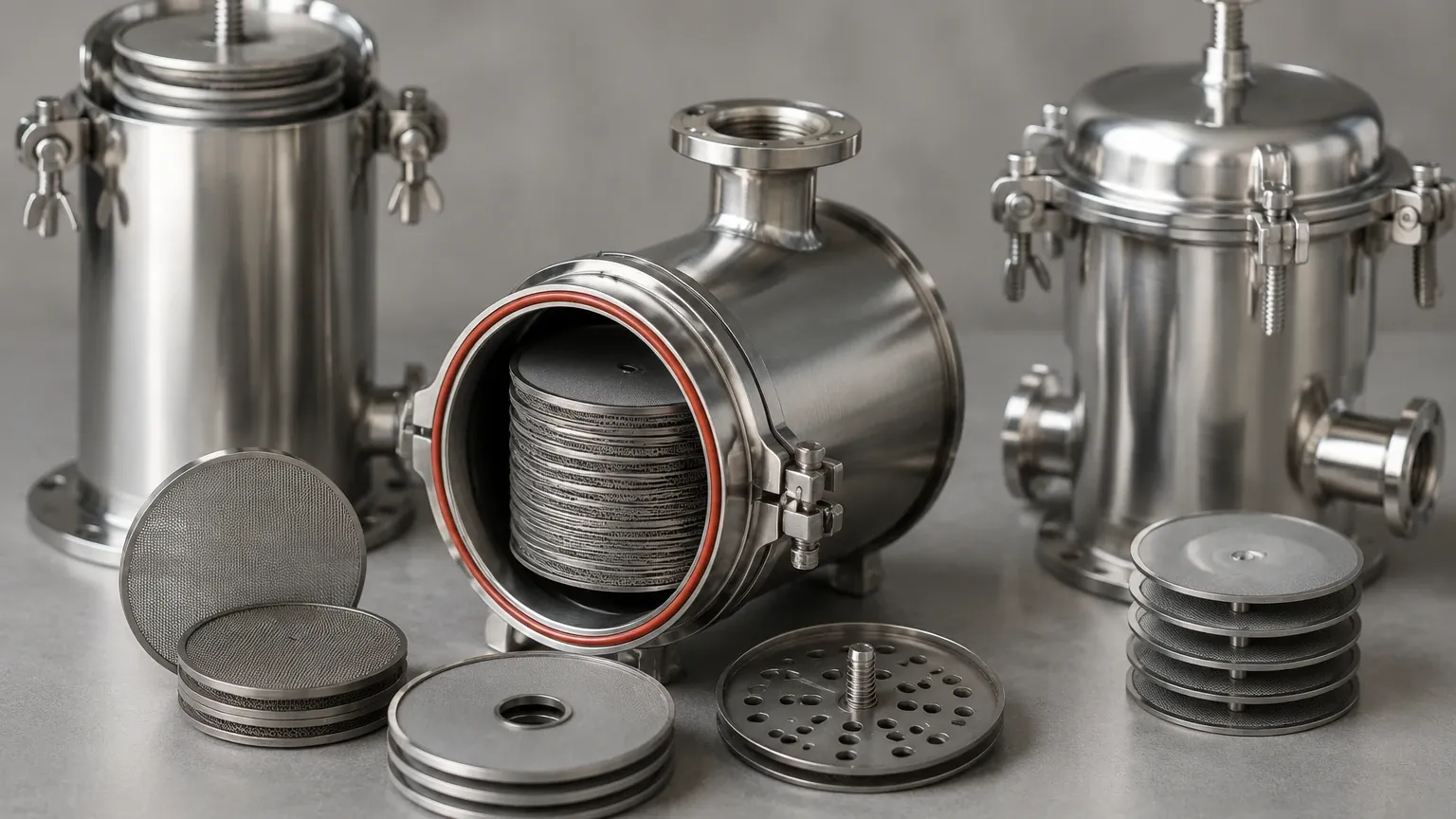
Disc Filter Chamber
In industrial filtration, the disc filter chamber serves as the critical containment vessel and structural framework for high-precision separation processes. Whether utilized in polymer melt filtration, chemical processing, or hydraulic systems, the design and integrity of the chamber directly dictate the efficiency, safety, and longevity of the filtration cycle. For engineers and procurement specialists, understanding the mechanical nuances of the disc filter chamber is essential for optimizing throughput and ensuring that the internal media—specifically Filter Discs & Packs—performs to its engineered specifications.
The Role of the Disc Filter Chamber in Industrial Filtration
A disc filter chamber is a pressurized housing designed to hold one or more filter discs in a fixed orientation. Its primary function is to direct the flow of a fluid or gas through the filtration media while preventing bypass. In many high-viscosity or high-pressure applications, the chamber must withstand significant mechanical stress while maintaining a leak-proof seal.
The relationship between the chamber and the filter media is symbiotic. While the chamber provides the structural environment, the Filter Discs & Packs provide the actual particle retention. A poorly designed chamber can lead to uneven flow distribution, causing certain areas of the filter disc to blind (clog) prematurely, while other areas remain underutilized. Conversely, an expertly engineered chamber ensures laminar flow and uniform pressure distribution across the entire surface area of the disc.
Engineering Specifications and Material Selection
When specifying a disc filter chamber, material compatibility is the first line of evaluation. Because these chambers often operate in corrosive or high-temperature environments, stainless steel is the industry standard.
1. Stainless Steel 304/304L: Suitable for general industrial applications where basic corrosion resistance is required. It is commonly used in food and beverage or water treatment sectors.
2. Stainless Steel 316/316L: The preferred choice for chemical processing and pharmaceutical applications. The addition of molybdenum provides superior resistance to chlorides and acetic acids.
3. High-Nickel Alloys: In extreme cases involving highly acidic or alkaline fluids at elevated temperatures, alloys like Hastelloy or Monel may be required for the chamber construction to prevent pitting and stress corrosion cracking.
Beyond metallurgy, the mechanical design must account for the operating pressure. Industrial chambers are often built to meet ASME Section VIII standards or equivalent international codes. This involves calculating the wall thickness, flange ratings, and the strength of the closure mechanism—whether it be a bolted flange, a swing-bolt design for quick access, or a threaded cap for smaller-scale hydraulic applications.
Integrating Filter Discs & Packs for Optimal Performance
The internal geometry of the disc filter chamber must precisely match the dimensions of the Filter Discs & Packs used. Even a millimeter of clearance error can result in fluid bypass, which compromises the purity of the filtrate and can damage downstream equipment like high-pressure pumps or precision nozzles.
Sealing Mechanisms
To ensure that 100% of the fluid passes through the media, the chamber utilizes various sealing methods:
* Mechanical Compression: The chamber lid or a specialized internal mandrel applies axial force to the edges of the filter pack, compressing a gasket or the metal rim of the disc against a machined seat.
* O-Rings and Gaskets: Depending on chemical compatibility, Viton, PTFE, or EPDM gaskets are used to create a soft seal. In high-temperature polymer filtration, metal-to-metal seals or copper gaskets are more common.
* Welded Stacks: In some permanent installations, the discs are welded to a central support tube (core), and the entire assembly is inserted into the chamber as a single cartridge.
Support Structures
Because filter discs are often made of fine wire mesh, they can deform under high differential pressure (ΔP). A well-engineered disc filter chamber includes internal support plates or "backup screens" that provide a rigid surface for the filter disc to rest against. This prevents the mesh from stretching or tearing, which is vital for maintaining the integrity of the micron rating.
Fluid Dynamics and Pressure Management
One of the most overlooked aspects of disc filter chamber design is the internal fluid dynamics. If the inlet port is positioned too close to the filter surface, it can create a high-velocity "jetting" effect that erodes the filter media or causes localized blinding. Engineers often incorporate baffles or diffusers within the chamber to break up the incoming flow and distribute it evenly.
Pressure Drop (ΔP) Monitoring
The chamber must be equipped with upstream and downstream pressure ports. Monitoring the differential pressure is the only reliable way to determine the loading state of the Filter Discs & Packs. As contaminants accumulate on the disc surface, the ΔP will rise.
* Clean Pressure Drop: The initial resistance caused by the chamber geometry and the clean filter media.
* Terminal Pressure Drop: The maximum allowable ΔP before the filter must be cleaned or replaced. Exceeding this limit can cause "breakthrough," where particles are forced through the media, or mechanical failure of the disc itself.
Identifying and Mitigating Operational Risks
Operating a disc filter chamber involves several risks that can lead to downtime or product loss. Identifying these early in the procurement phase is essential for long-term reliability.
1. Media Migration
If the filter discs are not properly secured within the chamber, or if the mesh is of low quality, individual wires can break off and enter the process stream. This is known as media migration. Using high-quality Filter Discs & Packs with sintered edges or reinforced borders significantly reduces this risk.
2. Chemical Incompatibility
It is not enough for the chamber to be corrosion-resistant; the gaskets and the internal support components must also be compatible with the process fluid. For example, a chamber used in a solvent-based chemical plant cannot use standard Buna-N seals, as they will swell and fail, leading to leaks.
3. Thermal Expansion
In high-temperature applications, the chamber and the internal filter stack may expand at different rates. If the design does not account for this thermal expansion, the internal components can buckle, or the seals can lose compression. Spring-loaded tensioning devices are often used in these scenarios to maintain a constant sealing force.
Technical Checklist for Engineering and Procurement
Before finalizing the design or purchase of a disc filter chamber and its associated Filter Discs & Packs, technical teams should confirm the following parameters:
* Maximum Operating Pressure (MAWP): Does the chamber rating exceed the system's relief valve setting?
* Temperature Range: Are all materials, including seals and adhesives (if any), rated for the maximum and minimum process temperatures?
* Filtration Surface Area: Is the Effective Filtration Area (EFA) sufficient to handle the required flow rate without exceeding the recommended flux (flow per unit area)?
* Micron Rating and Efficiency: Is the media absolute-rated or nominal-rated? For critical pharmaceutical or hydraulic applications, absolute-rated discs are usually mandatory.
* Cleaning Protocol: Is the chamber designed for easy disassembly? If the filter discs are to be reused, can they be cleaned via backwashing, ultrasonic cleaning, or chemical burn-off without damaging the chamber internals?
* Certification Requirements: Does the application require FDA compliance, 3-A Sanitary Standards, or PED (Pressure Equipment Directive) certification?
Maintenance and Replacement Cycles
The longevity of a disc filter chamber is generally measured in decades, provided it is maintained correctly. However, the Filter Discs & Packs housed within are consumables. The replacement cycle depends on the solids loading of the process fluid and the robustness of the media.
In continuous processes, a duplex chamber configuration is often used. This allows one chamber to be taken offline for maintenance or disc replacement while the other remains in operation, ensuring zero downtime. During maintenance, the chamber's sealing surfaces should be inspected for scratches or pitting, as even minor imperfections can lead to bypass in high-pressure systems.
Conclusion
The disc filter chamber is more than just a container; it is a precision-engineered component that determines the success of the industrial filtration process. By focusing on material integrity, fluid dynamics, and the precise fit of Filter Discs & Packs, manufacturers can achieve reliable separation, protect downstream equipment, and minimize total cost of ownership. For engineers, the key to an optimized system lies in the details—from the selection of the alloy to the specific configuration of the internal support structures.