


Disc Filter Cleaning
In the landscape of industrial fluid management, the efficiency of a filtration system is not just defined by its initial micron rating but by its sustained performance over time. For engineers and maintenance teams utilizing Filter Discs & Packs, the ability to restore flow rates and lower differential pressure through effective maintenance is a critical operational factor.
Disc filter cleaning is a technical process that requires an understanding of contaminant characteristics, material science, and mechanical limits. Unlike disposable polymer filters, stainless steel filter discs are engineered for longevity and reusability. However, the restoration of these components to their original permeability requires a systematic approach to ensure that the structural integrity of the wire mesh or sintered media is not compromised during the process.
The Role of Differential Pressure in Maintenance Scheduling
The primary indicator for initiating a disc filter cleaning cycle is the increase in differential pressure ($ΔP$) across the filter media. As contaminants accumulate on the surface or within the depth of the mesh, the available flow area decreases, forcing the system to work harder to maintain throughput.
In B2B industrial environments—ranging from chemical processing to hydraulic systems—operating a filter beyond its recommended $ΔP$ threshold can lead to several risks:
1. Media Migration: Excessive pressure can cause the fine wires of the mesh to shift or break, allowing contaminants to bypass the filter.
2. Structural Collapse: In multi-layer packs, high pressure can deform the support layers, leading to permanent damage that cannot be corrected by cleaning.
3. Energy Inefficiency: Pumps must consume significantly more power to overcome the resistance of a blinded filter.
Technical professionals generally recommend a cleaning cycle when the $ΔP$ reaches a predetermined set point, typically 50% to 70% of the maximum allowable pressure drop specified by the manufacturer. Waiting until the system reaches a critical failure point often makes the cleaning process more difficult and less effective.
Understanding Contaminant Types and Their Impact
Effective disc filter cleaning begins with an analysis of what is actually clogging the filter. The nature of the foulant dictates the cleaning method. In industrial applications, contaminants generally fall into three categories:
Inorganic Particulates
These include metal shavings, scale, sand, and mineral deposits. These are typically non-adhesive and are often trapped on the surface of the disc. Surface-loading filters are the easiest to clean via mechanical means like backwashing or vibration.
Organic and Biological Matter
Oils, greases, polymers, and biofilms present a greater challenge. These substances often adhere to the wire intersections of the mesh. Biological growth can create a "slime" layer that is resistant to simple water rinsing and requires chemical intervention or thermal treatment to break down the molecular bonds.
Embedded Depth Contaminants
In sintered multi-layer Filter Discs & Packs, fine particles can become lodged deep within the tortuous path of the media. This is known as "blinding." Surface rinsing is ineffective here; instead, energy must be delivered into the internal structure of the mesh to dislodge these particles.
Technical Methods for Disc Filter Cleaning
There is no one-size-fits-all approach to cleaning industrial filters. The choice of method depends on the material of construction (typically 304 or 316L stainless steel) and the severity of the fouling.
1. Ultrasonic Cleaning
Ultrasonic cleaning is widely considered the most effective method for precision metal filters. This process involves immersing the filter discs in a fluid bath where high-frequency sound waves (usually between 25 kHz and 40 kHz) create microscopic vacuum bubbles.
When these bubbles collapse—a phenomenon known as cavitation—they release intense localized energy. This energy penetrates the innermost layers of the wire mesh, dislodging particles that are otherwise inaccessible. For multi-layer sintered discs, ultrasonic cleaning is often the only way to restore the filter to near-original performance levels.
2. Chemical Soaking and Passivation
Chemical cleaning uses acids, alkalis, or specialized solvents to dissolve contaminants.
* Alkaline Washes: Effective for removing oils, greases, and organic proteins.
* Acid Washes: Used to remove mineral scale or metallic oxides.
When cleaning stainless steel components, it is vital to ensure chemical compatibility. For instance, while 316L stainless steel has excellent corrosion resistance, exposure to high concentrations of chlorides can cause pitting. Furthermore, after an acid wash, the discs should undergo a passivation process to restore the protective chromium oxide layer on the steel surface, preventing future corrosion.
3. Backwashing and Back-pulsing
This is a mechanical method where the flow of fluid is reversed through the filter. The reverse pressure forces the "filter cake" off the surface of the disc. While effective for surface-loading applications, backwashing is less effective for removing depth-loaded contaminants or adhesive substances. In automated systems, back-pulsing uses a high-pressure burst of air or fluid to shock the contaminants off the mesh.
4. Thermal Cleaning (Burn-off)
In industries like polymer processing or resin manufacturing, filter discs can become clogged with hardened plastics. Thermal cleaning involves placing the discs in a controlled-vacuum oven or a fluidized bed at high temperatures (400°C to 500°C). This carbonizes the organic material, which can then be removed via ultrasonic cleaning or high-pressure air. This method must be carefully controlled to avoid reaching the annealing temperature of the stainless steel, which could soften the wire and reduce the disc's structural strength.
Step-by-Step Cleaning Procedure for Industrial Filter Discs
To maximize the lifespan of Filter Discs & Packs, maintenance teams should follow a standardized protocol:
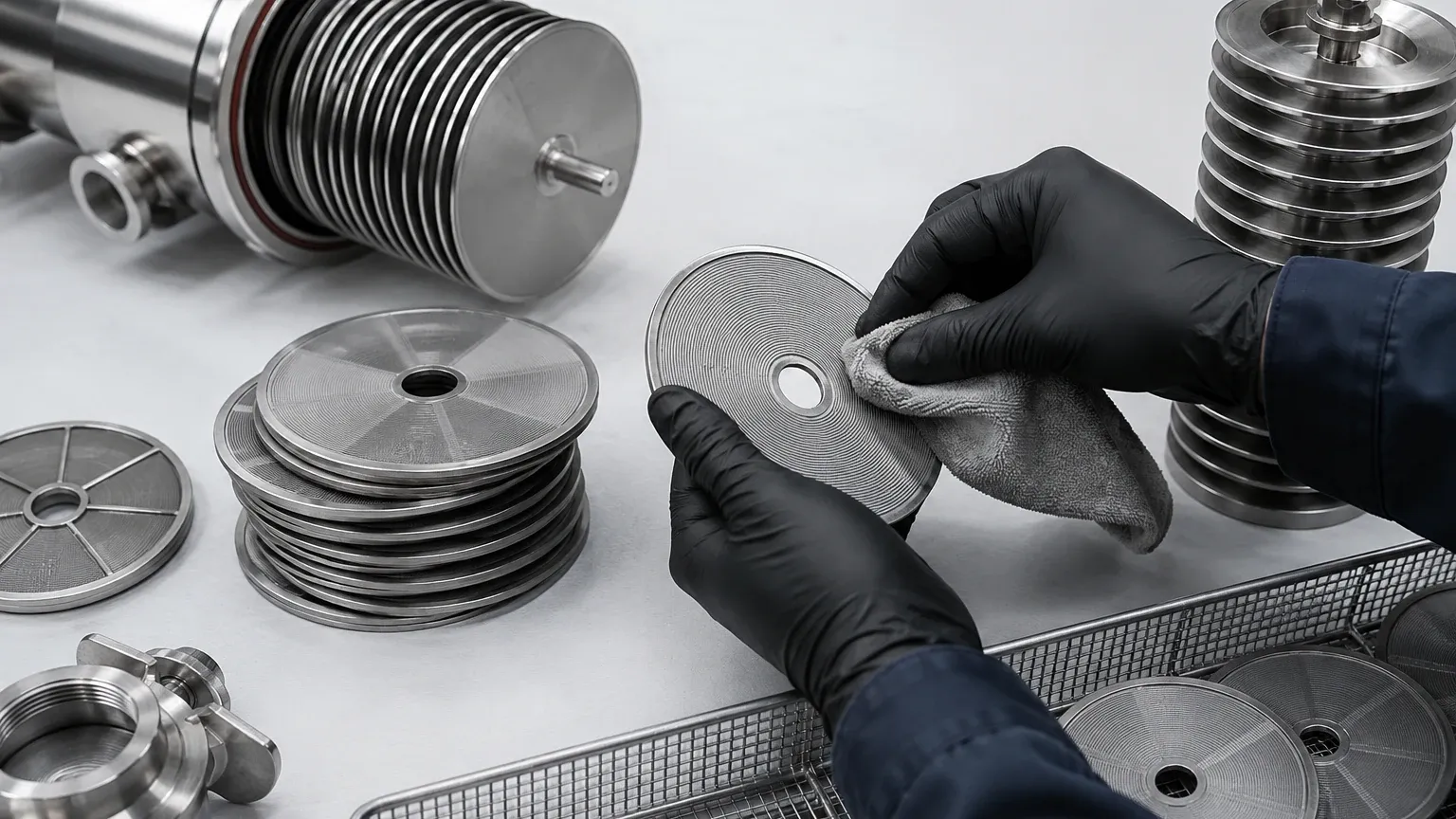
1. Pre-Inspection: Before cleaning, visually inspect the discs for signs of mechanical damage, such as tearing in the mesh or warping of the rim. If the structural integrity is compromised, the disc should be replaced rather than cleaned.
2. Initial Rinse: Use a low-pressure water rinse to remove loose, bulk contaminants from the surface. This prevents the cleaning bath (ultrasonic or chemical) from becoming prematurely saturated with debris.
3. Primary Cleaning: Employ the chosen method (e.g., 30 minutes in an ultrasonic bath with a compatible detergent). If using chemicals, monitor the temperature and concentration closely.
4. Secondary Rinse: Thoroughly rinse the discs with deionized or distilled water to ensure no cleaning agents or dissolved contaminants remain in the mesh pores.
5. Drying: Dry the discs in a clean, dust-free environment. For precision applications, a drying oven at low temperatures is preferred to ensure all moisture is removed from the internal layers of the mesh.
6. Integrity Testing: Perform a "bubble point test" or a flow-restriction test. This confirms that the pores are open and that the micron rating has not been altered by the cleaning process.
Engineering Considerations: When to Clean vs. When to Replace
While stainless steel filters are designed for multiple cleaning cycles, they do not last forever. Engineers must evaluate the Total Cost of Ownership (TCO) when deciding between cleaning and replacement.
The Limits of Cleaning
Each cleaning cycle, especially those involving aggressive chemicals or high temperatures, slightly alters the material properties of the steel. Over time, the wire diameters may thin due to microscopic erosion, or the pore structure may become permanently "blinded" by sub-micron particles that cannot be removed. If a cleaned filter returns to high differential pressure significantly faster than a new one, it has reached the end of its functional life.
Labor and Utility Costs
The cost of specialized ultrasonic equipment, chemical disposal, and the labor required for manual cleaning must be weighed against the cost of purchasing new Filter Discs & Packs. In high-volume operations, it is often more economical to have a rotation of filter sets: one set in operation while the other is being professionally cleaned and tested.
Customization for Easier Cleaning
At the design stage, engineers can select filter configurations that simplify the cleaning process. For example:
* Sintered Wire Mesh: By bonding multiple layers of mesh together through heat and pressure, the structure becomes rigid. This prevents individual wires from shifting during high-pressure backwashing or ultrasonic cleaning.
* Rim and Frame Design: A robust, welded rim ensures that the filter pack remains flat and sealed within the housing, even after repeated thermal expansion and contraction during cleaning cycles.
* Material Selection: Choosing 316L over 304 stainless steel provides better resistance to the aggressive chemicals often used in industrial cleaning baths, extending the total number of possible cleaning cycles.
Conclusion
Disc filter cleaning is a vital component of industrial maintenance that directly impacts process efficiency and equipment longevity. By understanding the specific contaminants in a system and applying the appropriate technical cleaning methods—such as ultrasonic cavitation or controlled chemical soaking—operators can significantly extend the service life of their filtration components.
For engineers, the goal is to balance the restoration of flow performance with the preservation of the filter’s structural integrity. When performed correctly, a rigorous cleaning regimen ensures that Filter Discs & Packs continue to provide the precise filtration accuracy required for demanding industrial applications, from hydraulic fluid power to pharmaceutical processing. Regular monitoring of differential pressure and a commitment to standardized cleaning protocols are the best defenses against unexpected downtime and premature component failure.
