


Disc Filter Orientation
In industrial filtration, the performance of a system is often determined by the smallest details of its mechanical assembly. Among these, disc filter orientation stands as a critical factor that influences flow rates, pressure stability, and the structural integrity of the filter media. For engineers and maintenance teams working with polymer extrusion, hydraulic systems, or chemical processing, understanding how to correctly orient and install Filter Discs & Packs is essential to preventing premature blinding and ensuring consistent product quality.
Disc filter orientation refers to the specific alignment and sequencing of wire mesh layers relative to the direction of fluid flow. While a single-layer disc might appear symmetrical, multi-layer packs and specialized weaves possess directional properties that must be respected to achieve the intended filtration micron rating and mechanical strength.
The Fundamentals of Disc Filter Orientation in Industrial Systems
At its core, disc filter orientation is governed by the direction of the process fluid. Industrial filters are typically designed to operate in a specific flow path—either from the outside in or from the top down, depending on the housing design. When dealing with stainless steel wire mesh, the orientation of the weave determines how particles are captured and how the filter cake builds up over time.
In surface filtration, the orientation ensures that the finest mesh layer (the control layer) encounters the fluid at the correct stage. If a disc is installed in reverse, the coarser support layers may become prematurely clogged with large particles that should have been managed by a pre-filter layer, or the fine mesh may lack the necessary backing to withstand high differential pressures. For technical professionals, verifying the orientation before sealing a filter housing is a standard protocol to avoid costly downtime and potential downstream contamination.
Multi-Layer Pack Configuration: Sequence and Directionality
Most demanding industrial applications utilize multi-layer packs rather than single discs. These packs are engineered with a specific sequence of mesh counts to optimize dirt-holding capacity and structural rigidity. The disc filter orientation in these assemblies follows a strategic hierarchy:
1. The Upstream Layer (Breaker/Coarse Mesh): This layer faces the incoming contaminated fluid. Its primary role is to catch large contaminants and protect the finer layers beneath. Orientation here is focused on maximizing the open area to maintain low initial pressure drops.
2. The Control Layer (Fine Mesh): Positioned in the middle or toward the downstream side, this layer defines the absolute micron rating of the pack. Its orientation is critical; it must be perfectly flat and supported to prevent "ballooning" or wire displacement.
3. The Downstream Support Layer (Drainage Mesh): This is typically a heavy, coarse mesh that provides mechanical strength. In high-pressure environments, such as polymer melt filtration, the orientation of the support layer ensures that the fine control mesh does not migrate or tear under the force of the viscous fluid.
When these layers are sintered or spot-welded together, the manufacturer often marks the upstream side. However, in loose-leaf configurations, the responsibility falls on the technician to maintain the correct disc filter orientation during manual assembly.
Impact of Mesh Weave Types on Filter Orientation
The specific weave of the stainless steel wire mesh significantly impacts how orientation should be handled. Different weaves have different "faces" that interact with the fluid differently.
Plain and Twilled Weaves
In standard square mesh (plain weave), both sides of the disc are technically similar. However, during the manufacturing process, one side may have slightly more prominent "knuckles" (the points where wires cross). In precision applications, orienting the smoother side toward the scraper or cleaning mechanism can improve the efficiency of backwashing or cake removal.
Dutch Weaves (Plain and Twilled)
Dutch weaves are designed with a higher density of wires in one direction, creating a tortuous path for filtration. These meshes are inherently directional. The "shute" wires and "warp" wires create a surface that is often smoother on one side. In disc filter orientation for Dutch weaves, the fluid should typically enter the side that allows for the most effective particle entrapment without causing the wires to spread apart under pressure. Reversing a Dutch weave disc can lead to a loss of filtration accuracy as the pressure may force the tightly packed wires to shift.
Mechanical Support and Pressure Considerations
One of the most common reasons for focusing on disc filter orientation is the management of differential pressure (ΔP). As a filter disc accumulates contaminants, the pressure on the upstream side increases. If the disc is oriented incorrectly, the mechanical stresses are distributed unevenly.
For example, in a hydraulic system, a disc filter is often backed by a perforated plate or a heavy support mesh. If the disc filter orientation is reversed, the fine mesh may be pushed directly against a coarse support with large openings. Under high pressure, the fine wires can be forced into those openings—a phenomenon known as "wire migration" or "dimpling." This not only damages the filter but can also allow bypassed contaminants to enter the clean side of the system. Proper orientation ensures that the load is transferred from the fine mesh to a medium-support mesh, and finally to the heavy structural support, distributing the stress across the entire surface area.
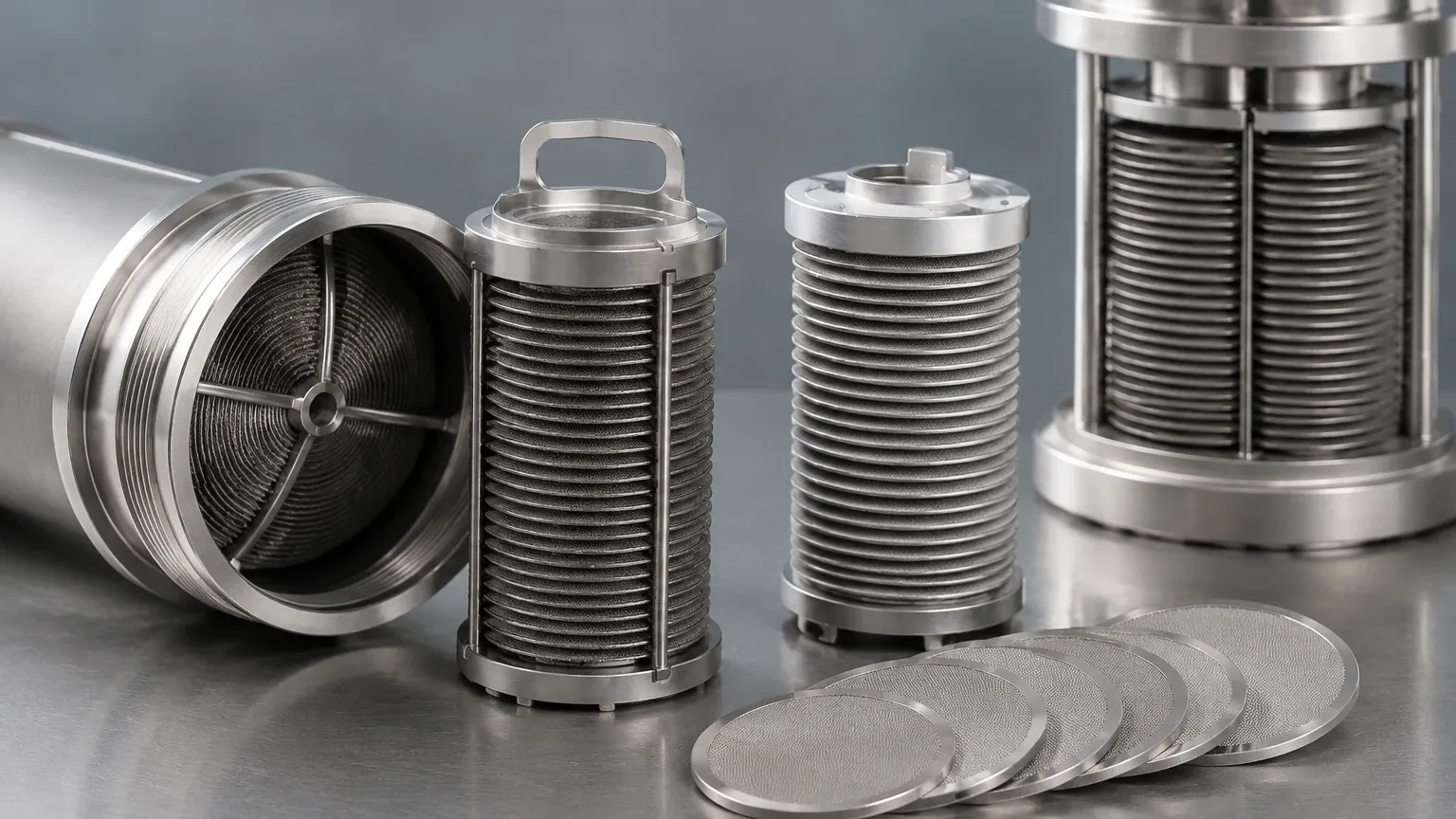
Identifying and Mitigating Risks of Improper Orientation
Incorrect disc filter orientation carries several industrial risks that can impact the total cost of ownership and process safety. Engineers should be aware of the following symptoms of orientation errors:
* Rapid Pressure Spikes: If a fine mesh is placed upstream of a coarse mesh in a way that prevents depth filtration, the surface will blind almost instantly, leading to a rapid rise in differential pressure.
* Media Migration: When oriented incorrectly, the physical wires of the mesh may break off due to lack of support. These metal fragments can then travel downstream, damaging precision pumps, valves, or injection molds.
* Bypass and Leakage: In some disc designs, the edge seal is asymmetrical. If the orientation is flipped, the seal may not seat properly against the housing flange, allowing unfiltered fluid to bypass the media entirely.
* Reduced Cleaning Efficiency: For systems that utilize backpulsing or ultrasonic cleaning, a disc installed backward may trap particles in a way that they cannot be dislodged, effectively shortening the service life of the Filter Discs & Packs.
To mitigate these risks, many facilities implement visual inspection steps or use keyed disc designs that only allow for installation in one direction.
Selection and Customization for Optimized Orientation
When sourcing filtration components, it is beneficial to work with a manufacturer that understands the engineering requirements of disc filter orientation. Customization options can simplify installation and reduce the margin for human error.
Sintered Multi-Layer Discs
Sintering multiple layers of mesh into a single, rigid plate is one of the most effective ways to manage orientation. Since the layers are permanently bonded in the correct sequence and orientation, the end-user only needs to identify the upstream face of the single component. This eliminates the risk of misaligning individual mesh sheets during high-stakes maintenance turnarounds.
Edging and Framing
Adding a metal U-binding or a specialized rim to the disc can serve two purposes: it provides a superior seal and can be used as a visual indicator for orientation. For instance, a flange on one side of the rim can act as a mechanical "stop," ensuring the disc can only be inserted into the housing in the correct direction.
Material Selection
The choice of material, such as 304 or 316L stainless steel, also plays a role in how the disc maintains its orientation under thermal stress. In high-temperature chemical processing, thermal expansion can cause thin discs to warp. Choosing the correct alloy and thickness ensures that the disc remains flat and correctly oriented within its seat throughout the entire operating cycle.
Conclusion: Best Practices for Engineers and Purchasing Teams
Achieving optimal filtration performance requires more than just selecting the right micron rating; it requires a disciplined approach to disc filter orientation. By ensuring that each layer of a filter pack is correctly sequenced and aligned with the flow of the process fluid, companies can extend the life of their equipment, maintain product purity, and reduce maintenance costs.
When evaluating Filter Discs & Packs for your next project, consider the following checklist:
* Confirm Flow Direction: Clearly define the fluid path within the housing.
* Verify Layer Sequence: Ensure that the coarse, fine, and support layers are arranged to handle the specific contaminant load of your application.
* Check for Directional Weaves: Determine if your mesh type (such as Dutch weave) has a specific upstream/downstream requirement.
* Evaluate Support Needs: Ensure the downstream side of the disc is sufficiently supported to prevent mechanical failure under peak differential pressure.
* Standardize Installation: Use marked or keyed discs to minimize the risk of incorrect orientation during field replacement.
By focusing on these technical parameters, engineering teams can ensure that their filtration systems operate at peak efficiency, providing reliable protection for downstream processes and consistent results in even the most demanding industrial environments.
