


Disc Filter vs Screen Filter Which Is Better
In the realm of industrial filtration, selecting the appropriate media is a critical engineering decision that directly impacts process efficiency, equipment longevity, and total operational costs. Two of the most common technologies employed across chemical processing, water treatment, and hydraulic systems are disc filters and screen filters. When technical professionals ask "disc filter vs screen filter which is better," the answer is rarely a simple binary. Instead, the "better" solution is defined by the specific characteristics of the fluid, the nature of the contaminants, and the operational constraints of the system.
As a manufacturer of precision stainless steel filtration components, Kaifil recognizes that both technologies offer distinct advantages. Understanding the underlying mechanics of surface filtration versus depth-style filtration is essential for engineers tasked with optimizing industrial processes. This guide provides a technical comparison to help you determine which technology aligns with your specific application requirements.
Understanding Screen Filters: The Precision of Surface Filtration
Screen filters are perhaps the most straightforward filtration technology. They consist of a single or multi-layer mesh—often made of stainless steel wire—that acts as a mechanical barrier. The filtration occurs on the surface of the mesh; any particle larger than the pore size (the "opening") is trapped, while smaller particles and the fluid pass through.
Key Characteristics of Screen Filters
1. Fixed Pore Geometry: Because screen filters are typically made from woven wire mesh, the pore sizes are highly uniform and predictable. This makes them excellent for applications requiring absolute filtration ratings.
2. Surface Loading: Contaminants accumulate on the upstream side of the screen. Over time, these particles can form a "filter cake," which may actually improve filtration efficiency but will also increase the pressure drop across the media.
3. Ease of Cleaning: Screen filters are generally easier to clean via backwashing or manual rinsing because the debris is trapped on a single plane rather than embedded within a matrix.
Screen filters are ideal for removing hard, spherical particles and for applications where the particle size distribution is relatively narrow. However, they can struggle with "blinding" (clogging) if the fluid contains high concentrations of fibrous or organic matter that can wrap around the wires or plug the openings.
Understanding Disc Filters: The Advantage of Depth Filtration
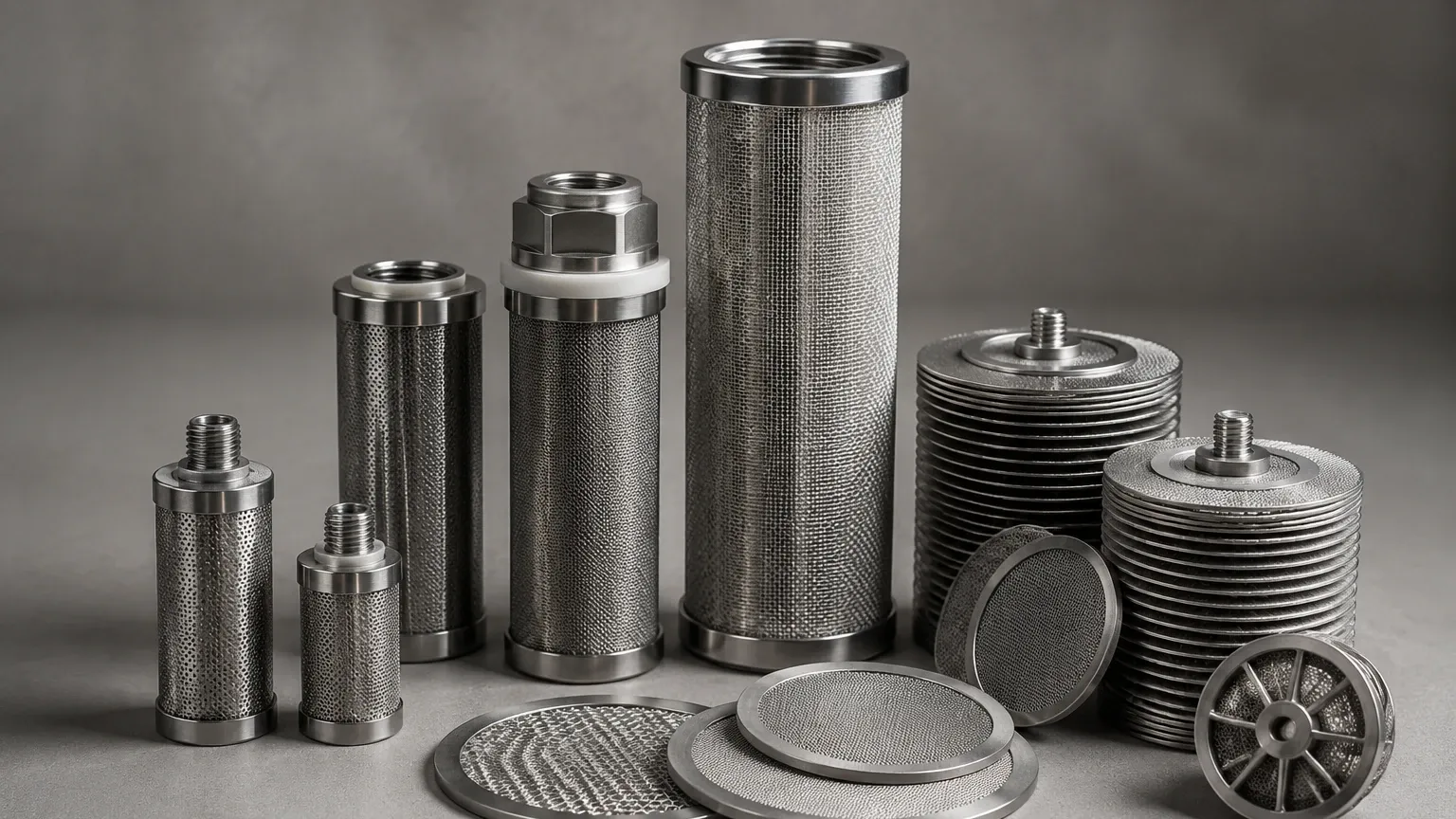
Disc filters represent a shift from surface filtration to a form of depth filtration. In an industrial context, these often consist of multiple Filter Discs & Packs stacked together. In some designs, especially in water treatment, these are plastic discs with grooves; however, in high-performance industrial applications, these are often multi-layered stainless steel mesh discs or sintered metal packs.
Key Characteristics of Disc Filters
1. Tortuous Path: As fluid passes through the stack of discs or the internal layers of a filter pack, it must navigate a complex, three-dimensional path. This allows the filter to trap particles not just on the surface, but throughout the thickness of the media.
2. High Dirt-Holding Capacity: Because the filtration occurs in three dimensions, disc filters can typically hold a larger volume of contaminants before reaching the maximum allowable pressure drop compared to a single-layer screen.
3. Resistance to Deformable Solids: Disc filters are particularly effective at capturing organic matter, algae, and irregularly shaped particles that might otherwise "squeeze" through the pores of a simple screen.
When considering disc filter vs screen filter which is better, the disc filter is often the superior choice for "dirty" fluids with high organic loads or varied particle shapes, as the depth of the media provides more opportunities for particle impingement and capture.
Technical Comparison: Performance Metrics
To make an informed decision, engineers must evaluate several performance metrics that differentiate these two technologies in a laboratory and field setting.
1. Filtration Efficiency and Micron Ratings
Screen filters provide a very precise "cut point." If you specify a 50-micron stainless steel mesh, you can be confident that rigid particles larger than 50 microns will be excluded. Disc filters, due to their depth-loading nature, often provide a nominal rating. While they are highly efficient, the "tortuous path" means that some smaller particles may be trapped while some slightly larger, deformable particles might eventually work their way through under high pressure.
2. Pressure Drop (ΔP)
Initially, a clean screen filter usually exhibits a lower pressure drop than a disc filter because the fluid only has to pass through a thin layer of material. However, as the screen begins to load with contaminants, the ΔP increases rapidly. Disc filters start with a slightly higher baseline ΔP but maintain a more gradual increase in pressure as they fill, allowing for longer run times between cleaning cycles.
3. Cleaning and Maintenance
Screen filters are the gold standard for automated backwashing systems. The surface-loaded debris is easily dislodged by a reverse flow of fluid. Disc filters can be more challenging to clean thoroughly. In some stacked disc systems, the discs must be separated or loosened to allow the backwash flow to reach the trapped particles within the grooves or layers. For sintered metal Filter Discs & Packs, ultrasonic cleaning or chemical cleaning is often required to restore the media to its original state.
Material Selection: Why Stainless Steel Matters
Regardless of whether you choose a disc or screen configuration, the material of construction is paramount, especially in the chemical, pharmaceutical, and food industries. Kaifil specializes in stainless steel (typically 304, 316, or 316L) for several engineering reasons:
* Corrosion Resistance: Stainless steel withstands aggressive chemicals and high-moisture environments that would degrade plastic or carbon steel components.
* Thermal Stability: Industrial processes often operate at elevated temperatures. Stainless steel filters maintain their structural integrity and pore size at temperatures where polymer-based filters would soften or fail.
* Mechanical Strength: In high-pressure hydraulic systems, the filter media must resist collapsing. Stainless steel wire mesh and sintered packs provide the necessary rigidity to handle high differential pressures.
* Hygiene and Cleanability: For food and beverage or pharmaceutical applications, the non-porous surface of stainless steel prevents bacterial growth and allows for rigorous sterilization (SIP/CIP) processes.
Application-Specific Guidance
To determine disc filter vs screen filter which is better for your facility, consider the following common industrial scenarios:
Scenario A: High-Pressure Hydraulic Systems
In hydraulic circuits, protecting sensitive valves and pumps from metal wear particles is the priority. Here, a screen filter (often in the form of a high-strength stainless steel mesh) is usually preferred. The particles are typically hard and inorganic, and the precise micron rating of a screen ensures that no particle large enough to damage a component passes through.
Scenario B: Cooling Water or Process Water Intake
If you are drawing water from a lake or river, the fluid will contain algae, silt, and organic debris. A disc filter is significantly better in this application. A screen filter would blind almost immediately with organic slime, whereas the depth of a disc filter allows it to trap the soft matter while maintaining flow.
Scenario C: Chemical Catalyst Recovery
In chemical processing, recovering expensive catalysts requires absolute retention and the ability to withstand harsh solvents. Multi-layer Filter Discs & Packs are often the engineered solution here. They combine the precision of a fine mesh surface with the structural support of coarser layers, allowing for high-efficiency recovery under demanding conditions.
Total Cost of Ownership (TCO) Considerations
When evaluating the cost, engineers must look beyond the initial purchase price. The TCO includes:
* Replacement Frequency: How often does the media fail or become permanently fouled?
* Downtime: How long does it take to clean or replace the filter?
* Waste Disposal: Are you using disposable cartridges, or can the stainless steel discs/screens be cleaned and reused?
* Energy Costs: A filter that operates with a high average pressure drop requires more pump energy to maintain flow.
Stainless steel screen and disc solutions generally have a higher upfront cost than plastic disposables but offer a lower TCO over several years due to their cleanability and durability. In many industrial settings, a single stainless steel filter pack can replace thousands of disposable cartridges over its lifespan.
Conclusion: Making the Informed Choice
There is no universal winner in the debate of disc filter vs screen filter which is better. The choice is a function of your fluid's contaminant profile and your operational goals.
* Choose Screen Filters when you need precise, absolute filtration of hard particles, low initial pressure drop, and easy backwashing.
* Choose Disc Filters (or multi-layer filter packs) when you are dealing with high concentrations of organic or irregular debris, require high dirt-holding capacity, and want to extend the intervals between maintenance cycles.
At Kaifil, we understand that every industrial environment presents unique challenges. We provide customized stainless steel filtration solutions, ranging from simple wire mesh screens to complex, multi-layered sintered filter packs. By focusing on material quality and precision engineering, we help our partners achieve reliable performance in the most demanding applications.
Before finalizing your system design, it is advisable to confirm the chemical compatibility of your fluid with the filter media and to calculate the expected flow velocity to ensure the chosen filter area is sufficient. For technical assistance in selecting the right configuration for your project, exploring professional Filter Discs & Packs options is the first step toward a more efficient filtration process.
Download Disc Filter vs Screen Filter Which Is Better as a PDF
