


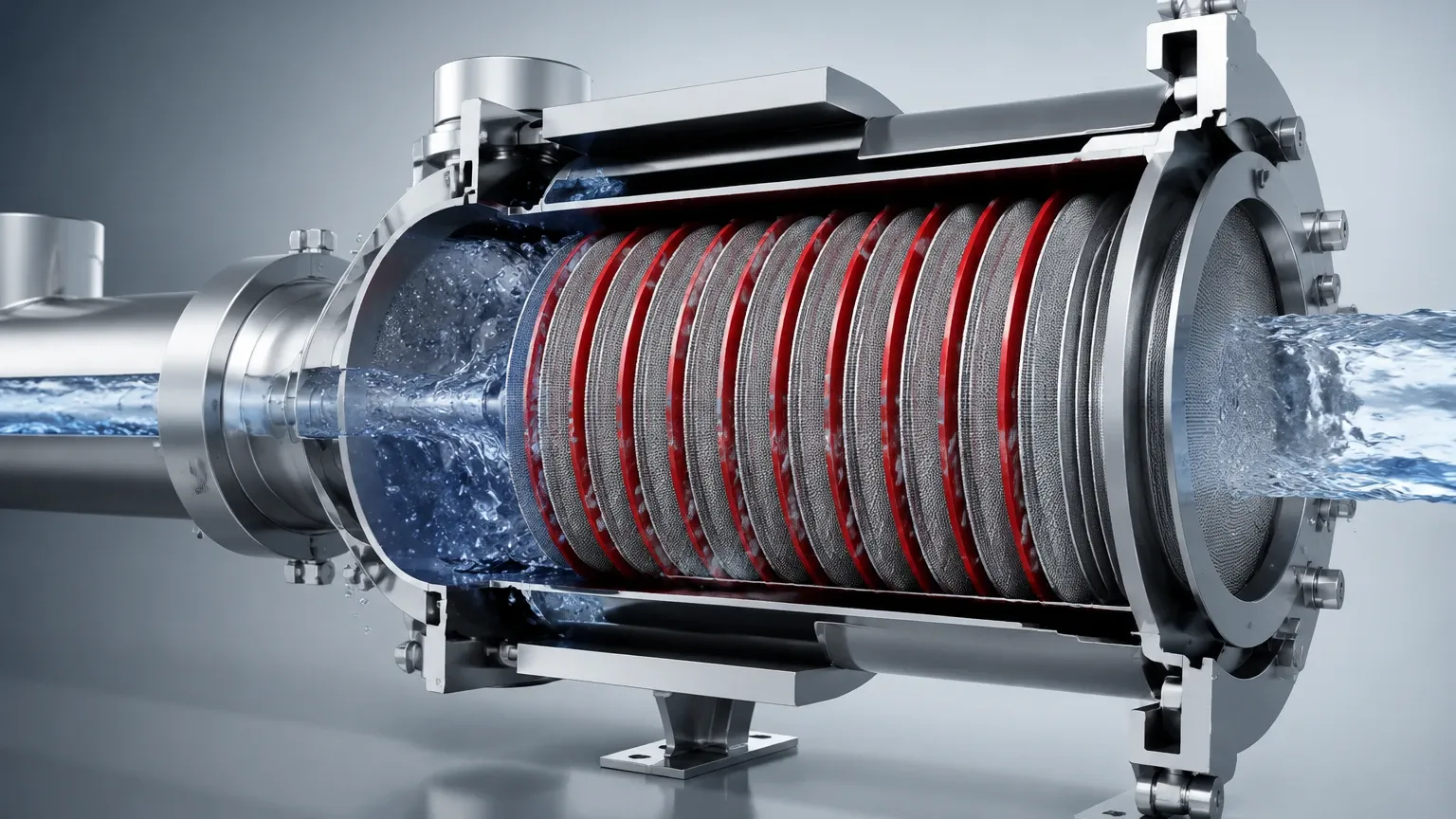
Disc Filter Working Animation
In industrial filtration, visualizing the internal mechanics of a component is essential for engineering teams tasked with optimizing fluid systems. While a static technical drawing provides dimensions, a disc filter working animation offers a dynamic view of how fluid interacts with wire mesh layers, how contaminants are captured, and how pressure differentials develop over time. Understanding these principles is critical for selecting the right Filter Discs & Packs for demanding applications in chemical processing, plastic extrusion, and hydraulic systems.
This guide explores the technical logic behind disc filtration, the engineering variables that dictate performance, and the criteria professionals use to evaluate these components within a larger industrial assembly.
Understanding the Mechanics of Filter Discs & Packs
Filter discs and packs are precision-engineered components typically made from stainless steel wire mesh. Their primary function is to remove solid particles from liquid or gaseous streams. In a B2B context, these are rarely standalone units; they are usually integrated into larger filtration housings, extruders, or valve assemblies.
Material Composition and Durability
Most industrial applications require materials that can withstand high temperatures and corrosive environments. Stainless steel (specifically grades 304, 316, and 316L) is the industry standard due to its oxidation resistance and structural integrity. For specialized chemical processing, alloys like Hastelloy or Monel may be used, though stainless steel remains the most cost-effective solution for the majority of hydraulic and food-grade applications.
Weave Patterns and Filtration Precision
The performance of a filter disc is fundamentally tied to its weave pattern. Common types include:
- Plain Weave: The simplest pattern, offering high flow rates and easy cleaning.
- Twill Weave: Allows for a heavier wire diameter in a given mesh count, increasing strength.
- Dutch Weave: Features a denser structure with smaller openings, ideal for high-pressure applications requiring fine micron ratings.
Step-by-Step Breakdown: The Disc Filter Working Animation Logic
To understand the "animation" of a disc filter in operation, one must look at the sequence of events as fluid moves through the mesh. This process can be broken down into three distinct phases: entry, entrapment, and discharge.
1. Fluid Entry and Laminar Flow
As the fluid enters the filtration chamber, it approaches the surface of the filter disc. In a well-designed system, the goal is to maintain a laminar flow to ensure even distribution across the entire surface area of the mesh. If the flow is too turbulent, it can cause localized wear or "channeling," where fluid bypasses certain areas of the mesh, leading to uneven contaminant loading.
2. The Entrapment Phase (Surface vs. Depth)
In a single-layer disc, filtration is primarily a surface phenomenon. Particles larger than the mesh opening are blocked at the interface. However, in multilayer Filter Discs & Packs, the process shifts toward depth filtration.
In a multilayer configuration, a disc filter working animation would show larger particles being caught by the outer, coarser layers, while finer particles penetrate deeper into the pack to be captured by the fine-mesh core. This graduated filtration prevents the surface from blinding prematurely, significantly extending the service life of the component.
3. Clean Fluid Discharge and Pressure Maintenance
Once the fluid passes through the final layer of the pack, it exits as a clarified stream. The efficiency of this phase is measured by the "clean pressure drop" (the initial resistance offered by the filter). As the filter captures more debris, the resistance increases. Monitoring this pressure differential ($ΔP$) is the standard method for determining when a filter pack needs cleaning or replacement.
Engineering Considerations for Material and Weave Selection
Selecting the correct filter disc involves more than just picking a micron rating. Engineers must balance several competing factors to ensure system reliability.
Micron Rating vs. Permeability
A finer micron rating increases filtration efficiency but decreases permeability. This means the pump or system pressure must work harder to move the same volume of fluid. Engineers must calculate the minimum acceptable filtration level that protects downstream equipment without causing excessive energy loss or system strain.
Mechanical Strength and Support
Under high-pressure conditions, a single layer of fine mesh may deform or rupture. To prevent this, filter packs often include a "support mesh"—a coarse, heavy-duty layer that provides structural rigidity without significantly affecting the flow. In a disc filter working animation, this support layer remains stationary and undeformed even as the fluid pressure fluctuates.
Chemical and Thermal Compatibility
In the pharmaceutical and food industries, the filter must not only remove contaminants but also resist leaching or reacting with the product. Stainless steel 316L is preferred in these sectors for its low carbon content and high resistance to pitting corrosion, especially when exposed to chlorides or high-temperature cleaning cycles (CIP).
The Role of Multilayer Packs in High-Pressure Systems
In industries like plastic extrusion or polymer processing, the pressures involved are immense. Here, a single filter disc is insufficient. Instead, multilayer packs are used, often consisting of three to five layers of varying mesh counts.
Sintered vs. Spot-Welded Packs
There are two primary ways to join multilayer packs:
1. Spot-Welding: The layers are joined at specific points along the rim. This is cost-effective and suitable for many standard applications.
2. Sintering: The layers are bonded together through a high-temperature heat treatment process without the use of binders. Sintered packs act as a single, rigid piece of metal. They offer superior mechanical strength and are virtually impossible to delaminate, making them the gold standard for high-pressure hydraulic systems.
Rim and Bordering Options
The edges of the filter discs are often finished with a rim (or "border") made of aluminum, stainless steel, or copper. This rim serves two purposes: it prevents the wire mesh from fraying and provides a compression seal within the filter housing. An effective seal ensures that 100% of the fluid passes through the mesh rather than leaking around the edges.
Performance Evaluation: Flow Rate and Pressure Drop
When evaluating Filter Discs & Packs, technical professionals focus on the relationship between flow rate and the accumulation of solids. This is often represented by a "filter cake" formation.
Filter Cake Formation
As particles accumulate on the surface of the disc, they actually begin to act as a secondary filter medium. This is known as the filter cake. While the cake improves filtration fineness, it also increases the pressure drop. A disc filter working animation would depict this cake thickening over time, eventually reaching a point where the flow rate drops below the required threshold for the process.
Calculating Total Cost of Ownership (TCO)
While the initial purchase price of a filter disc is important, the TCO is determined by:
- Replacement Frequency: How long the disc lasts before blinding.
- Cleanability: Can the disc be ultrasonically cleaned and reused, or is it a disposable component?
- Downtime Costs: The labor and production loss associated with changing the filter.
High-quality stainless steel discs from manufacturers like Kaifil are often designed for multiple cleaning cycles, providing a lower TCO compared to cheaper, lower-grade alternatives.
Customization and OEM Solutions for Industrial Filtration
Every industrial process has unique requirements, which is why customization is a core component of the filtration industry. Standard sizes exist, but many engineers require specific geometries or layer combinations to fit proprietary machinery.
Custom Shapes and Dimensions
Beyond standard circular discs, filtration components can be manufactured in oval, rectangular, or ring shapes (donuts). Precision laser cutting or die-cutting ensures that these shapes meet tight tolerances, which is essential for maintaining a leak-proof seal in automated equipment.
Prototyping and Technical Support
When developing a new system, engineers often work with manufacturers to prototype different mesh combinations. By analyzing the performance of these prototypes in a real-world environment, teams can fine-tune the micron rating and layer structure to achieve the optimal balance of flow and particle retention.
Maintenance and Replacement Cycles
Establishing a predictable maintenance schedule is vital for preventing unscheduled downtime. In most industrial settings, this is handled through automated monitoring of the differential pressure.
- Preventative Maintenance: Replacing or cleaning the filter discs at 80% of their maximum rated pressure drop.
- Ultrasonic Cleaning: For stainless steel packs, ultrasonic baths can remove deeply embedded particles that backwashing cannot, extending the life of the pack through several cycles.
- Inspection for Damage: During replacement, discs should be inspected for signs of "wire migration" or mesh distortion, which could indicate that the system is operating outside its designed pressure or temperature parameters.
Conclusion
Understanding the dynamics of a disc filter working animation allows engineers to move beyond basic specifications and appreciate the complex interplay of fluid dynamics, material science, and mechanical design. Whether you are managing a chemical refinery or a precision hydraulic system, the quality of your Filter Discs & Packs directly impacts the efficiency and longevity of your equipment.
By focusing on high-grade materials, precise weave patterns, and robust construction, manufacturers like Kaifil provide the reliable filtration components necessary for modern industrial success. When selecting your next filtration solution, consider the total environment—pressure, temperature, and chemical exposure—to ensure you choose a product that delivers consistent, high-performance results.
