


Disc Filter Wwtp
In the landscape of modern wastewater management, the transition from traditional gravity-fed sand filters to mechanical filtration systems has been driven by the need for higher efficiency, smaller footprints, and more consistent effluent quality. The disc filter WWTP (Wastewater Treatment Plant) application represents a critical advancement in tertiary treatment, designed to remove fine suspended solids that secondary clarification processes may leave behind. For engineers and facility managers, understanding the mechanical and material nuances of these systems is essential for optimizing plant performance and ensuring regulatory compliance.
Disc filters operate on a relatively straightforward mechanical principle but require high-precision components to function effectively in the demanding environment of a municipal or industrial wastewater plant. As the industry moves toward more stringent standards for Total Suspended Solids (TSS) and phosphorus removal, the selection of the internal filtration media—specifically the Filter Discs & Packs—becomes the determining factor in the system’s overall reliability and operational cost.
The Role of Disc Filters in Modern Wastewater Treatment
A disc filter in a WWTP setting is primarily utilized for polishing effluent. After the biological treatment and secondary clarification stages, the water still contains micro-solids that can interfere with disinfection processes or exceed discharge limits. The disc filter provides a physical barrier that captures these particles.
Tertiary Polishing and TSS Removal
The primary objective of a disc filter WWTP installation is the reduction of TSS. Typical secondary effluent might contain TSS levels between 10 and 30 mg/L. A well-engineered disc filter can reduce these levels to below 5 mg/L, and in many cases, even lower. This is crucial for plants that must meet strict environmental permits or those looking to reuse treated water for irrigation or industrial cooling.
Phosphorus Removal
When combined with chemical coagulation and flocculation, disc filters are highly effective at phosphorus removal. By adding metal salts (like alum or ferric chloride) upstream, dissolved phosphorus precipitates into flocs. The disc filter then captures these flocs. Because the surface area of a disc filter is significantly larger than that of a traditional sand filter relative to its footprint, it can handle the variable loading often seen in phosphorus removal applications.
Protection of Downstream Processes
For plants utilizing Ultraviolet (UV) disinfection, the clarity of the water (transmissivity) is paramount. Suspended solids can "shield" pathogens from UV light, rendering the disinfection process ineffective. By implementing a disc filter WWTP solution, operators ensure that the water entering the UV channels is free of interfering particles, thereby optimizing energy use and ensuring pathogen inactivation.
Technical Mechanics of Disc Filtration
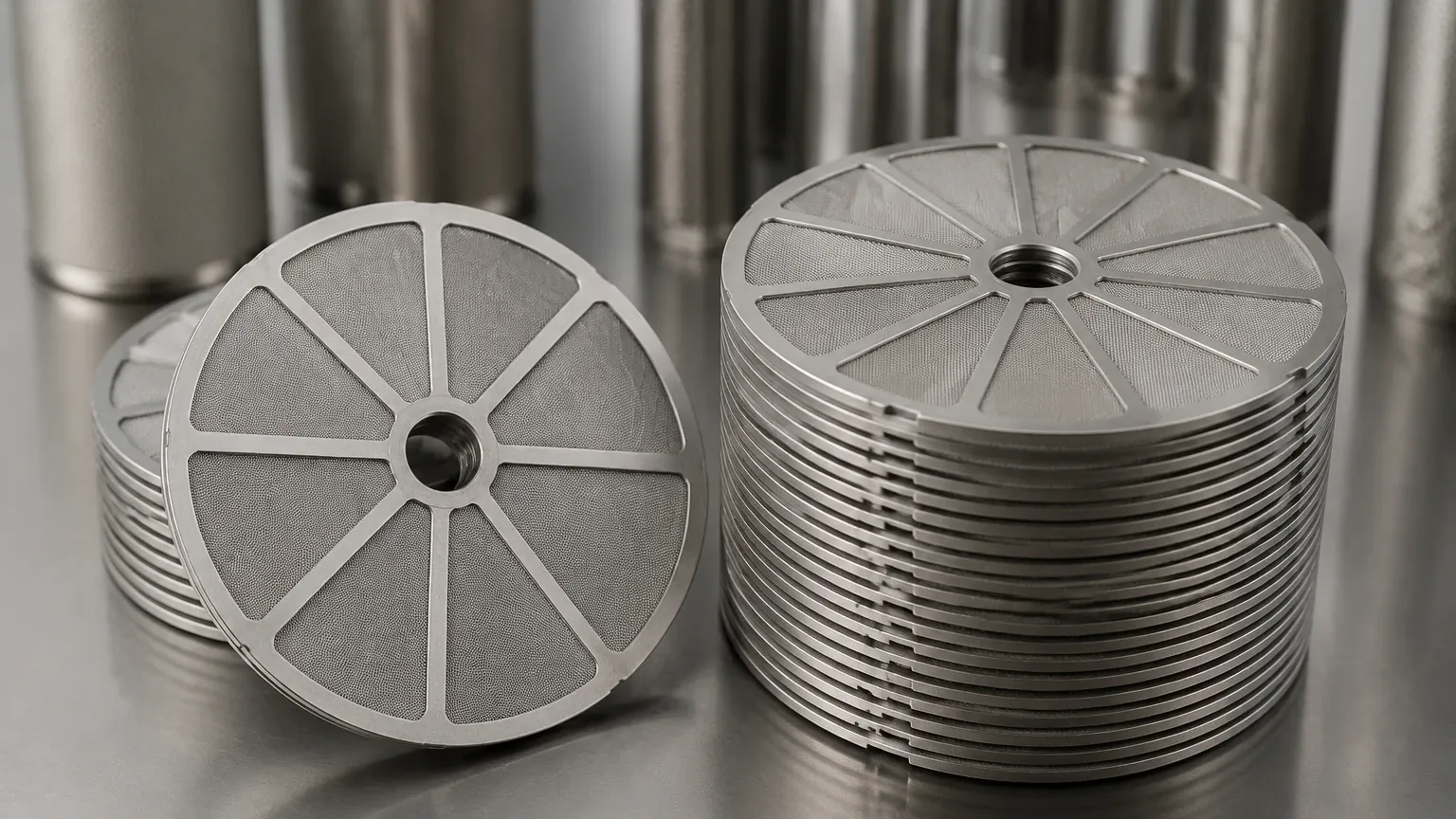
The architecture of a disc filter typically consists of a series of parallel discs mounted on a central rotating drum. Each disc is composed of several individual segments or "leaves" covered with a filtration medium.
Flow Dynamics
In most configurations, the wastewater enters the center of the drum and flows outward through the filter media. As the water passes through the Filter Discs & Packs, solids are retained on the inner surface of the filter cloth or mesh. The filtered water (permeate) is then collected in a tank surrounding the drum.
The Backwashing Cycle
As solids accumulate on the media, the pressure differential across the filter increases. Once a predetermined set point is reached, or on a timed interval, the drum begins to rotate, and a backwash system is activated. High-pressure spray nozzles located on the outside of the discs blast the accumulated solids off the media and into a collection trough for return to the headworks or solids handling stream. This continuous cleaning cycle allows the filter to remain in operation without the need for the lengthy "out-of-service" backwash periods required by sand filters.
Material Engineering: Stainless Steel vs. Synthetic Media
One of the most critical decisions in the design of a disc filter WWTP system is the choice of filtration material. While synthetic fabrics like polyester are common, stainless steel wire mesh offers distinct engineering advantages in specific industrial and heavy-duty municipal environments.
Durability and Mechanical Strength
Stainless steel Filter Discs & Packs provide superior mechanical strength compared to polymers. In applications where the wastewater may contain abrasive particles (such as grit that escaped primary treatment) or where high-pressure backwashing is frequent, stainless steel resists tearing and stretching. This dimensional stability ensures that the pore size remains constant over the life of the filter, providing consistent filtration accuracy.
Chemical and Thermal Resistance
WWTP environments can be chemically aggressive, especially during Clean-In-Place (CIP) procedures intended to remove organic fouling or mineral scaling. Stainless steel (typically 304 or 316L grade) is resistant to a wide range of cleaning agents and can withstand higher temperatures than most synthetic media. This allows for more aggressive cleaning protocols, which can extend the time between full media replacements.
Precision Weave and Filtration Accuracy
Metal wire mesh can be manufactured with extremely tight tolerances. For disc filter WWTP applications, the mesh is often woven in a plain, twill, or Dutch weave pattern. Dutch weaves, in particular, offer a combination of high flow rates and fine filtration, as the "tortuous path" created by the overlapping wires captures particles more effectively than a simple square mesh.
Key Engineering Considerations for Selection
When specifying Filter Discs & Packs for a wastewater project, engineers must balance several competing factors to ensure the system meets its performance targets.
Micron Rating and Particle Size Distribution
The micron rating of the filter media should be selected based on the particle size distribution (PSD) of the secondary effluent. Most disc filter WWTP applications utilize media ranging from 10 to 40 microns. Selecting a micron rating that is too fine can lead to rapid blinding and excessive backwashing, while a rating that is too coarse will fail to meet TSS targets. A technical analysis of the influent solids is highly recommended before finalizing the media specification.
Hydraulic Loading Rate (HLR)
The HLR defines how much water can pass through a square meter of filter area per hour (m³/m²·h). This is influenced by the open area of the filter mesh. Stainless steel mesh often provides a higher percentage of open area compared to thick synthetic felts, allowing for higher flow rates through a smaller physical footprint.
Backwash Water Consumption
An efficient disc filter should use as little of its own permeate as possible for backwashing. Generally, backwash consumption should be less than 1-3% of the total throughput. The design of the filter pack—specifically how easily it releases captured solids—directly impacts this percentage. Smooth, precision-woven stainless steel surfaces tend to release solids more readily than fibrous synthetic materials.
Maintenance and Operational Longevity
The total cost of ownership (TCO) for a disc filter WWTP system is heavily influenced by the maintenance requirements and the replacement cycle of the filter elements.
Managing Biological Fouling
In wastewater applications, biofilm growth on the filter media is an inevitable challenge. If not managed, this biofilm can "blind" the filter, leading to a permanent increase in head loss. Systems using stainless steel Filter Discs & Packs can often utilize more effective bio-control measures, including localized UV exposure or mild chlorinated backwash, without risking the integrity of the media.
Inspection and Replacement Cycles
While disc filters are designed for long-term operation, the filter segments should be inspected periodically for signs of bypass or mechanical wear. In a typical municipal WWTP, high-quality stainless steel mesh packs can last several years before requiring replacement, provided that the backwash system is maintained and the influent remains within design parameters.
Customization for Specific Applications
Not all wastewater is the same. Industrial wastewater from food processing, for example, may have higher fat, oil, and grease (FOG) content, requiring a different mesh structure or surface treatment than municipal sewage. Customization of the filter disc design—including the frame construction and the layering of the mesh—allows the system to be tailored to the specific rheology of the waste stream.
Conclusion: Making Informed Procurement Decisions
Implementing or upgrading a disc filter WWTP system requires a deep dive into the technical specifications of the filtration components. For engineers, the focus should remain on the long-term stability of the effluent quality and the operational resilience of the equipment.
By selecting high-performance Filter Discs & Packs, facilities can achieve a balance between fine filtration accuracy and robust mechanical durability. Whether the goal is meeting strict discharge limits for phosphorus or preparing water for high-level reuse, the integrity of the filter media is the foundation of a successful wastewater treatment strategy. When evaluating suppliers, it is essential to confirm material certifications, mesh weave precision, and the ability to customize the filter geometry to fit existing drum architectures, ensuring a seamless integration into the plant’s infrastructure.
