


E Filters
In the landscape of industrial filtration, "e filters"—most commonly recognized as extruder filters—represent a critical component in the manufacturing of polymers, plastics, and chemical resins. These precision-engineered components are essential for ensuring the purity of high-viscosity fluids under extreme pressure and temperature. For engineers and procurement specialists, selecting the correct Filter Discs & Packs is not merely a matter of purchasing a consumable; it is a strategic decision that impacts machine uptime, product quality, and the total cost of ownership.
As industrial processes become more complex, the demand for high-performance e filters has shifted toward customized stainless steel solutions. These filters must withstand the rigorous demands of continuous extrusion lines where even microscopic contaminants can lead to structural weaknesses in the final product or cause significant damage to downstream equipment like spinnerets or pelletizers.
Technical Foundations of E Filters in Extrusion
The primary function of e filters is the removal of foreign particles, gels, and un-melted polymer fragments from the melt stream. In a typical extrusion setup, these filters are placed within a screen changer or a breaker plate. The environment is characterized by high differential pressures and temperatures that often exceed 300°C.
To maintain structural integrity under these conditions, e filters are typically manufactured from high-grade stainless steel wire mesh. The choice of material—most frequently SS304 or SS316L—is dictated by the chemical compatibility of the polymer and the operating temperature. Stainless steel provides the necessary mechanical strength to resist deformation, a common failure point in lower-quality filtration components.
Material Selection and Alloy Characteristics
1. Stainless Steel 304: The standard choice for general-purpose filtration. It offers excellent strength and basic corrosion resistance, making it suitable for many standard thermoplastic applications.
2. Stainless Steel 316L: Preferred for applications involving corrosive additives or high-acid polymers. The addition of molybdenum and a lower carbon content enhances resistance to pitting and chemical degradation.
3. Specialty Alloys: In niche chemical processing, alloys like Hastelloy or Inconel may be utilized for e filters to handle extreme acidity or temperatures that surpass the limits of standard stainless steel.
Structural Configurations of Filter Discs & Packs
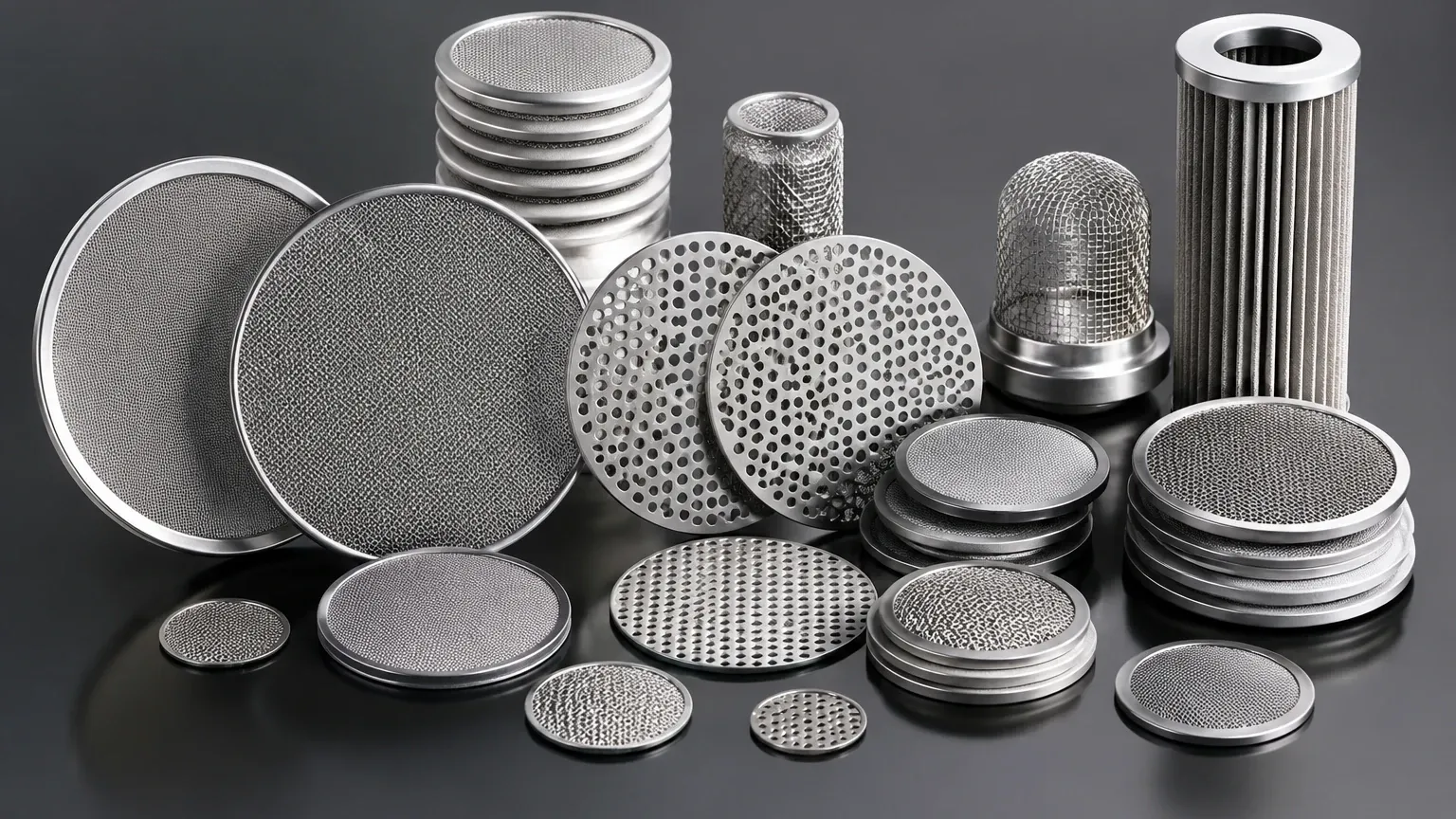
E filters are rarely used as single, unsupported layers of mesh. Depending on the filtration fineness required and the pressure of the system, they are configured into various types of Filter Discs & Packs to optimize performance.
Single-Layer Discs
Used primarily in low-pressure applications or as pre-filtration stages, single-layer discs are laser-cut or stamped to precise diameters. While cost-effective, they lack the structural reinforcement needed for high-viscosity polymer melts.
Multi-Layer Spot-Welded Packs
This is the most common configuration for industrial e filters. Multiple layers of wire mesh with varying mesh counts are stacked and spot-welded together. A typical sequence might include:
* Support Layer: A coarse mesh (e.g., 20 mesh) that provides mechanical rigidity.
* Filtration Layer: A fine mesh (e.g., 200 to 500 mesh) that determines the micron rating.
* Drainage/Protection Layer: Another coarse mesh to protect the fine filtration layer from the pressure of the breaker plate.
Rimmed or Framed Packs
For high-pressure environments, the edges of the multi-layer pack are bound with a metal rim, usually made of aluminum, copper, or stainless steel. This rim prevents bypass—where unfiltered material leaks around the edges of the filter—and ensures a secure seal within the screen changer. The rim also adds significant hoop strength to the assembly, preventing the mesh from warping under the force of the melt flow.
Engineering Considerations: Micron Ratings and Weave Types
When specifying e filters, engineers must balance filtration efficiency with pressure drop. A filter that is too fine will clog rapidly (shortening the replacement cycle), while one that is too coarse will allow contaminants to pass through.
Understanding Weave Patterns
* Plain Weave: The most common and economical weave, where wires cross over and under each other. It provides a high open area and low pressure drop.
* Dutch Weave (Plain and Twilled): These weaves use heavier warp wires and smaller shute wires, resulting in a dense, strong mesh with very fine filtration paths. Dutch weave e filters are ideal for high-pressure applications where precision is paramount.
* Twill Weave: Allows for a heavier wire diameter in a given mesh count, increasing the durability of the filter disc.
Nominal vs. Absolute Filtration
It is vital to distinguish between nominal and absolute ratings. Nominal ratings refer to the ability of the mesh to retain a percentage of particles of a certain size, whereas absolute ratings indicate the size of the largest spherical particle that can pass through the mesh. For critical e filter applications, absolute ratings are often required to guarantee product purity.
Performance Expectations and Operational Challenges
The performance of Filter Discs & Packs is measured by their dirt-holding capacity and their resistance to "blinding" or clogging. In polymer extrusion, the buildup of contaminants leads to an increase in differential pressure across the filter. Once this pressure reaches a predetermined threshold, the filter must be replaced or cleaned.
Common Risks in E Filter Implementation
* Mesh Migration: In poorly manufactured filters, individual wires may break loose and enter the product stream. High-quality spot welding and rimming are essential to prevent this.
* Pressure Spikes: Sudden increases in pressure can cause "ballooning" of the mesh if the support layers are insufficient. This distorts the pore size and compromises filtration accuracy.
* Chemical Degradation: If the alloy is not properly matched to the polymer chemistry, the mesh may undergo stress corrosion cracking, leading to premature failure.
Customization and OEM Integration
Every extrusion line has unique requirements based on the barrel diameter, the type of screen changer, and the specific rheology of the material being processed. Customization is a core requirement for industrial e filters. Professional manufacturers provide tailored solutions that include:
* Custom Diameters: Precise sizing to fit specific breaker plate recessed areas.
* Variable Layering: Adjusting the number and sequence of mesh layers to achieve a specific flow-to-filtration ratio.
* Shape Variations: While discs are standard, some systems require oval, kidney-shaped, or rectangular packs.
By working closely with an OEM manufacturer like Kaifil, engineering teams can develop e filters that are optimized for their specific equipment, rather than relying on "off-the-shelf" components that may lead to suboptimal performance.
Total Cost Considerations and Replacement Cycles
The purchase price of e filters is only one component of the total cost of ownership. Engineers must also consider the cost of downtime required for filter changes and the potential waste generated by off-spec products.
Factors Influencing Replacement Cycles
1. Contamination Levels: The purity of the raw material (virgin vs. recycled resin) significantly affects how often e filters must be changed.
2. Flow Rate: Higher throughput speeds increase the rate of particle accumulation.
3. Filter Area: Increasing the effective filtration area through pleating or larger disc diameters can extend the time between changes, though this often requires hardware modifications.
In some high-volume applications, stainless steel Filter Discs & Packs can be cleaned and reused. Methods such as ultrasonic cleaning or burn-off ovens (pyrolysis) can remove polymer residue. However, the integrity of the mesh must be verified after each cleaning cycle to ensure that the pore structure has not been damaged or enlarged.
Conclusion: Selecting the Right Filtration Partner
For B2B buyers and engineers, the selection of e filters is a balance of technical specification and supplier reliability. A high-quality filter ensures that the extrusion process remains stable, protecting both the machinery and the brand's reputation for product quality. When evaluating suppliers, it is essential to confirm their capabilities in material sourcing, precision manufacturing, and quality control.
Reliable filtration components are the backbone of efficient industrial processing. By focusing on the engineering nuances of Filter Discs & Packs, such as weave type, layer configuration, and alloy selection, companies can achieve significant improvements in their production metrics and long-term operational stability.
