


Filter Paper Discs 6mm
In the precision-driven sectors of laboratory analysis, pharmaceutical manufacturing, and micro-fluidic engineering, the selection of filtration media is a critical determinant of process accuracy and product purity. Among the various formats available, filter paper discs 6mm in diameter represent a specialized standard used extensively for micro-scale filtration, antibiotic susceptibility testing (AST), and sample preparation. While often associated with laboratory environments, these small-diameter discs play a vital role in industrial B2B applications where precise fluid control and contaminant removal are paramount.
Selecting the correct filtration component requires a deep understanding of material properties, pore size distribution, and the mechanical stresses of the application. For engineers and procurement specialists, the choice between paper-based media and more durable alternatives like stainless steel Filter Discs & Packs depends on the chemical environment, temperature requirements, and the need for reusability.
Technical Role of 6mm Filter Discs
The 6mm diameter is a standardized size in several scientific and industrial protocols. In microbiology, these discs are frequently impregnated with specific reagents or antibiotics to measure zones of inhibition. However, in industrial filtration, the 6mm format is often utilized as a primary or secondary filtration stage within micro-valves, sensors, and analytical instrumentation.
Material Composition and Grades
Filter paper discs are typically categorized by their composition and the manufacturing process used to define their retention characteristics:
1. Qualitative Filter Paper: Used primarily for rapid filtration and clarifying liquids. These are composed of high-quality cellulose fibers and are graded by their flow rate (fast, medium, or slow). In industrial settings, qualitative 6mm discs may be used for simple particulate removal where high-precision retention is not the primary goal.
2. Quantitative (Ashless) Filter Paper: These are treated with acid to remove impurities, resulting in an extremely low ash content (typically <0.01%). This is essential for gravimetric analysis where the filter paper is ignited after filtration to weigh the remaining precipitate.
3. Glass Microfiber Discs: For applications involving high temperatures or aggressive chemicals, glass fiber is preferred over cellulose. Glass microfiber discs offer high loading capacity and can retain particles in the sub-micron range, making them suitable for air monitoring and water analysis.
Engineering Considerations for Micro-Filtration
When integrating a 6mm filter disc into an industrial system, engineers must account for several physical and chemical factors that influence the total cost of ownership and system reliability.
Pore Size and Retention Efficiency
The "nominal" micron rating of a filter paper disc refers to its ability to retain particles of a specific size with a certain percentage of efficiency. Unlike absolute-rated metal mesh, paper media has a complex, three-dimensional depth structure. This means that while it is excellent at trapping a variety of particle sizes throughout its thickness, it may experience "particle breakthrough" if the pressure differential becomes too high.
Flow Rate and Pressure Drop
The small surface area of a 6mm disc (approximately 28.27 mm²) means that the flow resistance is significantly higher than that of larger formats. Engineers must calculate the expected pressure drop (ΔP) across the disc to ensure that the pump or gravity-fed system can maintain the required flow rate without rupturing the media. The thickness of the paper and its porosity are the primary variables in this calculation.
Chemical Compatibility
Cellulose-based filter paper discs 6mm are compatible with most neutral aqueous solutions and organic solvents. However, they are susceptible to degradation in the presence of strong acids or bases. In processes involving caustic cleaning agents or high-temperature steam sterilization (SIP), paper media may lose structural integrity. In such cases, transitioning to stainless steel Filter Discs & Packs is often the most cost-effective long-term solution due to their superior chemical resistance and mechanical strength.
Applications in Industrial B2B Contexts
Beyond the laboratory bench, 6mm filtration components are integrated into various industrial hardware:
* Chromatography Equipment: Used as pre-filters to protect sensitive HPLC columns from particulate matter that could cause clogging or baseline noise.
* Environmental Monitoring: Small discs are used in automated water sampling units to capture suspended solids for later analysis.
* Micro-Hydraulics: In precision hydraulic systems, 6mm discs act as "last chance" filters to protect delicate orifices and actuators from stray contaminants introduced during assembly or maintenance.
* Medical Devices: Integrated into diagnostic kits and point-of-care devices where small volumes of fluid must be filtered rapidly and accurately.
Challenges and Risks with Paper Media
While paper discs are inexpensive and readily available, they present specific risks in demanding industrial environments. Understanding these risks is essential for making an informed purchasing decision.
Fiber Migration
One of the primary disadvantages of cellulose filter paper is the potential for fiber shedding. As fluid passes through the disc, individual cellulose fibers can become detached and enter the downstream filtrate. In pharmaceutical or semiconductor applications, this downstream contamination can lead to batch failure. For these high-purity requirements, sintered metal mesh or edge-bonded Filter Discs & Packs are preferred because they provide a fixed pore structure with zero fiber migration.
Mechanical Burst Strength
Paper has limited wet burst strength. If a system experiences a sudden pressure spike, a 6mm paper disc may rupture, allowing unfiltered fluid to bypass the filtration stage. Engineers must ensure that the disc is properly supported by a rigid backing—often a perforated metal plate or a coarse wire mesh—to prevent mechanical failure.
Moisture Sensitivity
Cellulose is hygroscopic. In gas filtration applications, the presence of humidity can cause the paper fibers to swell, significantly increasing the pressure drop and potentially leading to premature clogging. Glass fiber or synthetic polymer discs (such as PTFE) are better suited for gas-phase micro-filtration.
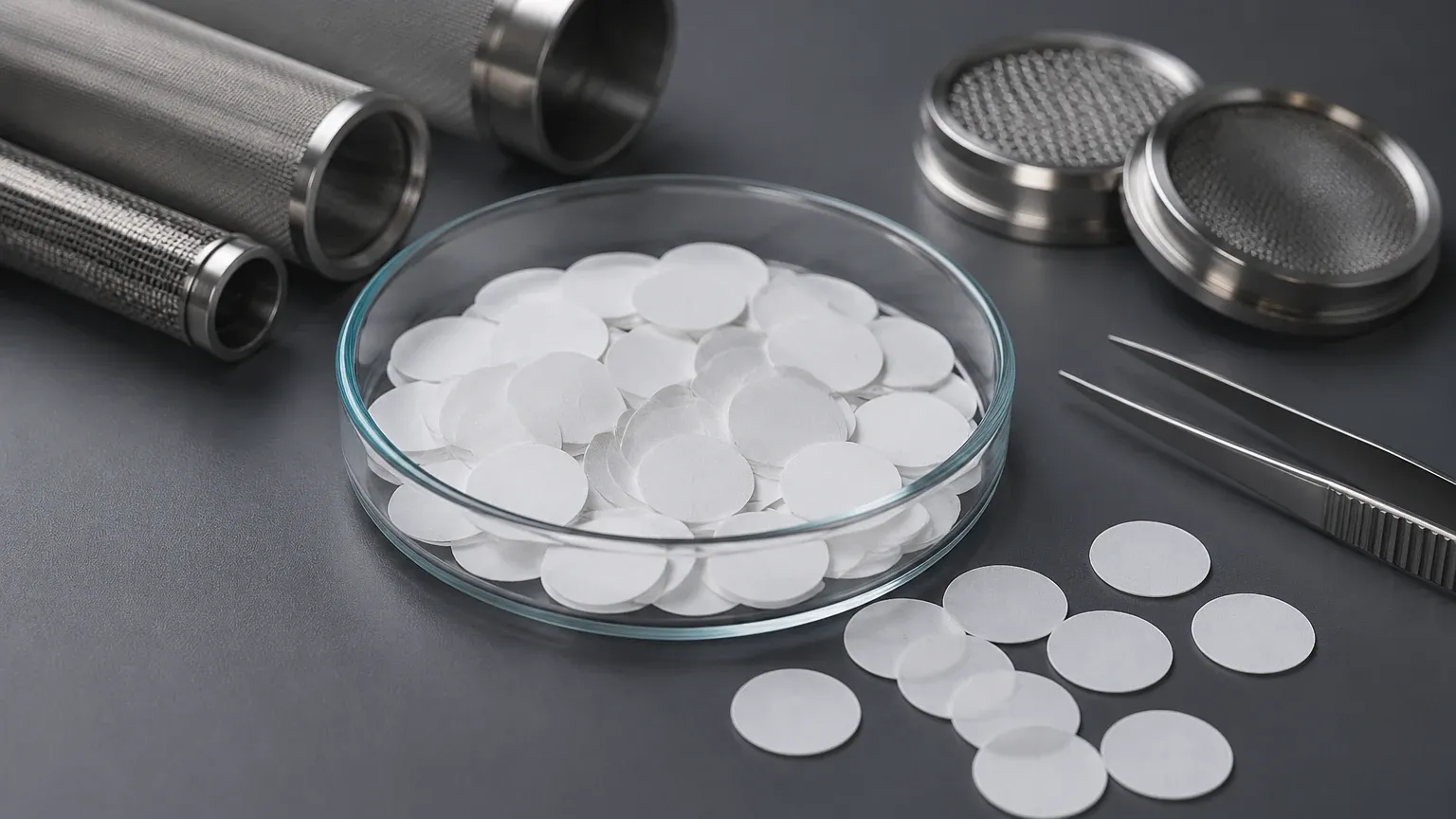
Comparing Paper to Stainless Steel Filter Discs
For many B2B buyers, the decision to use filter paper discs 6mm is based on the assumption of lower initial costs. However, a total cost analysis often reveals that stainless steel filtration components offer better value in industrial cycles.
| Feature | Cellulose Filter Paper | Stainless Steel Wire Mesh |
| :— | :— | :— |
| Durability | Single-use, fragile | Multi-use, extremely durable |
| Temperature Limit | Typically <120°C | Up to 600°C (depending on alloy) |
| Cleaning | Non-cleanable | Ultrasonic, backwash, or chemical cleaning |
| Pore Precision | Nominal (variable) | Absolute (fixed geometry) |
| Chemical Resistance | Limited (swells in water) | Excellent (316L, 304, etc.) |
| Fiber Migration | Possible | None (if sintered or properly finished) |
When a process requires frequent filter changes, the labor costs and system downtime associated with replacing paper discs can quickly exceed the investment in a permanent stainless steel filter. Furthermore, stainless steel Filter Discs & Packs can be custom-engineered to match the exact 6mm dimensions while providing much higher flow rates through optimized wire diameters.
Selection Guide: Confirming Your Requirements
Before finalizing a purchase order for filter paper discs 6mm or their metal equivalents, technical teams should confirm the following parameters with their supplier:
1. Retention Rating: Is the requirement for nominal or absolute filtration? If you are protecting a 10-micron orifice, you need a filter that is 100% efficient at that size.
2. Operating Pressure: What is the maximum differential pressure the disc will encounter? This determines whether you need a single-layer disc or a multi-layer pack with support meshes.
3. Fluid Chemistry: Will the media be exposed to solvents, acids, or high-pH cleaners? Ensure the binder in the paper (if any) or the alloy of the metal is compatible.
4. Sterilization Needs: If the component must be autoclaved or sterilized via gamma radiation, verify that the material will not degrade or release volatiles.
5. Housing Compatibility: 6mm is the outer diameter, but the sealing surface (the "land area") must be sufficient to prevent bypass without crushing the media.
Customization and OEM Solutions
In many industrial applications, a standard off-the-shelf 6mm disc is not sufficient. Manufacturers like Kaifil specialize in providing customized filtration solutions that bridge the gap between laboratory-grade paper and heavy-duty industrial mesh. This includes the production of multi-layer Filter Discs & Packs where different micron ratings are combined into a single, edge-welded or aluminum-rimmed component.
Customization options often include:
* Multi-Layer Construction: Combining a fine filtration layer with coarse support and drainage layers to maximize dirt-holding capacity and strength.
* Precision Die-Cutting: Ensuring that every 6mm disc has perfectly clean edges to prevent bypass in high-tolerance housings.
* Material Upgrades: Offering 304, 316L, or even exotic alloys like Hastelloy for environments where standard paper or steel would fail.
Conclusion
While filter paper discs 6mm are a staple of laboratory testing and micro-scale analysis, their use in industrial B2B applications requires careful consideration of mechanical and chemical limitations. For engineers seeking reliable, long-term filtration performance, understanding the transition from disposable paper to precision-engineered metal components is key to optimizing system efficiency. By evaluating the specific demands of the application—including pressure, temperature, and purity requirements—purchasing teams can select the filtration media that provides the best balance of performance and total cost.
For more information on high-performance filtration components and custom-engineered solutions, review the available Filter Discs & Packs to find the ideal match for your industrial requirements.
