


Filter vs Filter Out
In the technical lexicon of industrial separation, the distinction between the verb "to filter" and the phrasal verb "to filter out" often represents the difference between a process description and a performance requirement. For engineers and procurement specialists tasked with maintaining system integrity in chemical processing, polymer extrusion, or hydraulic systems, understanding this nuance is essential for specifying the correct components. While the terms are frequently used interchangeably in casual conversation, their application in a B2B manufacturing context dictates how filtration media are designed, tested, and implemented.
At its core, to "filter" refers to the act of passing a fluid—whether liquid or gas—through a porous medium to remove impurities. It describes the operation of the system as a whole. Conversely, to "filter out" specifies the target contaminants that must be captured by that medium. When an engineer defines what they need to filter out, they are establishing the micron rating, the efficiency requirements, and the physical characteristics of the Filter Discs & Packs required for the application.
Defining the Distinction in Industrial Filtration
To understand filter vs filter out, one must look at the relationship between the hardware and the objective. A filter is the physical assembly—the housing, the support structures, and the media. The process of filtering is the mechanical separation occurring within that assembly. However, the success of that process is measured by what is filtered out.
In high-pressure environments, such as plastic recycling or synthetic fiber production, the goal is often to filter out "gels," degraded polymers, or metallic fragments that could compromise the final product's quality. If a system is described simply as a "filter," it tells the manufacturer very little about the performance expectations. Specifying what needs to be filtered out allows for the engineering of multi-layered wire mesh structures that provide the necessary gradient density to capture specific particle sizes without prematurely clogging the system.
From a procurement perspective, focusing on what is being filtered out shifts the conversation from commodity purchasing to solution engineering. It requires an analysis of particle size distribution (PSD), flow rates, and the rheology of the fluid. By identifying the specific contaminants to be removed, manufacturers like Kaifil can recommend specific weave patterns—such as plain dutch weave or twilled dutch weave—to ensure the filtration media performs its intended function effectively.
The Role of Filter Discs & Packs in Precision Separation
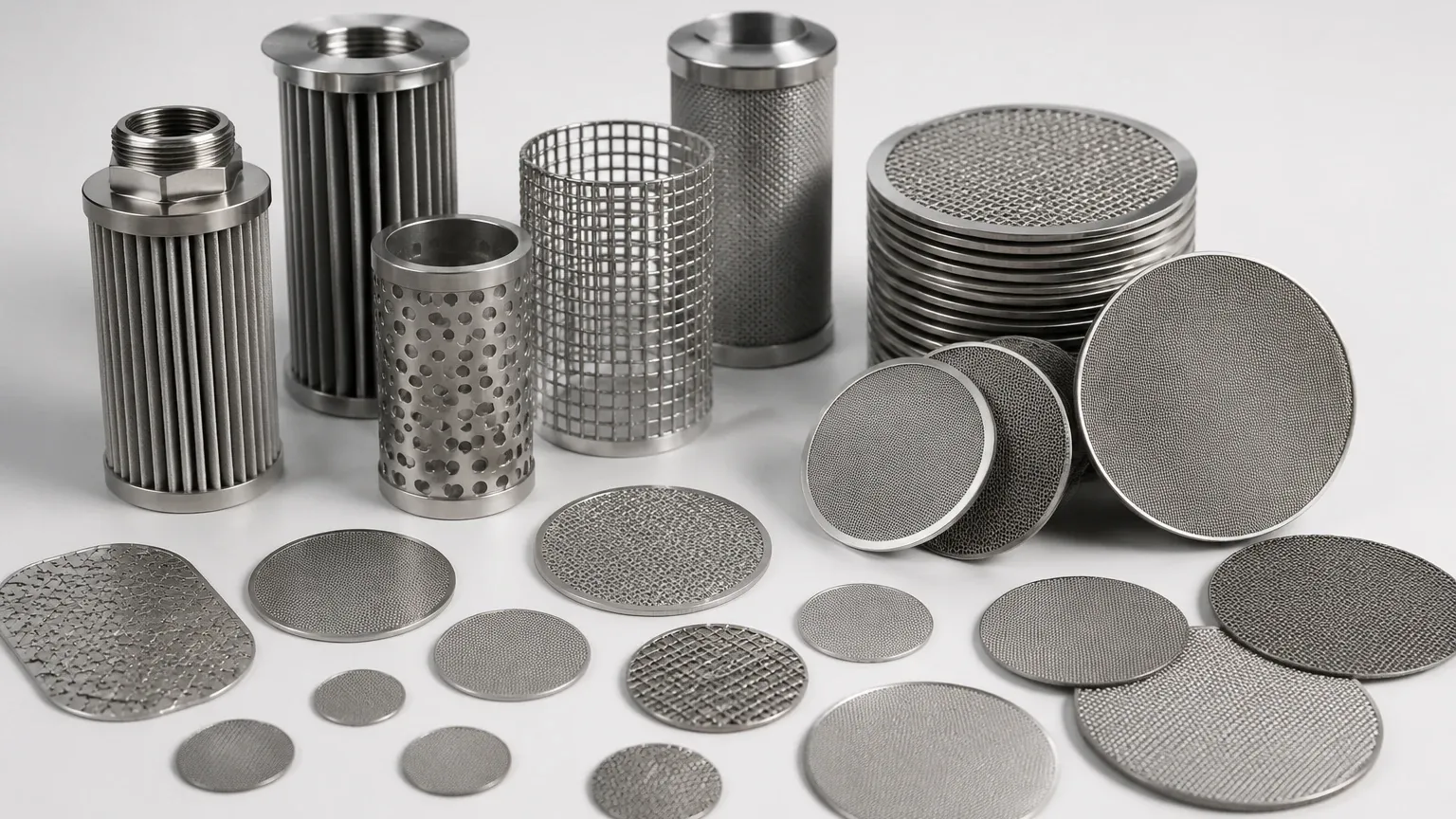
In many industrial applications, the primary tool used to filter out contaminants is the filter disc or pack. These components are typically constructed from multiple layers of stainless steel wire mesh, which are often spot-welded together or bound by an aluminum or stainless steel rim to form a robust unit. The complexity of these packs is a direct response to the need to filter out a wide range of particle sizes while maintaining structural integrity under high differential pressure.
Filter Discs & Packs are designed to provide surface or depth filtration depending on the layering strategy. For instance, a single-layer disc might be used in a simple strainer application where the goal is to filter out large debris. However, in a sophisticated melt filtration system, a multi-stage pack is required. This pack might include a fine filtration layer protected by coarser support layers. The support layers ensure the fine mesh does not deform under the force of the fluid, while the drainage layers facilitate the flow of the filtered medium away from the capture zone.
By utilizing various mesh counts and wire diameters, these packs can be tailored to filter out particles as small as 2 to 5 microns. The choice of stainless steel (typically 304 or 316L) ensures that the process of filtering out corrosive or high-temperature contaminants does not lead to the degradation of the filter itself, which would introduce new pollutants into the stream.
Technical Parameters: What Determines What is Filtered Out?
When evaluating filter vs filter out, engineers must look at the technical specifications that govern particle retention. The most critical of these is the micron rating, which is divided into absolute and nominal categories.
* Absolute Micron Rating: This refers to the diameter of the largest hard spherical particle that will pass through the filter under specified test conditions. If a filter pack is rated at 20 microns absolute, it is designed to filter out 100% of particles larger than 20 microns. This is crucial in applications where even a single oversized particle can cause downstream equipment failure or product defects.
* Nominal Micron Rating: This is an arbitrary value indicating a percentage of particles of a given size that the filter can retain. For example, a 10-micron nominal filter might filter out 90% of 10-micron particles. While useful for general clarification, nominal ratings are often insufficient for critical industrial processes.
Beyond the micron rating, the "dirt-holding capacity" determines how much a system can filter out before the pressure drop becomes unacceptable. A filter with high efficiency but low dirt-holding capacity will require frequent replacement, increasing the total cost of ownership. Therefore, the engineering of filter packs often involves balancing the mesh density to maximize the volume of contaminants that can be filtered out over a specific service life.
Material Selection and Chemical Compatibility
What a system needs to filter out often dictates the material of the filter media. In the world of stainless steel filtration, the choice between different alloys is driven by the chemical environment and the temperature of the process.
Stainless steel 304 is a standard choice for many industrial applications due to its excellent mechanical properties and resistance to atmospheric corrosion. However, when the process involves filtering out contaminants from highly acidic or chloride-rich fluids, stainless steel 316L is preferred. The addition of molybdenum in 316L provides superior resistance to pitting and crevice corrosion.
In specialized chemical processing, the materials must be able to withstand the aggressive nature of the fluids being filtered. If the filter media reacts with the fluid, it may fail to filter out the intended particles and instead contribute metallic ions or fragments to the filtrate. This highlights the importance of matching the metallurgy of the Filter Discs & Packs to the specific chemical profile of the application.
Operational Efficiency: Balancing Retention and Flow Rate
The fundamental challenge in any filtration system is the trade-off between the ability to filter out small particles and the maintenance of an adequate flow rate. As the filtration media becomes finer to filter out smaller contaminants, the resistance to flow—measured as pressure drop (ΔP)—increases.
Engineers must calculate the clean pressure drop to ensure the system starts within operational limits. As the filter begins to filter out particles, these contaminants accumulate on the surface or within the depth of the mesh, creating a "filter cake." While this cake can actually improve filtration efficiency by acting as an additional filter layer, it also increases the pressure drop.
To optimize this balance, custom-designed filter packs often use a combination of different mesh types. For example, a "square weave" mesh might be used for high-flow support, while a "dutch weave" is used for the actual filtration layer. This configuration allows the system to filter out the necessary impurities while minimizing the energy required to pump the fluid through the media.
Customization and OEM Solutions for Specific Filtration Needs
Because every industrial process has unique requirements for what it needs to filter out, off-the-shelf solutions are often inadequate. Customization is the hallmark of effective industrial filtration. Whether it is a specific diameter for a circular disc, a unique shape for a kidney-style pack, or a specific combination of mesh layers, the design must be tailored to the housing and the operational parameters.
OEM (Original Equipment Manufacturer) services allow for the development of proprietary filtration components that are optimized for specific machinery. For instance, in hydraulic systems, the filter must be able to filter out microscopic wear particles that can damage sensitive valves. In food and beverage processing, the filter must be able to be cleaned or replaced easily to maintain hygiene standards.
When working with a manufacturer like Kaifil, engineers can specify the exact parameters of their Filter Discs & Packs, including the boundary conditions of the application. This ensures that the final product does not just "filter" in a general sense, but specifically and reliably filters out the contaminants that pose a risk to their process.
Information Confirmation for Technical Purchasing
Before moving forward with a purchase or a custom design, technical teams should confirm several key pieces of information to ensure the filtration solution meets their needs. The debate of filter vs filter out eventually lands on the data sheet.
1. Particle Characteristics: What is the shape, size, and concentration of the particles you need to filter out? Hard, angular particles behave differently than soft, deformable gels.
2. Fluid Properties: What is the viscosity, temperature, and chemical composition of the fluid? These factors influence the pressure drop and material selection.
3. Flow Conditions: Is the flow steady or pulsating? High-pressure spikes can damage unsupported filter discs.
4. Target Efficiency: Is a nominal rating sufficient, or does the application require an absolute rating to ensure zero bypass of critical contaminants?
5. Lifecycle Expectations: How often can the system be shut down for filter replacement? Increasing the surface area of the filter packs can extend the time between maintenance cycles.
By addressing these questions, engineers can move beyond the terminology and implement a filtration strategy that protects their equipment, ensures product purity, and optimizes operational costs. The goal is always to ensure that the medium used to filter is perfectly matched to the impurities it must filter out.
