


Filters for Xbox Series X
In the realm of high-performance electronics, thermal management and internal cleanliness are critical factors that directly influence the longevity and operational stability of the hardware. For devices like the Xbox Series X, which utilizes a high-velocity cooling architecture to manage the heat generated by its powerful SoC (System on a Chip), the ingress of airborne particulates represents a significant engineering challenge. While consumer-grade solutions often focus on aesthetics, an industrial perspective on filters for xbox series x reveals a complex balance between filtration efficiency and airflow resistance.
From a manufacturing standpoint, protecting sensitive electronic components requires a deep understanding of particle dynamics and the physical properties of the filtration media. Industrial-grade Filter Discs & Packs are often the benchmark for such applications, providing the precision necessary to block dust while maintaining the volumetric flow rates required for cooling.
Understanding Airflow and Particle Filtration in High-Performance Hardware
The Xbox Series X employs a large axial fan designed to pull air through the bottom and rear vents, exhausting it through the top. This "chimney" effect is highly efficient for heat dissipation but acts as a vacuum for household dust, pet hair, and microscopic fibers. When these particles settle on heat sinks and internal components, they create an insulating layer that traps heat, eventually leading to thermal throttling or hardware failure.
Engineers evaluating filtration solutions must consider the "Pressure Drop" (ΔP). This is the difference in total pressure between two points of a fluid carrying network. In the context of electronic cooling, a filter with a mesh that is too fine will increase the pressure drop, forcing the fan to spin faster and louder to maintain the same cooling capacity. Conversely, a mesh that is too coarse will fail to protect the internal circuitry. Finding the optimal micron rating is essential for ensuring that filters for xbox series x provide protection without compromising the system's thermal design power (TDP) limits.
Engineering Requirements for Precision Dust Management
When designing or selecting filtration components for high-end hardware, several technical parameters must be confirmed. These include the capture rate of specific particle sizes and the structural integrity of the filter media under constant suction.
1. Micron Rating: For general dust protection in electronics, filters typically range from 100 to 300 microns. Industrial Filter Discs & Packs allow for much tighter tolerances, often reaching down to 5 microns for specialized clean-room environments, though such levels are rarely necessary for consumer electronics due to the extreme airflow restriction they would cause.
2. Effective Open Area (EOA): This is the percentage of the filter surface that is actually open for air to pass through. A higher EOA reduces the load on the cooling fan. Stainless steel wire mesh is often preferred over plastic or foam because it provides a higher EOA while maintaining superior structural strength.
3. Face Velocity: This refers to the speed of the air as it hits the filter surface. High-performance consoles have high face velocities, meaning the filter must be securely fastened to prevent vibration or bypass (where air goes around the filter instead of through it).
Material Selection for Filter Discs & Packs in Electronics Cooling
The choice of material for filtration media significantly impacts both performance and maintenance. While many aftermarket filters for xbox series x use PVC or nylon mesh, industrial applications frequently turn to stainless steel (typically Grade 304 or 316) for several reasons:
* Thermal Conductivity: Stainless steel can assist in minor heat dissipation and does not degrade when exposed to the warm exhaust temperatures of a high-performance console.
* Durability: Unlike synthetic fibers, stainless steel wire mesh does not become brittle over time. It can withstand repeated cleaning cycles without losing its shape or filtration integrity.
* Precision: Woven wire mesh provides highly consistent aperture sizes. In a B2B manufacturing context, this consistency ensures that every unit produced meets the exact specifications required by the engineering team.
For specialized OEM applications, Filter Discs & Packs can be manufactured as multi-layer structures. These "packs" combine different mesh counts—for example, a coarse outer layer to catch large debris and a finer inner layer for microscopic dust—to optimize the dirt-holding capacity without a massive increase in airflow resistance.
Comparing Mesh Types: Woven Wire vs. Expanded Metal
In the production of filters for xbox series x and similar hardware, two primary types of metal media are considered: woven wire mesh and expanded metal.
Woven Wire Mesh
Woven mesh is created by weaving individual wires over and under each other. This results in a precise, square, or rectangular opening. It is the preferred choice for high-precision filtration because the aperture size can be controlled to within microns. For electronic cooling, a plain weave or a twilled weave is typically used to maximize airflow.
Expanded Metal
Expanded metal is produced by slitting and stretching a single sheet of metal, creating diamond-shaped openings. While it is more cost-effective and provides excellent structural rigidity, it lacks the precision of woven mesh. In industrial filtration, expanded metal is often used as a support layer for finer Filter Discs & Packs, protecting the delicate filtration layer from mechanical damage.
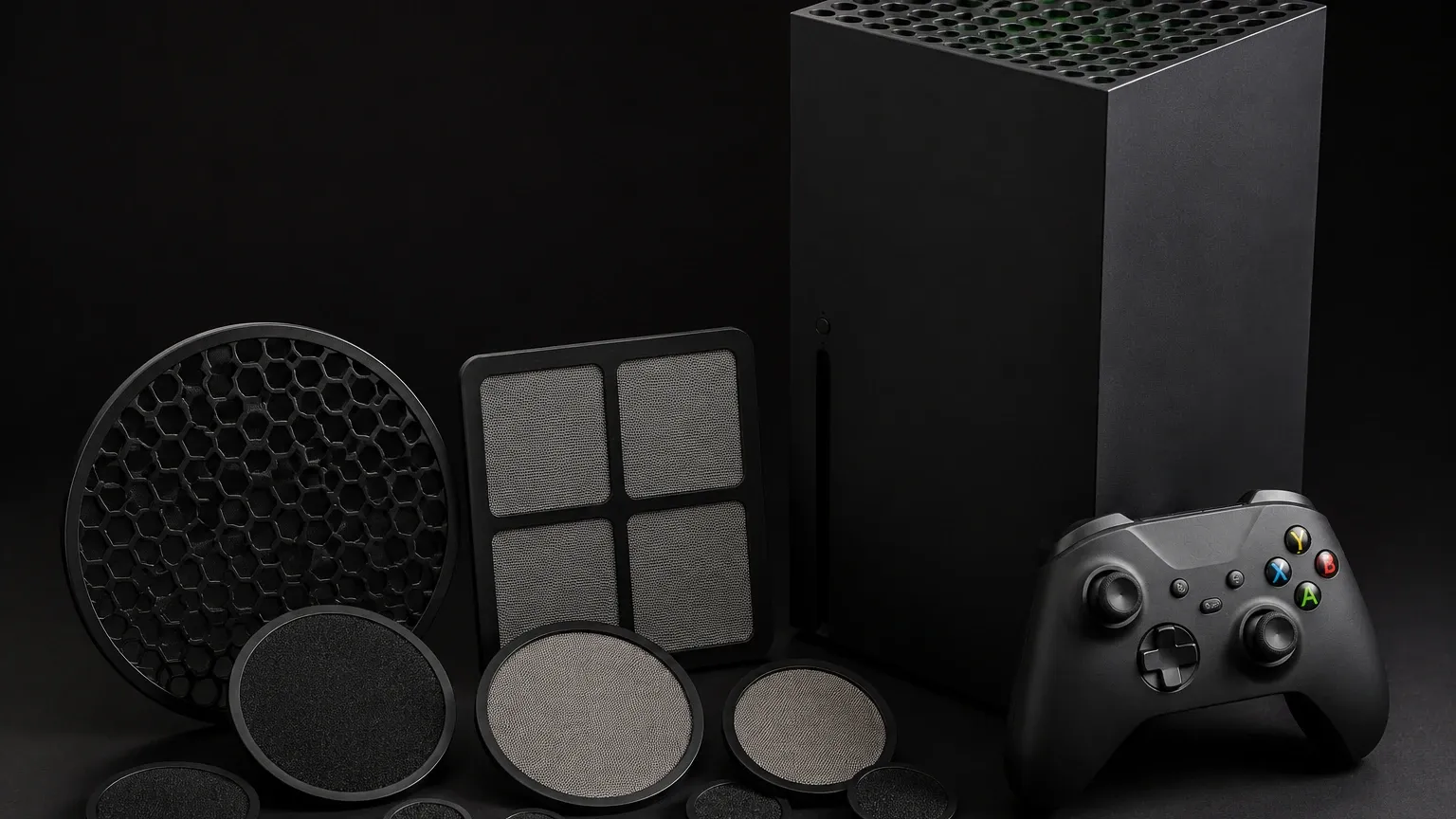
Performance Evaluation: Pressure Drop and Filtration Efficiency
Before implementing a filtration solution, engineers must conduct a performance evaluation. The primary metric is the efficiency-to-pressure-drop ratio. A high-quality filter should capture at least 80-90% of large dust particles while maintaining a pressure drop of less than 10-15% of the system's total static pressure capability.
In laboratory settings, this is tested using standardized dust (such as ISO Fine or Coarse test dust). By measuring the amount of dust that passes through the filter and the change in air velocity, manufacturers can provide a data-backed recommendation for the specific application. For those seeking filters for xbox series x, understanding these metrics helps in distinguishing between a simple "dust cover" and a functional engineering component.
Customization and OEM Solutions for Industrial-Grade Protection
For many industrial and commercial clients, off-the-shelf solutions are insufficient. Customization is often required to fit the specific geometry of the intake vents or to meet specific environmental challenges (such as high humidity or oily environments).
Custom Filter Discs & Packs can be tailored in several ways:
* Edge Treatment: To ensure a perfect seal and prevent fraying, filter discs can be edged with aluminum, stainless steel, or rubber gaskets. This is crucial for maintaining a bypass-free seal against the console or equipment housing.
* Shape and Geometry: Using advanced laser cutting or die-stamping, filters can be produced in complex shapes to match the unique aesthetic and functional design of modern hardware.
* Layering (Sintering): Multiple layers of mesh can be sintered together—fused using heat and pressure—to create a single, incredibly strong filtration plate that offers the benefits of multiple mesh sizes with the rigidity of a solid sheet.
Maintenance and Replacement Cycles for Filtration Components
No filter is permanent. As a filter captures dust, its EOA decreases and the pressure drop increases. In an industrial setting, this is monitored via pressure sensors. For consumer hardware, maintenance is typically scheduled based on visual inspection or fixed intervals.
One of the primary advantages of using stainless steel Filter Discs & Packs is their cleanability. Unlike disposable paper or foam filters, metal mesh can be cleaned using compressed air, ultrasonic baths, or mild detergents, restoring the filter to nearly its original performance levels. This sustainability is a key consideration for B2B purchasers looking to reduce the total cost of ownership and minimize environmental waste.
When evaluating filters for xbox series x, it is important to confirm the ease of access for cleaning. A filter that is difficult to remove will often be neglected, leading to the very thermal issues it was intended to prevent. Therefore, the design of the filter housing or attachment method (such as magnetic frames or friction fits) is just as important as the filtration media itself.
Conclusion: Selecting the Right Filtration Partner
Choosing the right filtration solution for high-performance electronics requires more than just finding a mesh that fits. It requires an understanding of fluid dynamics, material science, and precision manufacturing. Whether you are an engineer looking for OEM components or a technical professional seeking to protect critical hardware, focusing on the technical specifications—such as micron rating, material grade, and pressure drop—is essential.
By utilizing industrial-grade Filter Discs & Packs, manufacturers can ensure that their devices remain cool, clean, and operational in even the most demanding environments. When the goal is to protect a high-value asset like the Xbox Series X, the investment in high-quality, engineered filtration pays for itself through improved performance and extended hardware life.
