


Folgers Coffee Filter Packs
In both commercial beverage service and industrial processing, the concept of a "filter pack" represents a fundamental approach to consistency and efficiency. While many professionals are familiar with Folgers coffee filter packs as a staple in office environments and hospitality settings for their pre-measured convenience, the engineering principles behind these products intersect significantly with broader industrial filtration technologies. For engineers and procurement specialists in the food and beverage sector, understanding the transition from consumer-grade disposable packs to high-performance industrial Filter Discs & Packs is essential for optimizing production lines and ensuring product quality.
This article examines the technical specifications of filter packs, the materials used in their construction, and the engineering considerations that dictate their performance in demanding industrial environments. By analyzing the requirements of large-scale brewing and liquid processing, we can better understand how to select the appropriate filtration components for specific industrial applications.
Understanding the Mechanics of Filter Packs in Commercial Brewing
Folgers coffee filter packs are designed to simplify the brewing process by encasing a precise amount of ground coffee within a porous filter media. From a technical standpoint, this design serves two primary functions: it acts as a containment vessel for the solid media and as a filtration barrier that allows liquid extract to pass through while retaining particulates.
In a commercial context, such as high-volume catering or industrial extract production, the performance of these packs is measured by their ability to maintain structural integrity under thermal stress and their specific flow resistance. The paper or fiber-based media used in these packs must have a pore size distribution that prevents "fines" (extremely small particles) from entering the final beverage, which would otherwise lead to bitterness or sediment. For industrial-scale operations, however, the limitations of paper-based media—such as low pressure tolerance and single-use waste—often lead engineers to seek more robust solutions like stainless steel wire mesh filter discs.
Industrial Engineering of Filter Discs & Packs
When moving beyond the consumer-facing Folgers coffee filter packs into the realm of industrial manufacturing, the requirements for filtration components become significantly more rigorous. Industrial filtration often involves higher pressures, corrosive cleaning agents, and the need for repeatable performance over thousands of cycles.
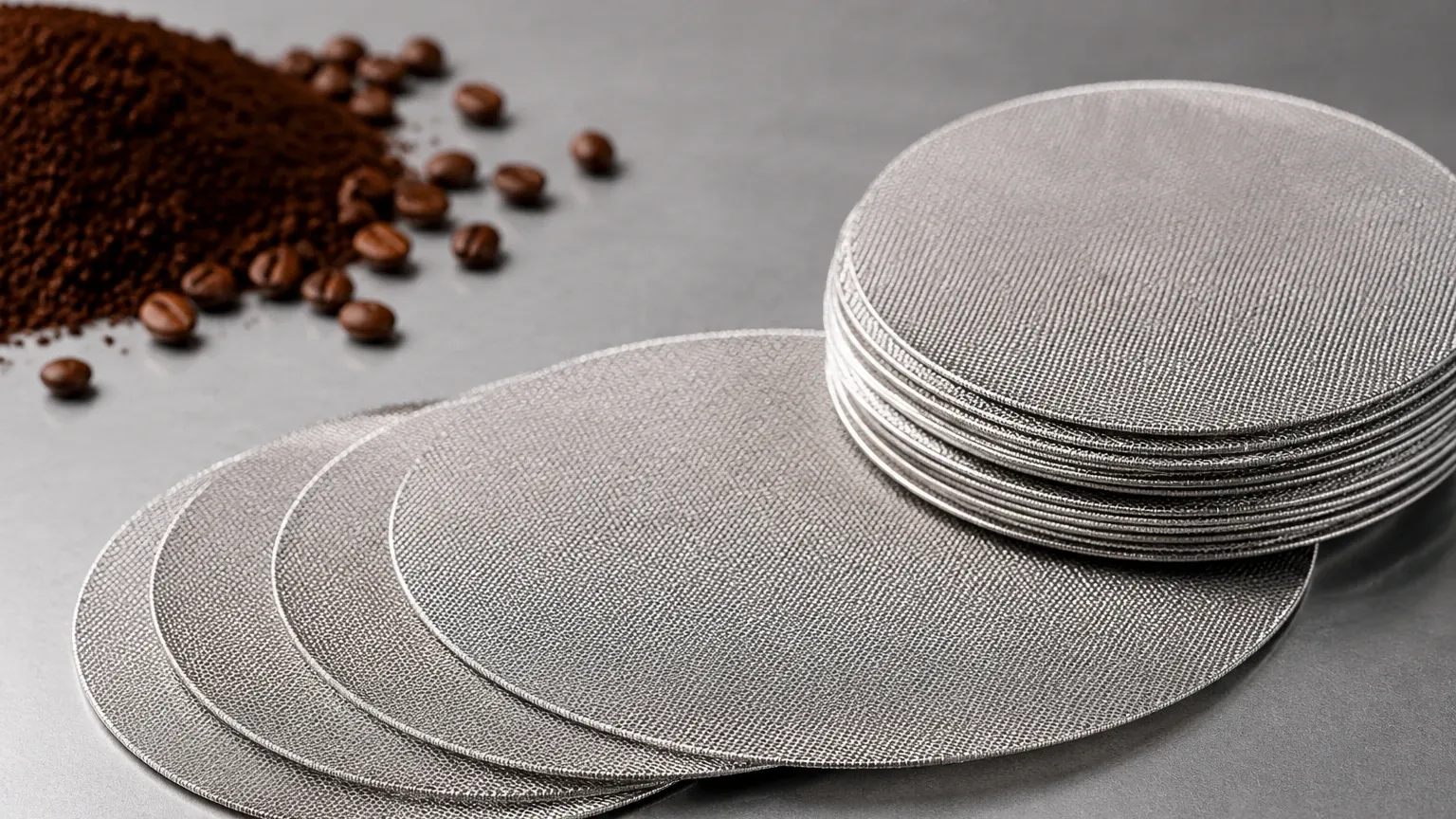
Kaifil specializes in the production of stainless steel Filter Discs & Packs designed to meet these challenges. Unlike paper packs, metal filter discs are engineered with precise apertures and mechanical strength. These components are typically constructed from multiple layers of wire mesh, which can be sintered together to create a rigid, high-strength filter element. These packs are used in various stages of beverage production, including the filtration of raw extracts, the removal of impurities in water lines, and the protection of downstream filling equipment.
Key Structural Variations
1. Single-Layer Discs: Used for simple straining applications where high pressure is not a primary concern.
2. Multi-Layer Mesh Packs: These consist of several layers of varying mesh counts. A fine inner layer provides the required filtration accuracy, while coarser outer layers provide mechanical support.
3. Sintered Packs: In environments where delamination is a risk, sintering fuses the wire intersections, creating a permanent bond that ensures the filter maintains its pore size even under extreme pressure differentials.
Material Considerations: Wire Mesh vs. Fiber-Based Media
The choice of material is perhaps the most critical decision in filtration engineering. While Folgers coffee filter packs utilize food-grade cellulose fibers, industrial applications often demand the properties of stainless steel (typically Grade 304 or 316L).
Chemical and Thermal Resistance
In industrial food processing, equipment must undergo Clean-in-Place (CIP) cycles. These cycles involve high-temperature water and caustic or acidic cleaning solutions. Paper-based filters cannot survive these processes. Stainless steel filter discs, however, are resistant to corrosion and can withstand temperatures exceeding 400°C, making them suitable for steam sterilization and aggressive chemical cleaning.
Pore Geometry and Filtration Accuracy
Paper filters have a random pore structure, which can lead to inconsistencies in filtration efficiency. In contrast, woven wire mesh offers a predictable and uniform pore geometry. Engineers can specify the exact micron rating required for their process—whether it is 5 microns for fine polishing or 200 microns for coarse solids removal. This level of precision is vital for maintaining the brand-standard flavor profiles and clarity expected in commercial beverage production.
Key Performance Metrics for Industrial Filtration Components
When evaluating filtration solutions, engineers must look beyond the initial purchase price and consider the performance metrics that impact the total cost of operation. Whether designing a system for coffee extraction or chemical processing, the following factors are paramount:
1. Pressure Drop (ΔP)
The resistance to flow offered by the filter pack is known as the pressure drop. A high initial pressure drop indicates that the filter media may be too restrictive for the pump capacity, leading to increased energy consumption. Industrial metal filter packs are engineered to maximize open area, ensuring high flow rates with minimal resistance.
2. Dirt Holding Capacity
This refers to the amount of particulate matter a filter can retain before the pressure drop reaches a critical level, necessitating cleaning or replacement. Multi-layer industrial packs often incorporate a "depth filtration" effect, where larger particles are trapped on the outer layers and smaller particles are caught deeper within the mesh, significantly extending the service life compared to single-layer paper filters.
3. Mechanical Stability
In high-pressure systems, the filter media must not deform or bypass. Industrial filter discs are often reinforced with perforated metal plates or heavy-duty support meshes to ensure that the filtration surface remains flat and functional throughout the production run.
Customization and OEM Capabilities in Filter Pack Manufacturing
While standardized products like Folgers coffee filter packs meet the needs of general consumers, industrial applications often require bespoke solutions. Customization is a core component of Kaifil’s manufacturing philosophy. Every industrial process has unique variables, including fluid viscosity, particle shape, and housing dimensions.
Tailored Geometry
Industrial Filter Discs & Packs can be manufactured in a wide range of shapes, including circular, rectangular, and oval, or even complex three-dimensional forms. Edge treatments are also customizable; discs can be supplied with raw edges, spot-welded borders, or aluminum/stainless steel rims to ensure a leak-proof fit within the filter housing.
Layer Configuration
Depending on the specific solids loading and the desired filtrate clarity, manufacturers can customize the sequence of mesh layers. For example, a five-layer sintered mesh might include a drainage layer, a support layer, a fine filtration layer, and two protective outer layers. This configuration provides a balance of filtration precision and physical durability that disposable packs cannot match.
Total Cost of Ownership: Disposable vs. Permanent Filtration Solutions
For purchasing teams, the decision between disposable filter packs (like those used in standard commercial brewing) and permanent stainless steel components often comes down to the Total Cost of Ownership (TCO).
Operational Expenses (OPEX)
Disposable filters represent a recurring cost. In high-volume environments, the cumulative expense of purchasing, storing, and disposing of paper-based packs can be substantial. Furthermore, the labor costs associated with frequent filter changes and the potential for downtime must be factored into the equation.
Capital Expenses (CAPEX) and Longevity
While stainless steel filter discs require a higher initial investment, they are designed for long-term use. When properly maintained through ultrasonic cleaning or backwashing, a high-quality industrial filter pack can last for several years. This reduces the frequency of procurement cycles and minimizes the environmental impact associated with waste generation.
Consistency and Quality Control
In industrial food and beverage production, the cost of a "bad batch" can be devastating. Permanent metal filters provide a level of consistency that is difficult to achieve with disposables, which may vary slightly between production lots. By using precision-engineered Filter Discs & Packs, manufacturers can ensure that every liter of product meets the required specifications.
Selecting the Right Filter Disc for Your Application
Choosing the correct filtration component requires a thorough understanding of the application's physical and chemical demands. Engineers should confirm several key data points before finalizing a specification:
* Micron Rating: What is the smallest particle that must be removed? Is the goal "absolute" filtration or "nominal" filtration?
* Operating Pressure and Temperature: Will the filter be subjected to pressure surges or extreme heat?
* Fluid Compatibility: Are the fluids being filtered compatible with 304 or 316L stainless steel?
* Flow Rate Requirements: What is the required throughput, and what is the maximum allowable pressure drop?
* Cleaning Protocols: How will the filter be cleaned, and what chemicals will be used?
By addressing these questions, technical professionals can move beyond the simplicity of standard consumer packs and implement filtration solutions that enhance efficiency and product integrity. Whether you are scaling up a beverage production line or optimizing an industrial hydraulic system, the selection of high-quality Filter Discs & Packs is a critical step in achieving operational excellence.
Kaifil remains committed to providing the engineering expertise and manufacturing precision necessary to support these demanding applications. By focusing on durability, customization, and technical performance, we help our global partners solve complex filtration challenges across the food, beverage, pharmaceutical, and industrial sectors.
