


How Much Is a Pack of Filters
In the industrial sector, procurement and engineering teams often face the foundational question: how much is a pack of filters? While the question seems straightforward, the answer is deeply rooted in technical specifications, material science, and the specific demands of the application. For industries ranging from polymer extrusion and chemical processing to food and beverage production, Filter Discs & Packs are critical components that ensure product purity and equipment longevity.
Understanding the pricing structure of these components requires a look beyond the sticker price. It involves evaluating the metallurgical composition, the complexity of the mesh weave, the layering configuration, and the manufacturing tolerances required for high-pressure or high-temperature environments. This guide breaks down the factors that influence the cost of industrial filter packs to help engineers make informed purchasing decisions.
Material Selection and Its Impact on Pricing
The primary driver of cost for any industrial filter is the raw material. Stainless steel is the industry standard due to its corrosion resistance and mechanical strength, but not all stainless steel is equal.
Stainless Steel 304 vs. 316L
For basic water treatment or non-corrosive hydraulic applications, Grade 304 stainless steel is often sufficient. It provides a cost-effective solution for general filtration needs. However, in pharmaceutical or chemical processing where acetic, sulfuric, or phosphoric acids are present, Grade 316L is mandatory. The addition of molybdenum in 316L enhances its resistance to pitting and crevice corrosion. Because 316L is a higher-spec alloy, a pack of filters made from this material will typically command a 15% to 30% premium over 304 equivalents.
Exotic Alloys
In extreme environments, such as those found in petrochemical refining, even 316L may fail. In these cases, engineers specify exotic alloys like Hastelloy, Monel, or Inconel. These materials are significantly more expensive and harder to weave into fine mesh, leading to a substantial increase in the total cost per pack. When asking how much is a pack of filters for specialized chemical reactors, the material cost alone can account for 70% of the final price.
The Complexity of Mesh Weave and Micron Ratings
The precision of the filtration—measured in microns—directly influences the manufacturing time and the cost of the wire mesh used in the packs.
1. Plain Weave: This is the most common and economical weave. It is used for coarser filtration where high flow rates are prioritized over ultra-fine particle retention.
2. Dutch Weave: This weave uses heavier warp wires and smaller shute wires, creating a dense, strong mesh with very fine openings. It is ideal for high-pressure applications but is more expensive to produce due to the density of the wire used.
3. Reverse Dutch Weave: Often used in continuous screen changers for plastic extrusion, this weave offers high strength and high dirt-holding capacity. The complexity of the loom setup for reverse Dutch weave increases the unit price compared to standard plain weaves.
As the micron rating gets smaller (finer), the wire used must be thinner and the weaving process more precise. A pack of 20-micron filters will invariably cost more than a pack of 200-micron filters because the rejection rate during quality control is higher for finer meshes.
Structural Configuration: Single-Layer vs. Multi-Layer Packs
When determining how much is a pack of filters, the structure of the disc or pack is a major variable.
Single-Layer Filter Discs
These are simple discs stamped from a single sheet of wire mesh. They are the most affordable option and are often used in low-pressure systems or as pre-filters. The cost here is largely determined by the diameter of the disc and the scrap rate of the stamping process.
Multi-Layer Mesh Packs
For demanding applications like polymer melt filtration, a single layer of mesh would collapse under the high differential pressure. Instead, engineers use multi-layer packs. These consist of a fine filtration layer sandwiched between coarser support layers and drainage layers.
* Spot-Welded Packs: Layers are held together by ultrasonic or resistance spot welding at the edges. This is a cost-effective way to ensure the layers stay in the correct sequence during installation.
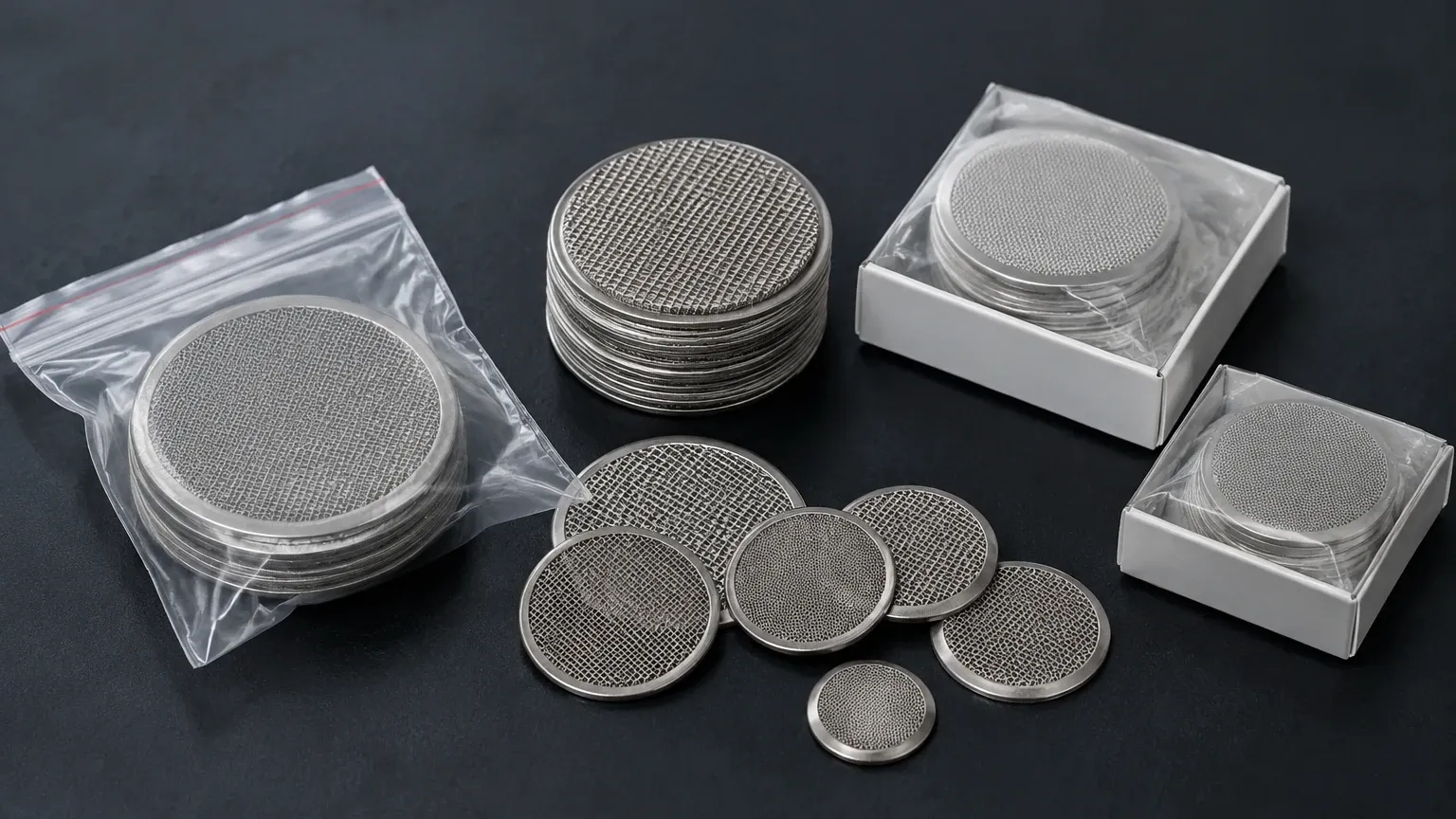
* Rimmed/Bound Packs: For high-pressure seals, the edges of the multi-layer pack are bound with an aluminum, copper, or stainless steel rim. This prevents bypass and provides structural rigidity. The addition of a metal rim involves manual labor and specialized tooling, which increases the cost per pack significantly.
Quantifying the Order: Volume and Customization
When a procurement officer asks "how much is a pack of filters," the answer depends heavily on the quantity ordered. Industrial filtration components are subject to significant economies of scale.
Minimum Order Quantities (MOQ)
Manufacturers like Kaifil operate high-speed stamping and welding machinery. Setting up these machines for a specific diameter or mesh combination takes time. Therefore, ordering a "pack" of 10 filters will result in a much higher unit price than ordering a pack of 1,000. Most B2B suppliers have a minimum order value or quantity to cover the engineering and setup costs.
Custom Dimensions and Shapes
Standard circular discs are the most economical because the tooling already exists. If an application requires oval, rectangular, or complex geometric shapes, new dies must be fabricated. This one-time engineering charge (NRE) must be factored into the initial purchase price. For long-term OEM contracts, these costs are usually amortized over several thousand units, reducing the impact on the individual pack price.
Total Cost of Ownership (TCO) and Replacement Cycles
A common mistake in industrial purchasing is focusing solely on the initial acquisition cost. To truly understand how much is a pack of filters, one must consider the Total Cost of Ownership (TCO).
* Durability and Reusability: High-quality stainless steel filter packs can often be cleaned and reused multiple times. A pack that costs $50 but can be cleaned five times is more economical than a $20 disposable pack that must be replaced every week.
* Downtime Costs: If a low-quality filter pack fails or clogs prematurely, the cost of shutting down a production line to replace it far outweighs the savings on the filter itself. In the chemical and food industries, an hour of downtime can cost thousands of dollars.
* Filtration Efficiency: A cheaper filter with inconsistent mesh openings may allow contaminants to pass through, leading to defective end-products or damage to downstream equipment like high-pressure pumps and nozzles.
Engineering Check-List Before Requesting a Quote
To get an accurate answer to "how much is a pack of filters," engineers should provide the following specifications to the manufacturer:
1. Dimensions: Precise diameter or CAD drawing for custom shapes.
2. Material Grade: 304, 316L, or specialized alloys based on chemical compatibility.
3. Micron Rating: The absolute or nominal filtration level required.
4. Layer Sequence: For multi-layer packs, specify the mesh count for each layer (e.g., 20/100/20 mesh).
5. Edge Treatment: Spot welded, rimmed (specify rim material), or loose layers.
6. Operating Conditions: Maximum operating temperature and differential pressure (DP).
7. Quantity: Monthly or annual volume to leverage bulk pricing.
Conclusion
The question of how much is a pack of filters is answered by the intersection of material science and manufacturing precision. While a basic single-layer disc may be inexpensive, a high-performance, multi-layer, rimmed pack designed for a polymer extruder is a sophisticated engineering component. By focusing on the technical requirements and the long-term performance of Filter Discs & Packs, companies can optimize their filtration processes, reduce maintenance overhead, and ensure the highest quality of their final products.
When evaluating suppliers, prioritize those who offer transparency in material sourcing and precision in manufacturing, as these factors ultimately determine the reliability of the filtration system in demanding industrial environments.
