


Porous Plastic Filter Discs
In industrial filtration, the selection of media is a critical engineering decision that dictates the efficiency, longevity, and cost-effectiveness of a process. While stainless steel and other metal alloys are often the standard for high-temperature and high-pressure environments, porous plastic filter discs serve as a vital alternative or specialized component in many fluid and gas handling systems. These components are engineered through a sintering process that creates a controlled, porous structure within a polymer matrix, providing a unique combination of chemical resistance, lightweight properties, and depth filtration capabilities.
Understanding the technical nuances of these discs is essential for engineers and procurement teams tasked with optimizing filtration performance. Whether used as standalone components or integrated into more complex Filter Discs & Packs, porous plastic media offer specific advantages in applications ranging from medical devices to pneumatic silencing and chemical venting.
The Engineering Behind Porous Plastic Media
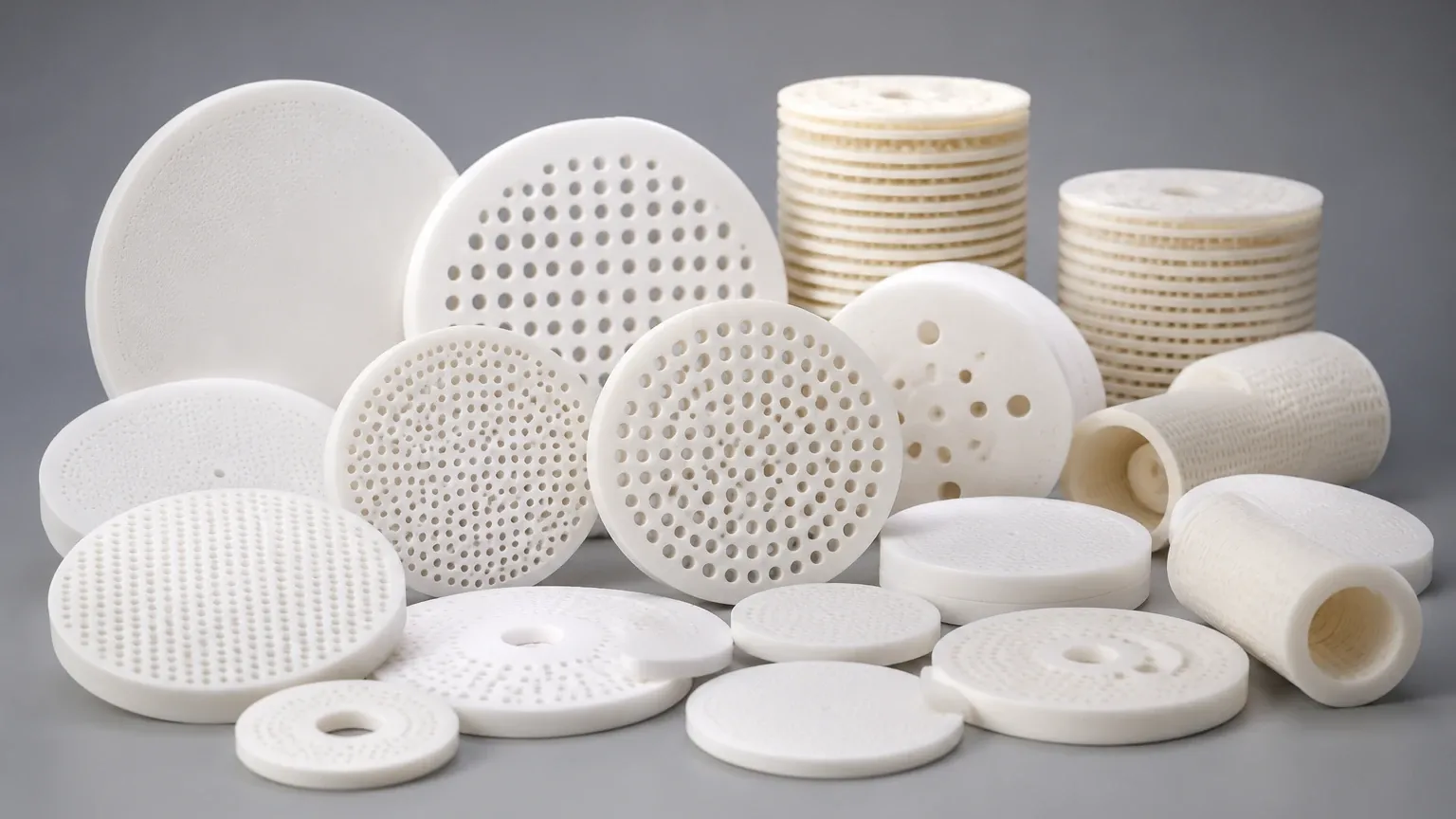
Porous plastic filter discs are typically manufactured from thermoplastic polymers such as Polyethylene (PE), Polypropylene (PP), Polytetrafluoroethylene (PTFE), and Polyvinylidene Fluoride (PVDF). The manufacturing process involves sintering, where polymer granules are subjected to controlled heat and pressure. Unlike traditional molding, sintering does not fully melt the material; instead, it fuses the contact points of the particles, leaving a network of interconnected voids.
This interconnected structure creates what is known as a "tortuous path." As fluid or gas passes through the disc, contaminants are trapped not just on the surface, but throughout the depth of the material. This depth filtration mechanism allows for a higher dirt-holding capacity compared to simple surface filters. The pore size, porosity, and thickness of the disc can be precisely controlled by adjusting the size of the polymer granules and the parameters of the sintering process.
Material Selection and Chemical Compatibility
The performance of porous plastic filter discs is fundamentally tied to the base polymer selected. Engineers must evaluate the chemical environment and thermal requirements of the application before finalizing a specification.
Polyethylene (PE and UHMWPE)
Polyethylene is one of the most common materials for porous discs due to its cost-effectiveness and broad chemical resistance. Ultra-High Molecular Weight Polyethylene (UHMWPE) is frequently chosen for its superior abrasion resistance and high impact strength. PE is generally suitable for temperatures up to 80°C (176°F) and is highly resistant to many acids and alkalis.
Polypropylene (PP)
Polypropylene offers slightly better thermal resistance than PE, often maintaining structural integrity up to 100°C (212°F). It is widely used in the food and beverage and pharmaceutical industries due to its low extractable profile and excellent resistance to organic solvents.
Polytetrafluoroethylene (PTFE)
For the most demanding chemical environments, PTFE is the material of choice. It is chemically inert to almost all reagents and can withstand temperatures up to 260°C (500°F). Additionally, PTFE is naturally hydrophobic, making it an excellent choice for gas-liquid separation and venting applications where water ingress must be prevented.
Technical Comparison: Plastic vs. Stainless Steel Filter Discs
When designing a filtration system, engineers often weigh the benefits of porous plastic against stainless steel options. While Kaifil specializes in high-performance metal filtration, understanding where plastic fits into the spectrum is necessary for a complete system design.
| Feature | Porous Plastic Discs | Stainless Steel Filter Discs |
| :— | :— | :— |
| Filtration Type | Depth filtration (Tortuous path) | Surface or depth (Mesh/Sintered fiber) |
| Temperature Limit | Low to Medium (Max ~260°C for PTFE) | High (Up to 800°C+ depending on alloy) |
| Pressure Resistance | Moderate (Subject to creep) | Very High |
| Weight | Very Lightweight | Heavy |
| Cost | Generally lower per unit | Higher initial investment |
| Cleanability | Often disposable | Highly cleanable and reusable |
In many industrial setups, porous plastic is used in low-pressure, ambient-temperature applications where weight or specific chemical inertness is more important than mechanical strength. However, in high-pressure hydraulic systems or high-temperature chemical processing, stainless steel Filter Discs & Packs remain the industry standard due to their ability to withstand differential pressures that would cause plastic to deform or fail.
Performance Metrics: Micron Ratings and Flow Rates
Selecting the correct micron rating is a balance between filtration efficiency and allowable pressure drop ($ΔP$). Porous plastic discs are typically available in ratings from 0.1 microns to 200 microns.
1. Nominal vs. Absolute Ratings: Most porous plastic media are rated nominally, meaning they will retain a high percentage (typically 60-90%) of particles at the specified micron size. If absolute retention is required, engineers must verify the testing methodology used by the manufacturer.
2. Porosity and Void Volume: The porosity (percentage of open space) directly impacts the flow rate. A higher porosity reduces the pressure drop but may compromise the structural integrity of the disc. Typical industrial porous plastics have porosities ranging from 30% to 50%.
3. Flow Characteristics: The flow rate through a porous disc is governed by Darcy’s Law. Factors such as fluid viscosity, disc thickness, and surface area must be calculated to ensure the filter does not become a bottleneck in the system.
Common Risks and Failure Modes
While porous plastic is versatile, it is not without risks. Engineers should be aware of several potential failure modes during the design phase:
* Mechanical Deformation (Creep): Unlike metal, polymers are susceptible to creep under sustained pressure, especially at elevated temperatures. This can lead to a reduction in pore size or a total collapse of the internal structure, resulting in a sudden increase in pressure drop.
* Chemical Swelling: Some polymers may absorb fluids, causing the material to swell. This swelling narrows the pores, restricting flow and potentially changing the filtration efficiency.
* Leachables and Extractables: In pharmaceutical or high-purity water applications, it is critical to ensure that the polymer does not release monomers, catalysts, or additives into the process stream. Virgin, medical-grade resins are often required for these scenarios.
* Static Accumulation: Non-conductive plastics can accumulate static charge during the flow of non-polar fluids (like hydrocarbons), which can lead to discharge events. In such cases, anti-static additives or a transition to metal media may be necessary.
Customization and Multi-Layer Configurations
In complex industrial applications, a single layer of porous plastic may not meet all performance requirements. This is where the concept of "packs" becomes relevant. By combining different materials or layers, engineers can create a multi-stage filtration solution within a single component.
For instance, a coarse porous plastic disc can act as a pre-filter for a finer downstream layer. In other designs, a porous plastic disc might be encapsulated within a stainless steel rim or supported by a metal mesh to provide the necessary mechanical strength while retaining the chemical properties of the plastic. Customization options typically include:
* Dimensional Tolerances: Precision machining or die-cutting to fit specific housing geometries.
* Hydrophilic Treatments: Modifying the surface energy of naturally hydrophobic plastics (like PE) to allow water to pass through more easily.
* Edge Sealing: Using ultrasonic welding or heat sealing to prevent bypass around the edges of the disc.
Critical Questions for Engineering and Procurement
Before finalizing an order for porous plastic filter discs or their metal counterparts, technical teams should confirm the following details to ensure application success:
1. What is the maximum operating differential pressure? If the $ΔP$ exceeds the material's yield strength at operating temperature, structural failure is likely.
2. Is the fluid compatible with the polymer over the long term? Short-term immersion tests may not reveal slow degradation or environmental stress cracking.
3. What are the sterilization requirements? If the disc must be autoclaved or chemically sterilized, the material must be able to withstand those specific cycles without losing its filtration properties.
4. Are there specific regulatory standards? Applications in food contact or medical devices may require FDA, USP Class VI, or REACH compliance.
By addressing these factors, engineers can determine whether a plastic solution is appropriate or if the durability and precision of stainless steel Filter Discs & Packs are required to meet the project's safety and performance goals. Kaifil’s expertise in manufacturing custom filtration components ensures that regardless of the material chosen, the final product meets the rigorous demands of modern industrial environments.
