


Rain Bird Disk Filter
In the landscape of industrial and agricultural water management, the selection of an appropriate filtration system is a critical engineering decision that impacts downstream equipment longevity, operational efficiency, and maintenance costs. Among the various technologies available, disk filtration has emerged as a robust solution for handling high organic loads and varying particle sizes. Specifically, the rain bird disk filter is a widely recognized component in irrigation and water treatment sectors, known for its ability to bridge the gap between simple screen filtration and complex media filtration.
For engineers and procurement professionals, understanding the technical nuances of disk filtration—ranging from the grooved geometry of the disks to the material science of the housing—is essential. While plastic disk filters serve many standard applications, demanding industrial environments often require the precision and durability found in specialized Filter Discs & Packs. This article examines the mechanics, performance criteria, and selection factors associated with disk filtration systems.
The Mechanics of Disk Filtration Technology
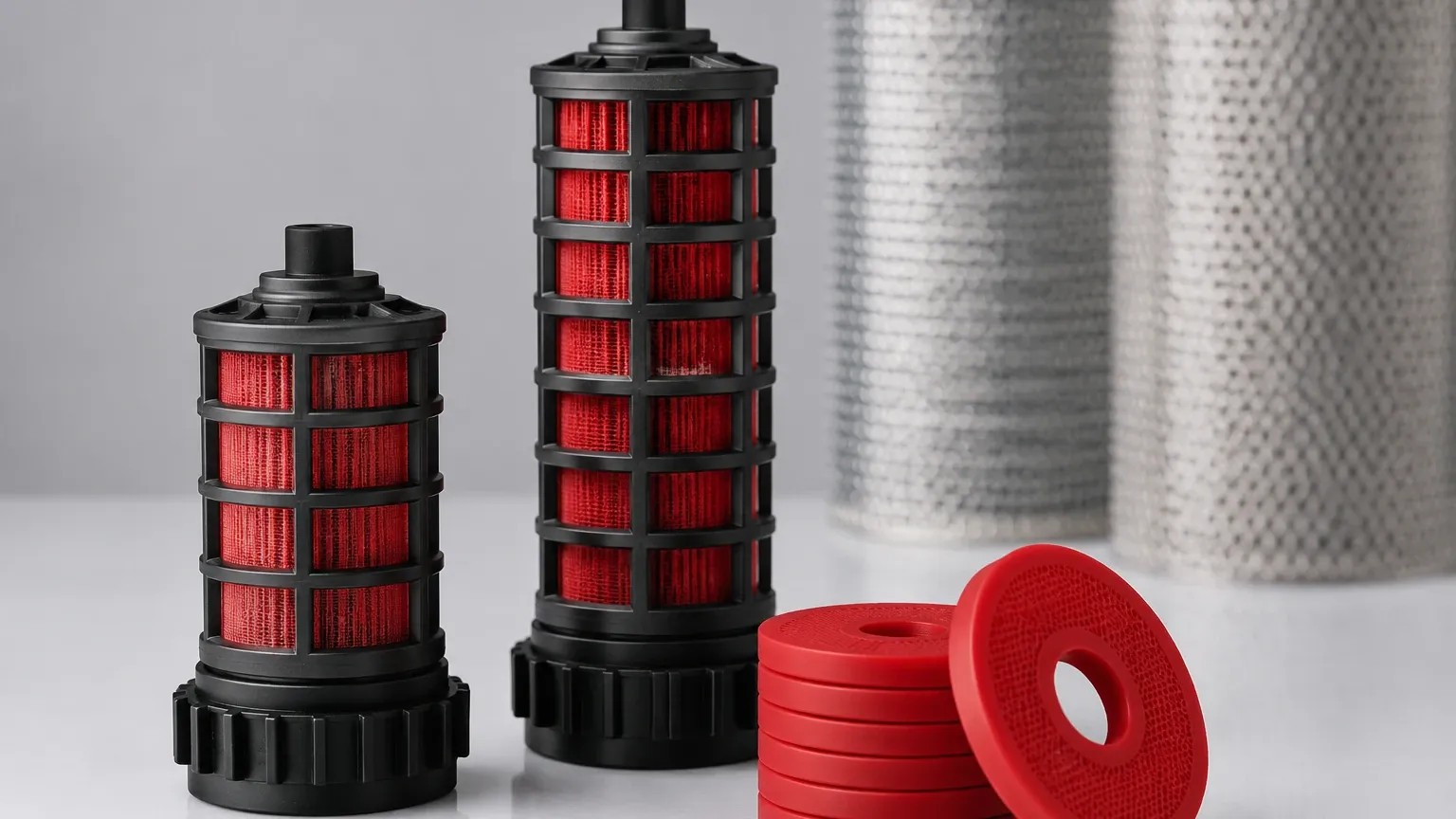
Disk filtration operates on a hybrid principle that combines surface filtration with depth filtration. Unlike a single-layer wire mesh, which captures particles on a two-dimensional plane, a disk filter utilizes a stack of compressed plastic or metal disks. Each disk is manufactured with microscopic grooves on both sides, which are angled in opposite directions.
When these disks are stacked and compressed within a filter housing, the intersecting grooves create a complex matrix of channels. This three-dimensional path forces water to change direction multiple times, effectively trapping particles of varying shapes and sizes throughout the depth of the stack. This mechanism is particularly effective at capturing organic contaminants, such as algae or fibrous materials, which might otherwise "thread" through the openings of a standard screen filter.
In a rain bird disk filter, the compression is typically maintained by a spring-loaded spine. During the filtration cycle, the spring keeps the disks tightly packed. When the system enters a backwash cycle, the pressure is released, allowing the disks to separate and spin, which facilitates the centrifugal removal of trapped debris. This self-cleaning capability is a primary reason why disk filters are preferred in high-load environments.
Comparing Disk Filters with Traditional Screen Filters
When evaluating filtration options, engineers often compare disk filters against traditional stainless steel screen filters. Each has distinct advantages based on the nature of the suspended solids in the source water.
Particle Retention Characteristics
Screen filters are excellent for removing inorganic, rigid particles like sand or scale. They provide a clear "go/no-go" threshold based on the micron rating of the mesh. However, they can struggle with soft, deformable organic matter. Disk filters, through their depth filtration matrix, are far superior at capturing these deformable solids. The tortuous path within the disk stack ensures that even if a particle deforms under pressure, it is likely to be trapped at a subsequent intersection within the grooves.
Maintenance and Backwashing Efficiency
While both systems can be automated, the backwashing mechanism of a disk filter is inherently more efficient for organic loads. In a screen filter, organic slime can become embedded in the mesh, requiring high-pressure jets or mechanical brushes for removal. In contrast, the separation and rotation of disks during the backwash cycle of a rain bird disk filter ensure that the entire filtration surface is exposed and cleaned, reducing water waste and preventing the buildup of bio-films.
Key Performance Metrics for Rain Bird Disk Filters
To specify the correct filtration solution, technical professionals must analyze several key performance indicators (KPIs). These metrics determine whether a standard rain bird disk filter or a custom-engineered solution is required.
1. Micron Rating and Mesh Equivalency: Disk filters are rated by the size of the smallest particle they can reliably capture. Common ratings range from 20 microns to 200 microns. It is important to note that because disk filters provide depth filtration, their effective removal rate for certain types of particles may exceed their nominal micron rating.
2. Flow Rate (Capacity): The flow capacity of a disk filter is a function of the total surface area of the disk stack and the groove geometry. Engineers must calculate the "flux rate"—the volume of water passing through a unit of filter area—to ensure the system does not exceed its design limits, which would lead to premature clogging.
3. Maximum Operating Pressure and Delta P: Standard plastic disk filters usually operate within a range of 85 to 140 PSI. The "Delta P" (differential pressure) is the difference in pressure between the inlet and outlet. A rising Delta P indicates that the filter is reaching its loading capacity and requires cleaning.
4. Chemical and Thermal Resistance: While the polypropylene disks in a rain bird disk filter are resistant to many agricultural chemicals, industrial processes involving high temperatures or aggressive solvents may necessitate the use of stainless steel Filter Discs & Packs.
Industrial Applications and Material Compatibility
While the rain bird disk filter is a staple in landscape and agricultural irrigation, its principles are applied across diverse industrial sectors. However, the material requirements often shift from polymers to high-grade metals as the environment becomes more demanding.
Water Treatment and Desalination
In pre-filtration for Reverse Osmosis (RO) systems, disk filters serve as a critical barrier to protect sensitive membranes from suspended solids. The ability to handle high flow rates with a small footprint makes them ideal for modular water treatment plants.
Food and Beverage Processing
In the food industry, filtration components must meet stringent sanitary standards. While plastic disks are used in some secondary water loops, primary process filtration often requires stainless steel components that can withstand Clean-in-Place (CIP) procedures and high-temperature sterilization. In these instances, custom-manufactured metal filter packs provide the necessary structural integrity.
Cooling Towers and HVAC Systems
Disk filters are frequently used to remove airborne dust and scale from cooling tower basins. By maintaining low turbidity in the cooling water, these filters prevent the fouling of heat exchangers, thereby maintaining the energy efficiency of the entire HVAC system.
Maintenance, Backwashing, and Operational Efficiency
The longevity of a filtration system is directly tied to its maintenance regime. For a rain bird disk filter, maintenance is categorized into manual and automatic processes.
Manual Cleaning
In smaller installations, manual disk filters are common. These require an operator to depressurize the system, unscrew the filter housing, and manually rinse the disk stack. This is cost-effective but carries the risk of inconsistent cleaning and increased labor costs.
Automatic Backwashing
For industrial scale operations, automatic backwashing is essential. These systems use a pressure differential switch to trigger the cleaning cycle. When the Delta P reaches a pre-set threshold (typically 5-7 PSI), the system diverts a portion of the filtered water (or uses an external source) to flush the disks in reverse. This process usually takes less than 30 seconds and does not require manual intervention, ensuring continuous operation.
Replacement Cycles
While the disks themselves are durable, they are subject to wear, especially in water with high concentrations of abrasive sand. Engineers should inspect the grooves for rounding or flattening, which reduces filtration accuracy. In industrial settings, the transition to stainless steel Filter Discs & Packs can significantly extend the replacement cycle, as metal components are far more resistant to abrasion and mechanical fatigue.
Engineering Checklist for Selecting Filtration Components
Before purchasing or specifying a disk filtration system, engineers should confirm several critical parameters to ensure the solution is fit for purpose:
* Total Suspended Solids (TSS): What is the parts-per-million (PPM) concentration of solids? High TSS may require a larger filter area or a multi-stage approach.
* Particle Characterization: Are the solids organic (soft) or inorganic (hard)? This determines the groove geometry and material choice.
* Flow Dynamics: Is the flow constant or surging? Disk filters perform best under steady-state conditions.
* Footprint Constraints: Disk filters are compact, but automatic backwash manifolds require additional space for valves and drainage piping.
* Total Cost of Ownership (TCO): Beyond the initial purchase price of a rain bird disk filter, consider the cost of backwash water loss, energy consumption for pumping, and the frequency of element replacement.
Customization and OEM Solutions in Filtration
Standard off-the-shelf products like the rain bird disk filter meet a wide range of general requirements. However, many industrial applications present unique challenges that standard plastic components cannot address. This is where custom manufacturing becomes vital.
Customized filtration solutions allow for the selection of specific alloys (such as 304, 316L, or Hastelloy) to combat corrosion in chemical processing. Furthermore, precision engineering allows for the development of multi-layered filter packs that provide graduated filtration, capturing larger particles on the outer layers and finer particles toward the core. This specialized approach optimizes the dirt-holding capacity and extends the time between cleaning cycles.
For technical teams managing complex fluid systems, the goal is to achieve a balance between filtration precision and system reliability. Whether utilizing a standard disk filter for irrigation or integrating high-performance Filter Discs & Packs into a chemical reactor, the fundamental objective remains the same: protecting downstream assets and ensuring process consistency through superior particulate separation.
