


Stainless Steel Filter Discs
In industrial filtration, the selection of media is a critical engineering decision that directly impacts process efficiency, product purity, and equipment longevity. Among the most versatile components used in high-pressure and high-temperature environments are stainless steel filter discs. These components serve as the primary barrier against contaminants in applications ranging from polymer melt filtration and oil refining to pharmaceutical processing and food production.
Industrial filtration often requires a balance between fine particle retention and the structural integrity necessary to withstand significant differential pressures. For engineers and procurement specialists, understanding the technical nuances of Filter Discs & Packs is essential for optimizing system performance and reducing downtime. This guide examines the engineering principles, material considerations, and selection criteria for stainless steel filtration components.
Understanding the Engineering Behind Filter Discs & Packs
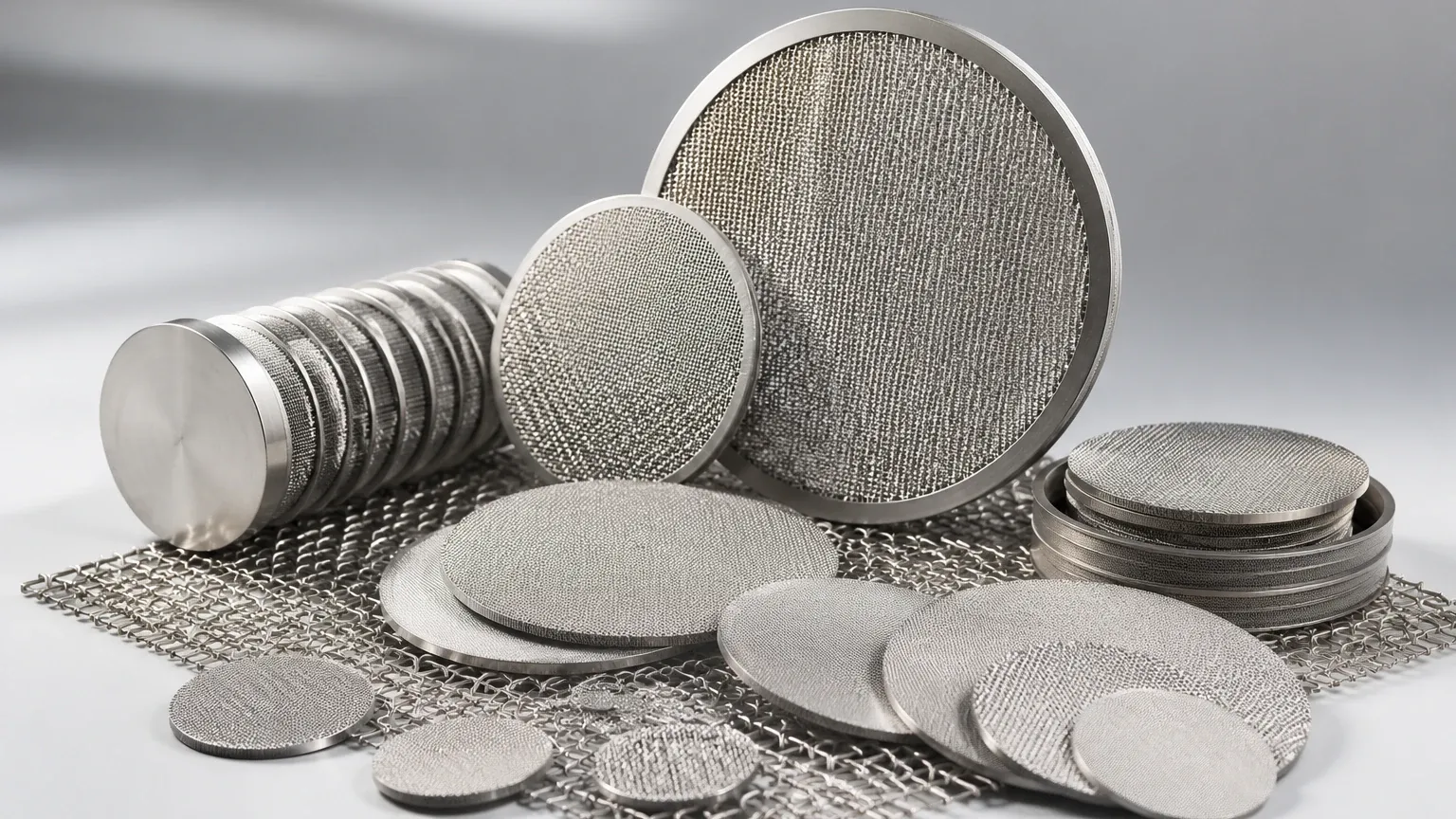
Filter discs are essentially precision-cut circular components made from wire mesh, expanded metal, or sintered fiber felt. While they appear simple, their performance is dictated by the geometry of the weave and the assembly method. When multiple layers are combined, they are referred to as filter packs, which offer multi-stage filtration or enhanced mechanical support.
Wire Mesh Weave Types
The performance of stainless steel filter discs begins with the weave pattern of the wire cloth. Each weave type offers distinct advantages:
* Plain Weave: The most common pattern where each warp wire crosses over and under each shute wire. It provides high flow rates and is ideal for general-purpose surface filtration.
* Twill Weave: Each shute wire passes over and under two warp wires. This allows for a heavier wire diameter for a given mesh count, increasing the strength and durability of the disc.
* Dutch Weave (Plain and Twill): These weaves use a larger diameter warp wire and a smaller diameter shute wire, creating a dense, strong mesh with very fine openings. Dutch weaves are preferred for high-pressure applications where precision micron ratings are required.
Micron Rating and Pore Size
Engineers must distinguish between nominal and absolute micron ratings. A nominal rating indicates the ability of the filter to retain the majority of particles of a specific size, while an absolute rating represents the largest opening in the mesh, ensuring that no particle larger than that size can pass through under laboratory conditions. For high-stakes applications like pharmaceutical manufacturing, absolute-rated stainless steel filter discs are often mandatory.
Material Selection: Why Stainless Steel is the Industrial Standard
The choice of material is driven by the chemical and thermal environment of the application. Stainless steel is the preferred medium due to its corrosion resistance, mechanical strength, and ability to be cleaned and reused.
Grade 304 Stainless Steel
Grade 304 is the standard industrial grade, offering excellent resistance to atmospheric corrosion and many organic and inorganic chemicals. It is widely used in food and beverage processing where hygiene is paramount but chemical aggression is moderate.
Grade 316L Stainless Steel
For more demanding environments, Grade 316L is the superior choice. The addition of molybdenum provides enhanced resistance to pitting and crevice corrosion, particularly in chloride-rich environments. The "L" denotes low carbon content, which improves weldability and prevents sensitization—a common cause of corrosion near welded joints in filter packs.
Thermal Stability
Unlike polymer-based filters, stainless steel components can operate in extreme temperatures, often exceeding 400°C (750°F), depending on the alloy and structural design. This makes them indispensable in steam filtration and high-temperature chemical reactions.
Structural Variations and Layering Strategies
Single-layer filter discs are suitable for low-pressure applications where the primary goal is simple straining. However, many industrial processes require the complexity of multi-layer Filter Discs & Packs.
Multi-Layer Filter Packs
In a multi-layer configuration, different mesh counts are stacked to achieve specific goals:
1. Drainage/Support Layer: A coarse mesh provides structural rigidity to prevent the finer filtration layer from deforming under pressure.
2. Filtration Layer: The middle layer(s) determine the micron rating of the pack.
3. Protective Layer: A coarse outer mesh protects the delicate filtration layer from mechanical damage during handling or installation.
Edge Treatments
The method used to secure the edges of a filter disc or pack is vital for preventing bypass and ensuring safety:
* Spot-Welded Packs: Multiple layers are joined at specific points. This is cost-effective but may leave edges exposed.
* Rimmed/Bound Discs: The edges are enclosed in a metal U-channel (often aluminum, copper, or stainless steel). This provides a superior seal against the housing wall and prevents individual wires from migrating into the process stream.
* Unrimmed Discs: Precision-cut discs without edge binding, often used in applications where the disc is clamped tightly between flanges.
Performance Metrics: Flow Rate, Pressure Drop, and Micron Rating
When evaluating stainless steel filter discs, engineers must analyze the relationship between flow rate and pressure drop (Delta P). A filter with a very fine micron rating will naturally create a higher resistance to flow.
Effective Filtration Area (EFA)
The EFA is the total area of the mesh available for the fluid to pass through. Maximizing the EFA reduces the initial pressure drop and extends the service life of the filter before it reaches its terminal pressure drop. In compact housings, designers may use pleated discs to increase the EFA without increasing the diameter of the component.
Dirt Holding Capacity
This metric refers to the amount of contaminant the filter can retain before the pressure drop becomes unacceptable. Multi-layer packs often have a higher dirt-holding capacity than single-layer discs because they can trap larger particles in the outer layers while the inner layers focus on fine particulates.
Common Failure Modes and Quality Control
Failure in filtration components can lead to costly downstream contamination or system damage. Understanding common risks helps in selecting a high-quality manufacturer.
1. Media Migration: If the wires are not properly woven or the edges are not secured, individual metal fragments can enter the process stream. High-quality stainless steel filter discs undergo rigorous cleaning and inspection to prevent this.
2. Bypass: If the disc is not perfectly flat or the rim is poorly manufactured, fluid may bypass the filter media entirely. Dimensional tolerance is critical; even a millimeter of deviation can compromise the system.
3. Structural Collapse: Under high differential pressure, the mesh may deform or "balloon." This is why the support layer in a filter pack is essential for maintaining the geometry of the filtration media.
4. Blinding: This occurs when particles become permanently lodged in the mesh openings. While stainless steel is cleanable, certain sticky or gelatinous contaminants can lead to premature blinding if the wrong weave type is selected.
Customization Parameters for OEM Applications
Standard sizes are rarely sufficient for specialized industrial machinery. OEM filtration solutions require precise customization. When specifying Filter Discs & Packs, the following parameters should be confirmed:
* Outer Diameter (OD) and Inner Diameter (ID): For annular discs, tolerances must be tight to ensure a proper fit within the housing.
* Thickness: The total thickness of a multi-layer pack must be compatible with the assembly's compression limits.
* Layer Sequence: The specific order of mesh counts tailored to the viscosity and particle load of the fluid.
* Surface Treatment: Options such as pickling, passivating, or electro-polishing can further enhance corrosion resistance and surface smoothness.
Maintenance, Cleaning, and Replacement Considerations
One of the primary B2B advantages of stainless steel filter discs is their reusability. Unlike disposable cartridges, these metal components can be cleaned multiple times, significantly reducing the total cost of ownership.
Cleaning Methods
* Ultrasonic Cleaning: High-frequency sound waves create cavitation bubbles that dislodge fine particles from deep within the mesh.
* Chemical Cleaning: Using acids or alkalis to dissolve specific contaminants, followed by thorough neutralizing and rinsing.
* Burn-off/Pyrolysis: For polymer filtration, the discs are placed in a vacuum oven to carbonize the plastic, which is then removed via ultrasonic cleaning.
When to Replace
Despite their durability, stainless steel filters have a finite lifespan. Replacement is necessary if the mesh shows signs of mechanical fatigue, wire thinning from corrosion, or if the "clean" pressure drop begins to rise after successive cleaning cycles, indicating permanent blinding.
Total Cost of Ownership and Procurement Guidance
While the initial purchase price of Filter Discs & Packs made from stainless steel is higher than that of synthetic alternatives, the long-term value is found in their durability. A single stainless steel disc may last through dozens of cleaning cycles, whereas a polymer filter would require frequent replacement and disposal.
Before finalizing a purchase, technical teams should confirm the following with their supplier:
* Material Certification: Ensure the alloy meets ASTM or ISO standards for 304 or 316L.
* Pressure Ratings: Verify that the disc or pack can handle the maximum expected differential pressure without deformation.
* Compatibility: Confirm that the rim material and any welding points are compatible with the process fluid.
By focusing on these technical specifications, engineers can ensure they select stainless steel filter discs that provide reliable, high-performance filtration in even the most demanding industrial environments.
